

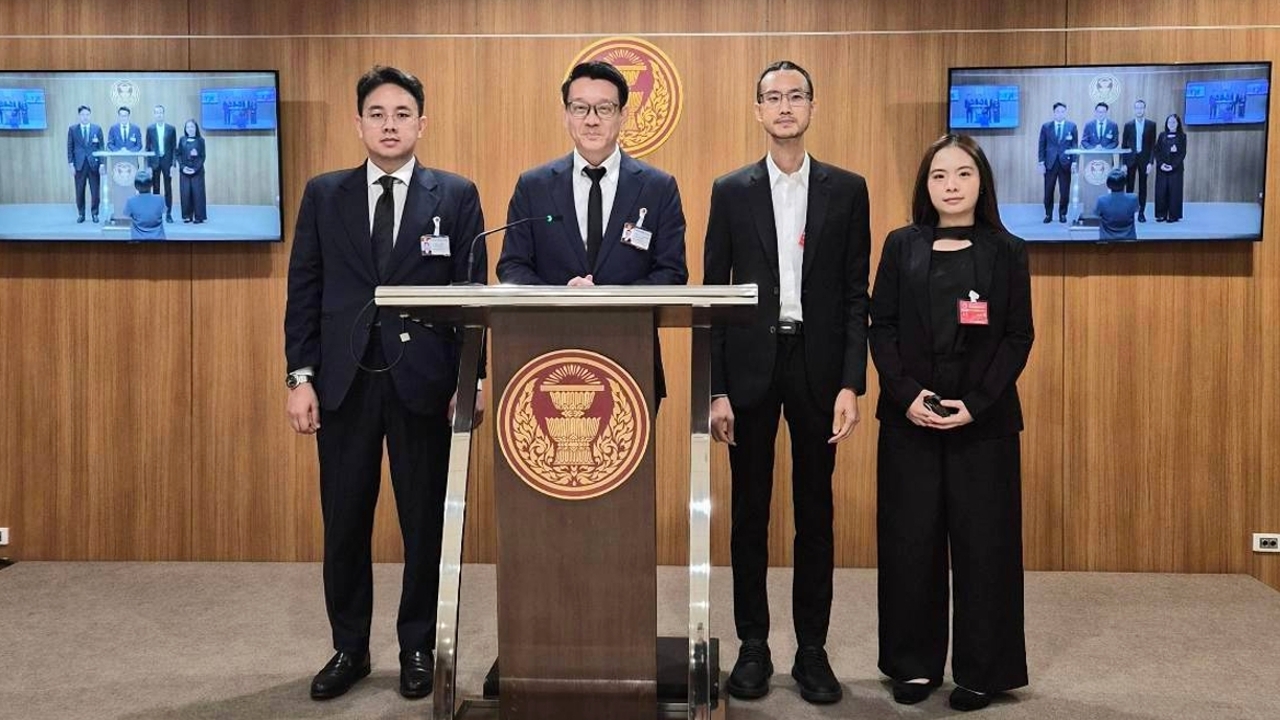
The chairman of the Economic Development Committee is preparing to propose a windfall tax bill to collect taxes on excess profits from oil refinery businesses to solve oil price problems during the crisis period.
At 1:00 p.m. on 12 Nov 2026 GMT+7, at the parliament building, Mr. Weerayut Kanchuchat, chairman of the Economic Development Committee, and committee member Mr. Supachot Chaisat announced that on behalf of the committee, they are preparing to propose a windfall tax bill. The oil price issue has continuously affected the public since the Middle East crisis and the closure of the Strait of Hormuz earlier this year. Although oil prices fell at one point, they rose again, reflecting price volatility. Each price increase impacts price management and costs, as well as causing the oil fund to accumulate losses continuously. Therefore, a systematic solution is necessary.
The oil refinery business has excess profits, or windfall profits, which are gains from the rise in oil prices mainly caused by external factors. In the past six months, six oil refineries in Thailand made a combined profit of about 30 billion baht, but in the first six months of 2026, during the energy crisis, their profits rose to approximately 100 billion baht. Even in normal price years, refineries earn around 30 billion baht, and the average profit over the past four years is about 50 billion baht, showing that the profit increase during the crisis is very significant.
Mr. Weerayut added that to promote fairness and share burdens in society, as well as to provide the state with additional revenue to assist the public and mitigate oil cost impacts systematically without relying solely on the oil fund for short-term aid, they propose drafting a windfall tax bill on excess profits of oil refineries. A working group under the Economic Development Committee of the People's Party has prepared this draft, which is Thailand's first windfall tax bill to be presented to parliament.
He also said the draft bill has been discussed with representatives from various groups, including the private sector, refinery businesses, related operators, and government agencies, to gather feedback, suggestions, and assess enforcement feasibility. This input will help improve the draft to be more appropriate. Windfall tax collection is a principle used by many countries, especially in the European Union, to ensure tax fairness.
Regarding tax criteria, the proposal allows refineries to earn up to 120% of normal profits. Any profit exceeding that threshold—profits beyond 20% above normal—would be taxed at 75%, following principles used in European countries, particularly Ireland. Revenue from this tax will be used to assist and compensate the public and support management efforts to maintain better oil price stability.
However, windfall tax collection offers a more sustainable solution than current government measures, which focus on negotiating refining margins and requiring refineries to self-disclose cost data. These methods leave enforcement subject to the discretion of the Minister of Energy. The aim is to establish clear, systematic, and verifiable criteria and mechanisms based on the sharp profit increases recently observed. It is expected refinery profits will remain high throughout this year, making it reasonable to tax excess profits to share burdens and promote fairness for the public.
The Economic Development Committee and the People's Party working group will jointly push the windfall tax bill for parliamentary consideration, hoping it will become law in the future. This will benefit the country and promote fairness between businesses and the public. Moreover, the tax collection under this bill will provide a systematic solution without relying on occasional ministerial or government decisions. It will establish clear responsible parties, definite conditions, and tax criteria, allowing continuous and systematic implementation.