

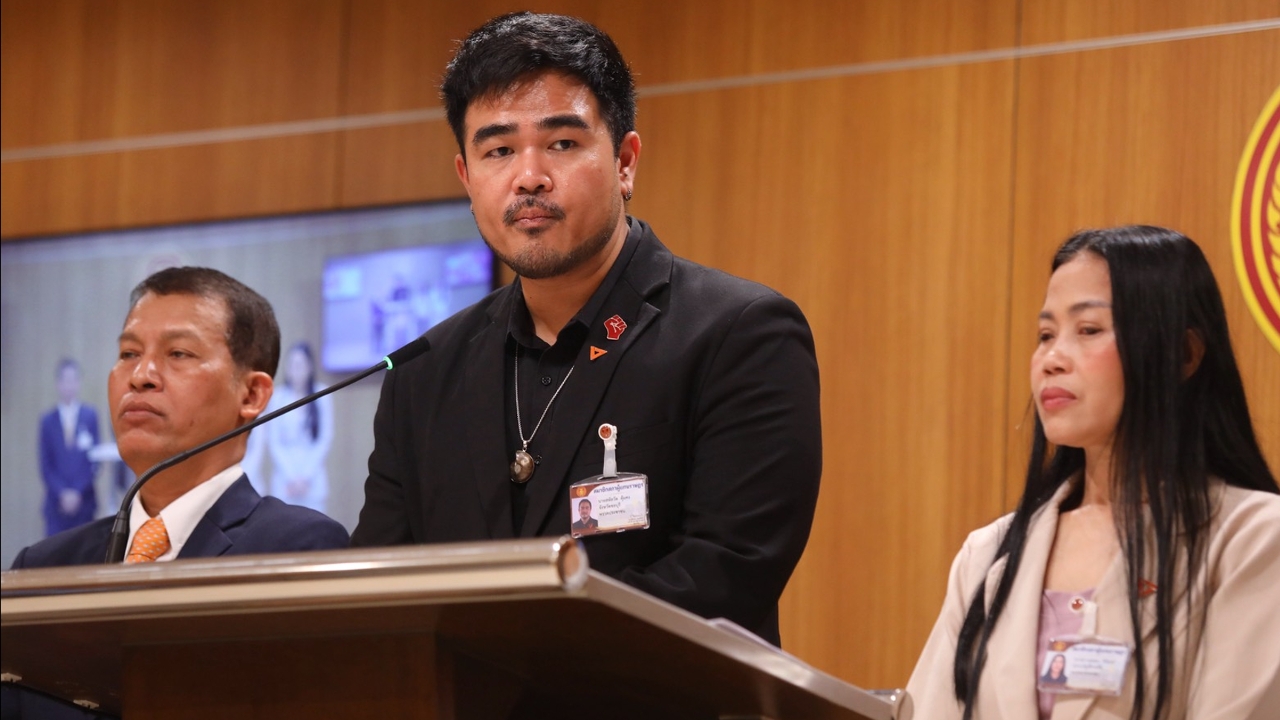
People's Party MPs have lined up to criticize the Cabinet's draft Social Security Act for inserting an “Audit Board” that holds power over the “Elected Board,” raising fears that this could cause the fund to collapse. They urged the Prime Minister to expedite endorsement of the People's Party's bill to submit it to Parliament simultaneously.
On 12 November 2026 at the Parliament, People's Party MPs, led by Sahaswat Khumkhong, Thanaporn Wijan, Sia Champathong, and Rakchanok Srinok, held a joint press conference to address issues with the Cabinet's draft Social Security Act, which is set for consideration by the House of Representatives next week. They called on the Prime Minister to promptly sign and endorse the People's Party's amendment bill to be submitted alongside the Cabinet's bill for parliamentary consideration.
Sahaswat Khumkhong stated that before the 2026 election, all political parties announced policies supporting social security reform. However, the Cabinet's draft Social Security Act, approved on 3 November, despite Labor Minister Chulanont Amornwiwat's attempts to communicate its benefits to insured persons, actually contains hidden agendas. Nearly all the content copies the original 2022 draft from former Minister Suchart Chomklin's era but modifies the power structure to block the “Social Security Board elected by the people.” It inserts added authority to an “Audit Committee” appointed by the minister, which he calls the “Senate of Social Security,” granting it powers to intervene and oversee the elected board at any time. Even more concerning, it has authority to evaluate and advise on appointing and transferring heads of internal audit units—powers not even held by the elected board—thus giving politically appointed individuals power over those elected by the insured.
Sahaswat continued that the Cabinet's draft also reflects an unforgivable haste and carelessness, as it still stipulates maternity leave benefits at 98 days, despite labor protection law having revised this to 120 days nearly a year ago. The claim that this will be corrected during committee review is unconvincing, showing the government is not genuinely concerned with insured persons’ real benefits but focused on creating political mechanisms to control the elected board.
Thanaporn Wijan addressed the “Three Requests” benefits (request to choose, to refund, to borrow) in the Cabinet's draft. She explained that the original principle of the 1990 Social Security Act is to pool hardships and benefits and serve as a welfare “support” for workers, covering unemployment, sickness, maternity, and old-age pensions. However, the “Three Requests” measure, especially allowing early withdrawal of old-age funds, would severely undermine the fund’s stability, shortening its lifespan and risking collapse in the near future. Once insured persons withdraw all their money, there will be no funds left to pay pensions in retirement. The People's Party therefore opposes the “Three Requests” system as a temporary welfare measure that destroys the fund's long-term stability.

Meanwhile, Sia Champathong expressed deep concern about the Cabinet's Social Security Act draft, or the “Three Requests” version, which originated during the COVID-19 crisis when the government failed to adequately assist insured persons. This led to calls to withdraw old-age funds for survival, a concept incorporated into the Cabinet's bill. As a Section 33 insured person for over 20 years with about 185,000 baht saved, he calculated that if he exercised the “Three Requests” right to withdraw the lump sum and carefully spent 3,000 baht per month, the funds would be depleted in just 60 months (5 years). After that, how would insured persons live? The elderly welfare allowance of 600 baht monthly is clearly insufficient to live on.
Sia compared that if he instead received an “old-age pension” upon retirement, he would get about 4,800 baht per month. Over 60 months, that totals more than 288,000 baht, exceeding the lump sum amount. Allowing lump-sum withdrawals thus undermines the financial security of retirees. With analyses suggesting the Social Security fund risks bankruptcy by 2054, mass withdrawals could accelerate collapse, possibly before 2047. He warned the government not to solve economic problems by destroying the fund that serves as citizens’ life security.

Rakchanok Srinok stated that the People's Party has submitted three Social Security Act amendment bills to Parliament: two non-financial bills and one “major structural reform” bill, which is hers. This bill proposes removing the Social Security fund from government bureaucracy, transitioning to professional management with expertise and transparent checks and balances. This aligns with commitments made by all political parties during campaigns, but currently only the People's Party offers such concrete reform proposals.
Rakchanok noted that the People's Party's structural reform Social Security bill has completed the constitutionally mandated public hearing process under Article 77 and is now awaiting consideration on Prime Minister Anutin Charnvirakul’s desk. As it is interpreted as a financial bill, she urged the Prime Minister to sign and endorse it, allowing its introduction to Parliament alongside the Cabinet's bill within one to two weeks. Without his signature, the bill cannot proceed, and Parliament will miss the opportunity to push through a major social security structural reform, which would be regrettable.
Rakchanok concluded that the social security contributions paid monthly by insured persons are their last safety net, providing rights to medical care, maternity benefits, and old-age security—not something for the administration to politicize. She called on the government and Prime Minister to demonstrate sincerity toward workers by allowing the People's Party's bill to be debated equally in Parliament.