

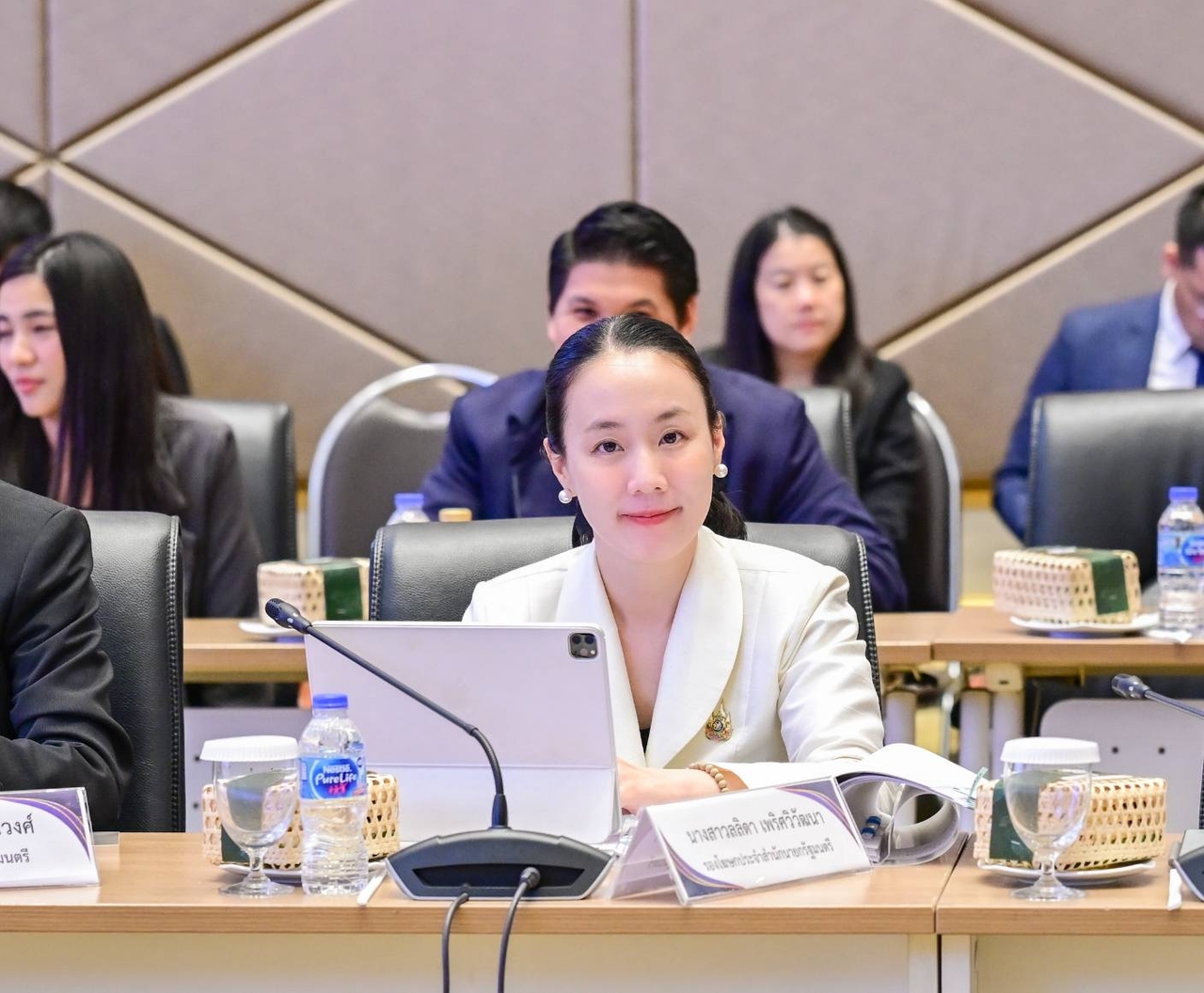
The Deputy Government Spokesperson refuted allegations that the government discriminates in addressing pollution issues, confirming that it has ordered the suspension of BWG's landfill operations. She emphasized that enforcement is serious and not limited to small factories but also applies to major investors.
On 13 November 2026, Ms. Lalida Pertwiwatthana, Deputy Spokesperson of the Prime Minister's Office, addressed criticism regarding industrial pollution management, including electronic waste and wastewater. She noted concerns that the government only acted against small factories while failing to manage large operators. She stated that the government takes pollution and its impact on citizens seriously, and claims that it neglects large operators do not fully reflect the facts, as inspections and law enforcement have been applied to large factories as well.
Ms. Lalida said the Department of Industrial Works, together with the Pollution Control Department and related agencies, inspected Better World Green Public Company Limited (BWG) on 4–5 June 2026. They found deficiencies in managing leachate from the landfill and internal drainage systems. Accordingly, under Section 39, paragraph one of the Factory Act, they ordered suspension of operations specifically for the hazardous waste landfill section. Meanwhile, T.N.C. Recycle Company Limited was ordered to suspend all operations due to detected deficiencies, demonstrating that the government does not exempt large operators from law enforcement.
"The fact is inspections have been conducted and partial suspension orders issued against BWG, a public company. Therefore, it is inaccurate to say the government only acts on small factories and avoids major investors. However, the government does not consider issuing orders as the end of the problem. The crucial point is to monitor whether factories fully correct deficiencies and how pollution affecting the public is addressed, since the goal of law enforcement is effective problem resolution," Ms. Lalida said, adding,
Regarding BWG, there are still issues to follow up on, including correction of deficiencies, submission of inspection documents, and limitations in collecting groundwater samples within the factory. These responsibilities rest with relevant agencies acting within their authority. The fact that the Department of Industrial Works previously inspected and issued orders does not mean all environmental inspections are complete. Continuous monitoring of compliance and community impact assessments is necessary.
On 11 November 2026, Mr. Kriangsak Sudlapa, Chairman of the Industry Subcommittee on Complaints and Problems under the Industry Committee, convened a meeting with related agencies to follow up on BWG issues. They pushed for the Saraburi Governor to serve as the lead coordinator for joint inspections to clarify responsibility in the area. They also proposed legal action against obstruction of inspections and monitoring of industrial waste routes and groundwater quality. These proposals will be submitted for consideration by the Industry Committee.
Ms. Lalida stated that pollution problem solving must be systematic, from factory inspections, monitoring compliance with orders, to oversight of industrial waste transport and disposal, as well as surveillance of water quality and public impact. If non-compliance or obstruction occurs, authorized agencies must consider legal action regardless of the operator's business size.
"The government affirms that laws must be applied equally to all operators. Company size or investment value is not a reason for exemption from inspections. However, enforcement must be based on facts and scientific evidence to accurately identify pollution sources and responsible parties, rather than relying on assumptions instead of inspection results," she said. .
Furthermore, the Department of Industrial Works reported results of nationwide waste management factory inspections from 2–9 November 2026. They inspected 752 out of a target 3,049 factories, issuing 470 administrative orders, including suspension orders for eight factories and closure with license revocation for one. This reflects ongoing law enforcement efforts. Follow-up on correction of deficiencies and prevention of community impact remains necessary to ensure practical effectiveness of measures.
Regarding fish cage deaths in Prachinburi Province, Ms. Lalida said related agencies have conducted water quality tests and partially explained findings but further investigation is needed to confirm the true cause. She emphasized the importance of explaining water quality restoration plans and the status of assistance for affected farmers, relying on scientific test results and verified data.
"The government is ready to listen to all complaints and open to work inspections, but criticism should be based on complete facts. Claims that the government does not act against large operators while enforcement orders have been issued may mislead the public. At the same time, the government acknowledges that issuing orders alone is insufficient; continuous monitoring, transparent information disclosure, and public assurance that violators will be held equally accountable under the law are essential. The ultimate goal is to protect the environment, health, and quality of life of the people," Ms. Lalida concluded.