

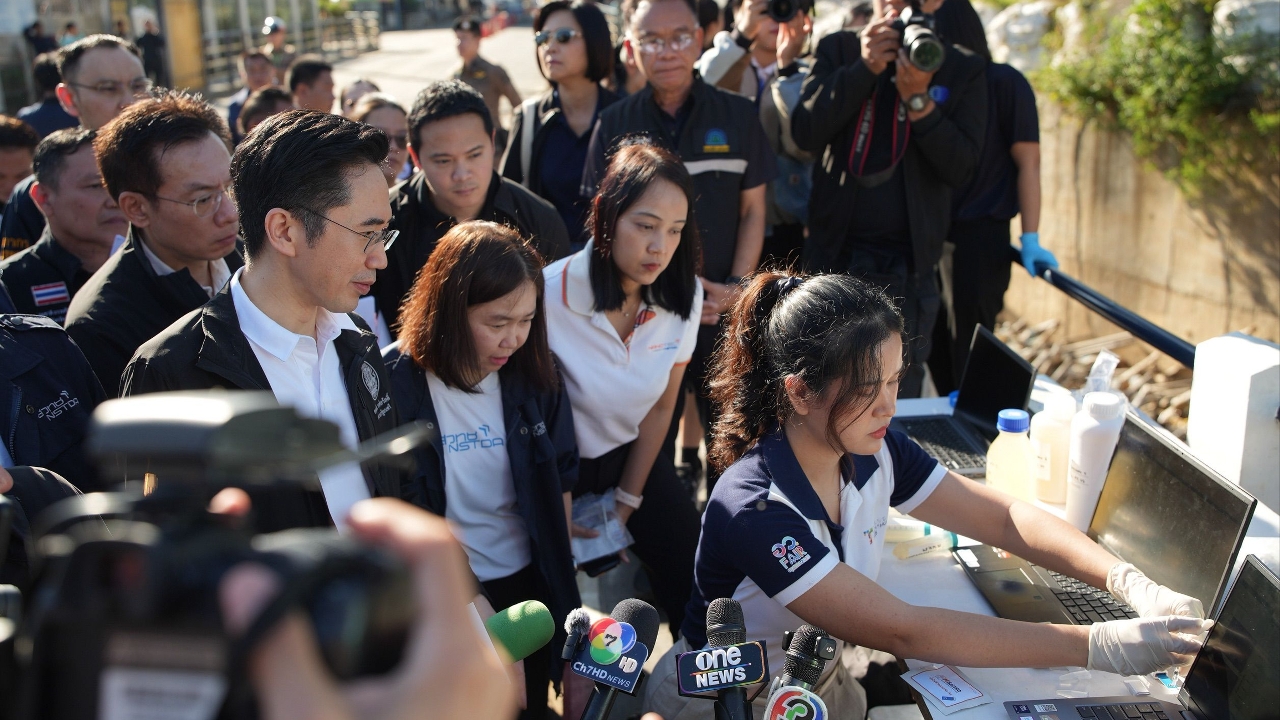
"Professor Chen" visited the Mae Sai border area to inspect contamination points, supporting solutions with "M-Sense," an arsenic detection sensor accessible and actually used daily by villagers, delivering results in 5 minutes at a cost of 60 baht, helping prevent toxic water hazards in the area.
On 15 Nov 2026, Mr. Yotchanan Wongsawat, Deputy Prime Minister and Minister of Higher Education, Science, Research and Innovation, led a team to the border area to examine the crisis of arsenic and heavy metal contamination in the Sai River, bringing advanced innovations from the National Science and Technology Development Agency (NSTDA) that are practical for daily use to urgently assist local residents.
The atmosphere at the Thai-Myanmar Friendship Bridge 1 in Mae Sai district was intense as a multi-sectoral working group surveyed risky spots along the riverbank where the water was visibly reddish and cloudy. Professor Dr. Yotchanan observed the work of researchers from the National Nanotechnology Center (NANOTEC), NSTDA, who applied the "M-Sense" innovation—a field test kit for arsenic and heavy metal contamination—to address the problem practically.
Regarding the operation of the "M-Sense" test kit, NSTDA researchers demonstrated and explained the user-friendly, straightforward process. The main equipment consists of a "testing reagent" and an "electrode chip." The procedure begins by inserting the electrode chip into a reader connected to a computer program pre-configured for measurement parameters.
Next, the water sample to be tested is mixed with the reagent and shaken to blend. Then, a dropper is used to place a drop of the mixed sample onto the electrode chip. Processing is initiated via computer, and the sensor analyzes and clearly displays the arsenic concentration as a numeric value on the computer screen within only 3 to 5 minutes.
This mechanism allows M-Sense to rapidly assess water quality with results comparable to central laboratory tests but at a significantly lower cost of just 60 baht per test. Consequently, local agencies, health officials, and even community leaders can access this tool for monitoring, screening, and promptly warning residents to stop using water when arsenic levels exceed standards, reducing panic and protecting public health effectively.
Mr. Yotchanan then revealed the long-term management direction, stating that arsenic contamination is a regional priority issue. Although his ministry is not the main responsible body, the Ministry of Higher Education, Science, Research and Innovation supports problem-solving and serves as a crucial backup in cross-border crisis management. This aligns with bilateral discussions between the Thai and Chinese prime ministers, who seriously addressed this issue to coordinate cooperative upstream management.
The Deputy Prime Minister explained the key engineering and environmental solution, noting that scientific data shows arsenic and heavy metals often attach to "turbidity" or sediment carried by the water flow. Relevant agencies are jointly studying a "water retardation" model—creating points to slow water currents so contaminated sediment settles to the riverbed, allowing machinery to dredge and safely dispose of the sediment. This approach will significantly reduce arsenic in the Sai River ecosystem and is planned to be proposed to the Northern Disaster Operations Center for flood, storm, and landslide relief to expedite real implementation.
Moreover, Mr. Yotchanan emphasized the necessity of using "scientific data" as a diplomatic tool to foster international cooperation. He noted that although Thailand has the M-Sense field test kit for rapid community warnings, when data must be used as evidence in government-to-government negotiations or talks with private sectors in neighboring countries, Thailand requires robust, internationally standardized data sets.
Therefore, the Ministry assigned NSTDA and the Synchrotron Light Research Institute (Public Organization) to act as the "scientific backbone," conducting accuracy verification alongside the Pollution Control Department's laboratory. This ensures transparency and credibility of Thailand's data, gaining international acceptance and leading to the ultimate goal of negotiating shared "water source safety standards" with neighboring countries to permanently end toxic discharges into public water sources.

Subsequently, Mr. Yotchanan and his team joined a meeting to summarize the arsenic contamination situation in the Sai River, assess impacts on residents’ lifestyles and health, and outline systematic remedial plans with Chiang Rai’s governor. They received reports on past operations and detailed water quality assessments from Dr. Urcha Raktanonthchai, Director of NANOTEC, NSTDA, before Professor Dr. Yotchanan delivered policy directives to ministry agencies to drive the mission of restoring clean and safe river water sustainably for Mae Sai residents.
This field visit and meeting included senior executives and relevant agencies, led by Ms. Piyarats Tiyapairat, Deputy Minister of Agriculture and Cooperatives; Mr. Supachai Pathumnakul, Permanent Secretary of the Ministry of Higher Education, Science, Research and Innovation; Ms. Theerarat Samretwanit, Assistant Minister to the Deputy Prime Minister; Mr. Sukit Srichomkwan, Deputy Secretary to the Prime Minister; Mr. Sompong Klaingnongsuang, Director of the Office of the Science Promotion Commission; Ms. Wiparat Diong, Director of the National Research Council Office; alongside the Chiang Rai governor and representatives from provincial agencies.


