

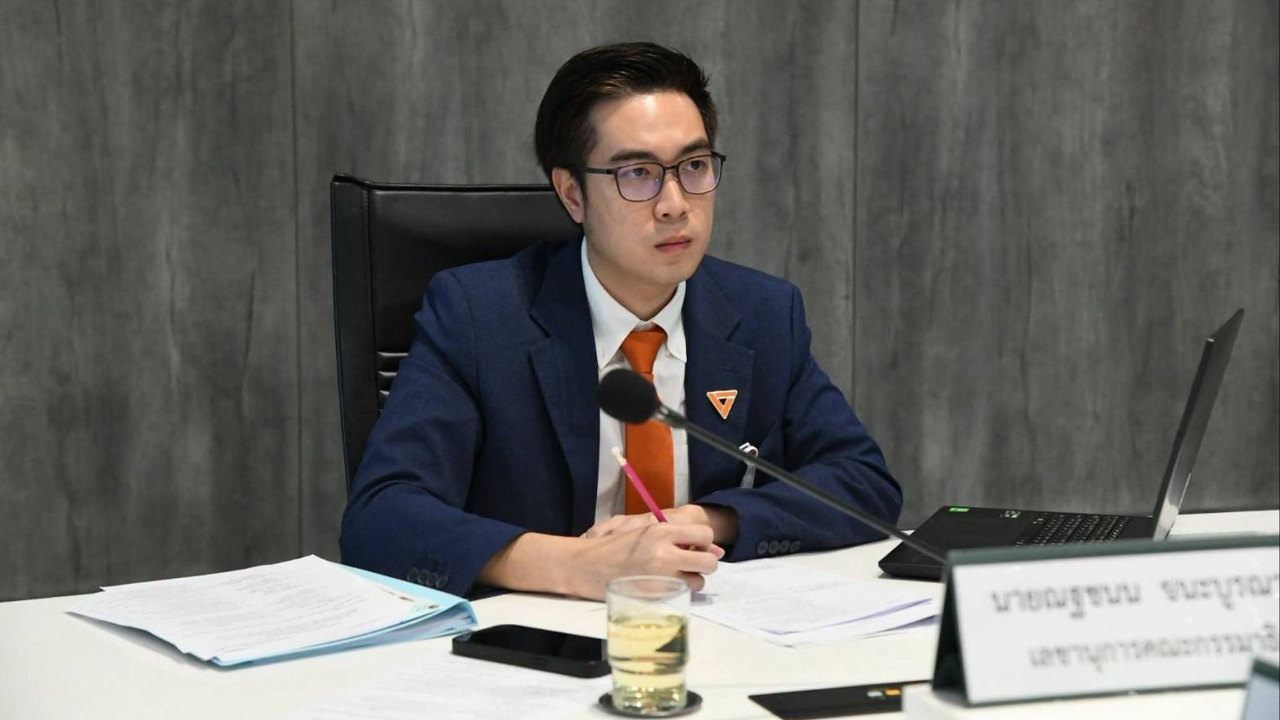
“Natchanon” demands the government answer five questions before relocating water production to escape toxic contamination in the Sai and Kok rivers. He criticizes the fragmented, reactive approach that fails to consider the system as a whole and stresses that unless the root cause from mines in neighboring countries is resolved, the problem will never end.,
On 15 Nov 2026, Mr. Natchanon Chanaburanasak, MP for Phitsanulok District 1 from the People’s Party, addressed the detection of toxic contamination in the Kok and Sai rivers in Chiang Rai Province. He noted that the government announced plans to shift raw water sources for tap water production—from Sai River to the Mekong River and from Kok River to the Lao River. While he agrees that providing clean and safe water to the public is urgent, he questioned whether the government has a truly integrated plan to protect all affected areas or is merely implementing isolated, project-based fixes. He highlighted the lack of clarity on how people outside the main water pipe systems will be supported and presented five key policy questions directly to the government.
First, before allocating investment budgets, has the government thoroughly surveyed the full scope of the problem? The government must clarify how many village and local water supply systems remain operational in the pollution risk areas, what water sources they use—whether river, shallow wells, or groundwater—and how many households are served. Has data from various agencies been systematically linked with water sources, quality test results, and risk zones? While the government’s announcement that some water systems passed quality tests is useful, it must specify how many systems were tested out of the total and what criteria are used to prioritize risk for untested systems. Without knowing the total number of people at risk, how can the government ensure its aid measures are comprehensive and no one is left out?
Second, on what data basis did the government decide to relocate raw water sources, and how effectively will this reduce risk? The government should transparently disclose comparative studies of options considering water quality and quantity throughout the year, cross-border pollution risks, construction costs, system management expenses, and project timelines. Particularly regarding shifting raw water pumping to the Mekong River—where the minister acknowledged contamination was also found, though still within safe production limits—the government must prove how the new treatment system can handle water quality fluctuations. What are the criteria for suspending water pumping if a major pollution wave occurs? How long will backup water sources suffice? Crucially, during construction, which water source will the public use, and how will those outside the new project’s service areas be supported with measures and budgets?
Third, does current water quality monitoring adequately cover actual risks? Toxic contamination in natural water sources can change rapidly, especially after heavy rain or unusual upstream events in neighboring countries. Monitoring systems must include both regular testing and immediate additional testing when incidents occur, along with clear criteria for public warnings, production shutdowns, and resumption. For water systems, quality must be tracked from raw water through treatment to tap water delivered to homes, with transparent disclosure of test results, sampling dates, and analysis methods. River testing should include both water samples and sediment because arsenic binds to sediment and can be re-released as environmental conditions change. For shallow wells and groundwater, assessments should consider depth and links to pollution sources, not just assume safety due to distance from rivers.
Fourth, where is the “risk map” that all agencies should use jointly to make decisions? The government should reveal progress on creating an integrated risk map combining data on pollution sources, rivers, wells, water systems, agricultural areas, and water user communities. This map must accurately identify contaminated areas, highest-risk zones, and data gaps, avoiding conflating “not yet tested” with “safe.” The risk data must inform prioritization for aid—where to urgently distribute replacement water, where to upgrade filtration systems, and where to send inspection teams. If data remains scattered, the government must clarify when it will centralize information, who will lead, and whether sufficient budget is allocated.
Fifth, what is the plan to address the problem’s root cause and ensure long-term water resource security? Relocating raw water sources only mitigates risk for some tap water users but does not change that many people and farmers still rely on the original river basins for their livelihood. The government must present clear emergency, transition, and long-term action plans. Especially given the minister's statement about a tailings dam breach at the upstream mine, how will the Thai government jointly investigate with neighboring countries, when will conclusions be reached, and what measures will prevent recurrence? The public deserves transparency on diplomatic negotiations, including clear goals and timelines, rather than bearing risk alone while the root problem remains unresolved.
Mr. Natchanon concluded that his demands are not mere criticism but recommendations for the government to manage the crisis on a foundation of complete scientific data agreed upon by all agencies, allocate budgets precisely, and prioritize fairly. Success in resolving toxic water contamination should not be measured by the number of water pumping relocation projects but by how many people gain access to safe clean water, actual reductions in health risks, and assurance that no citizens are left to suffer from poisoned water. The government must clearly explain how relocating raw water sources will improve safety for all residents and how it will decisively address cross-border pollution sources.