

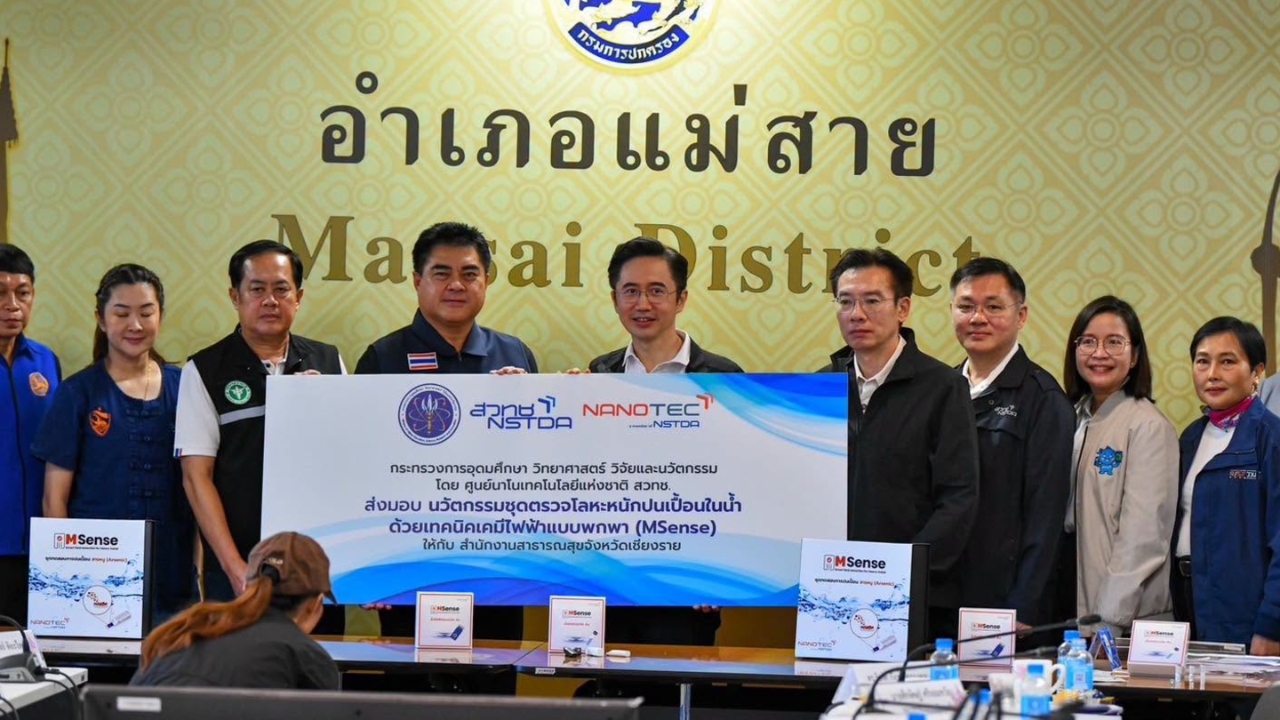
The government uses science to resolve the arsenic crisis in Sai River. The Ministry of Higher Education, Science, Research and Innovation (MHESI) deployed "M-Sense" test kits to local agencies for water quality screening, providing results within 5 minutes, while accelerating efforts to trace the contamination source.

On 16 Nov 2026 GMT+7, Second Lieutenant Phatdarasmi Thongsaluaykorn, Deputy Spokesperson of the Prime Minister's Office, revealed that the government is urgently addressing arsenic and heavy metal contamination in the Sai River, Chiang Rai Province. The Ministry of Higher Education, Science, Research and Innovation (MHESI) has brought technology and research into practical use, including filtration combined with reverse osmosis (RO) systems to produce community tap water and reduce arsenic, plus the portable "M-Sense" sensor kit detecting arsenic onsite with results in 3-5 minutes. Researchers and laboratories are mobilized to investigate contamination sources to ensure scientifically backed, targeted solutions.
MHESI established a project to expand the community tap water production system implemented about three months ago, using filtration combined with RO to reduce arsenic and heavy metals in water. Monitoring shows the system still operates efficiently, demonstrating that applying scientific and technological knowledge locally can effectively lower water quality risks and be practically beneficial.


For urgent response, MHESI deployed additional portable "M-Sense" arsenic detection sensor kits from the National Nanotechnology Center (NANOTEC), NSTDA, to the field. These kits were given to local agencies for water quality screening, delivering results in about 3-5 minutes, compared to previous methods requiring sample collection and lengthy laboratory testing. Having onsite testing tools enables officials to monitor the situation more frequently and implement water safety measures more quickly.
Simultaneously, MHESI plans long-term solutions using scientific data and engineering principles. A key measure is accelerating studies for constructing sediment-trapping weirs, since arsenic accumulates in river sediment according to scientific data. Discussions with the Governor of Chiang Rai aim to integrate previously proposed projects into the provincial plan and prioritize urgent locations for implementation.

Additionally, MHESI gathers scientific agencies and research institutions to support investigating contamination sources. Collaborating with Naresuan University, they use isotope analysis technology to study whether the arsenic in the river corresponds to specific origins. They also promote reanalysis and standard calibration in cooperation with Chinese laboratories to provide scientifically verifiable data that all parties can use for discussion and problem-solving.
Second Lieutenant Phatdarasmi added that solving the contamination in Sai River requires addressing both symptoms and root causes simultaneously. The government is accelerating public safety measures through filtration systems and field detection tools, while also pursuing scientific evidence to identify sources and develop systematic management plans. Cooperation with China, Myanmar, and international agencies is essential, as Sai River connects multiple countries. Effective resolution depends on verifiable data and collaboration.
The Deputy Spokesperson emphasized that MHESI’s efforts go beyond laboratory research; they apply technology directly to real-world problems—from water filters reducing contaminants to rapid-result test kits and scientific source verification—to ensure solutions are data-driven and precisely targeted.
