

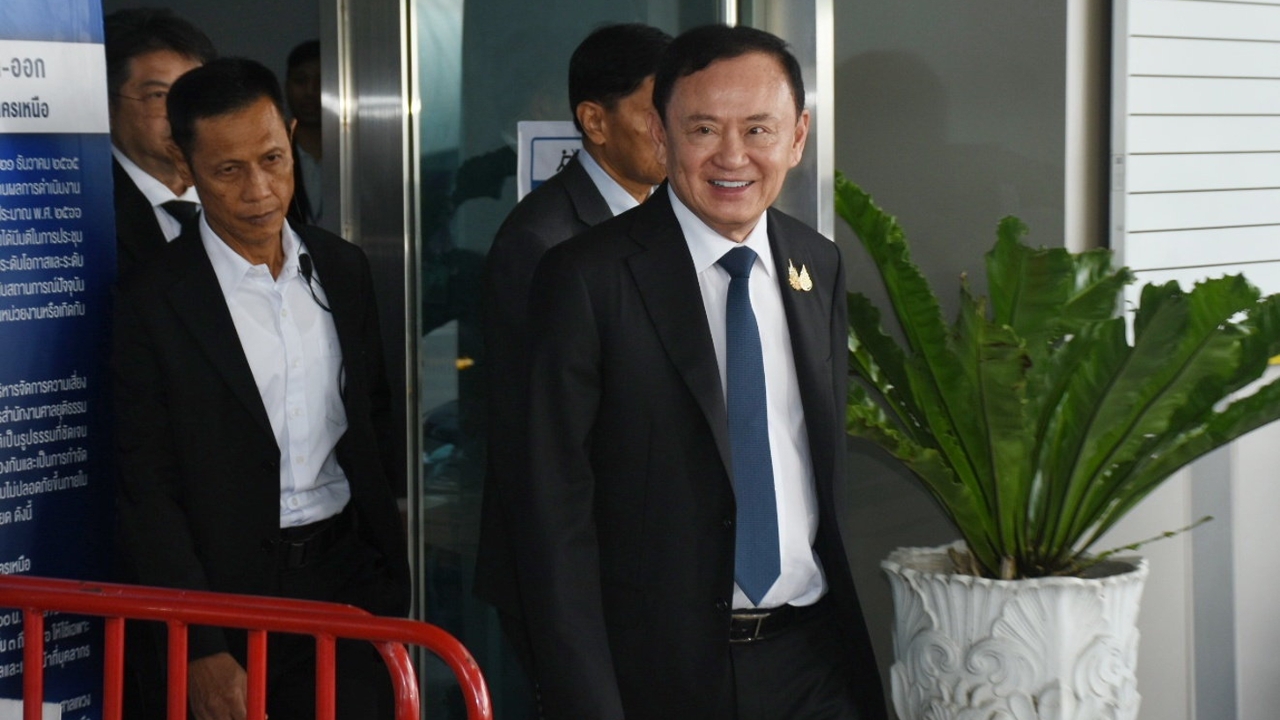
The Central Tax Court dismissed Thaksin's petition seeking temporary protection against the Revenue Department's asset seizure, ruling that he has no right to file at this stage.
At 09:30 on 16 Nov at the Central Tax Court, Government Complex, Chaeng Watthana Road, the court held a hearing for case number Por 59/2569, in which former Prime Minister Thaksin Shinawatra is the plaintiff suing the Revenue Department over tax issues. The case involved a preliminary hearing on a request for temporary protection before judgment, where Thaksin sought a court order to temporarily prohibit the Revenue Department from continuing the seizure and freezing of assets worth 17 billion baht, arguing it was an improper double taxation.
The court considered that the key issue was whether the plaintiff had the right to request temporary protection before a judgment. The Civil Procedure Code divides provisions into four parts, with Part 4 covering provisional measures before judgment and enforcement after judgment or order, divided into two types: Type 1 provisional measures before judgment and Type 2 enforcement according to judgment or order. The legal provisions in each part and type relate to the parties' rights, procedural steps, and interconnected matters. Temporary protection before judgment is a legal process prescribed in Section 254, which falls under Part 4, Type 1.
Type 1 involves provisional measures before judgment, distinct from Type 2 enforcement after judgment or order. Examining the law's content for these types shows that Type 1 grants plaintiffs who bring lawsuits the right to request the court to provide protective measures before judgment to prevent harm caused by defendants' actions, non-payment of debts, or asset transfers to avoid payment, as stipulated in Section 254. It also grants parties the right to request protective orders during proceedings or for enforcement after judgment as per Section 264.
Since when a plaintiff files a lawsuit and the court has not yet issued a judgment, one party cannot compel the other to refrain from causing harm, committing torts, or acts under litigation to evade payment, including potential costs if losing the case. Section 254 states, "In other cases apart from criminal cases, the plaintiff may submit to the court together with the complaint or at any time before judgment a unilateral petition requesting the court to issue an order imposing conditions to provide certain protective measures." Thus, the right to file such a petition belongs to the plaintiff bringing the case, who, if winning the judgment, can enforce the defendant to pay debts or comply with the judgment's terms.
In this case, however, the plaintiff is a person whose assets were seized and auctioned by the Director-General of the Revenue Department under Section 12 of the Revenue Code, who claims responsibility for unpaid taxes due. Therefore, the plaintiff is not a litigant under the meaning of Section 254 as described.
Furthermore, Section 12, paragraph 4 of the Revenue Code states that the procedures for seizure and auction of assets shall follow the Civil Procedure Code mutatis mutandis, while the seizure procedures shall follow regulations set by the Director-General and approved by the Minister. This implies that the Civil Procedure Code provisions applied are those in Part 4, Type 2 regarding enforcement after judgment or order, which cover seizure and auction of debtor's assets to satisfy creditors according to judgment. Debtors or related parties who believe the creditor has no right to enforce or enforcement is improper may request the court to suspend enforcement under Section 289.
The Director-General's exercise of authority under Section 12 of the Revenue Code is similar to a creditor enforcing a judgment by seizing the plaintiff's assets, who is in the position of a debtor under that judgment. This is an enforcement process; thus, the plaintiff has no right to request temporary protection before judgment under Section 254(2) of the Civil Procedure Code, together with Section 17 of the Revenue Court Establishment and Tax Case Procedure Act B.E. 2528 (1985). Therefore, the court ordered the petition dismissed and waived court fees at this stage.
Afterward, Vinyat Chatmontri, Thaksin's lawyer, revealed that the Central Tax Court had heard their petition for preliminary injunction or summary judgment. The court reviewed the petition and decided that legally, the court had not yet addressed the factual disputes raised. The Revenue Department's actions would be subject to evidence examination at the trial stage. Regarding the plaintiff's petition filed during the enforcement process, the court viewed that the Revenue Department acts as a creditor while they are the debtor, and thus the plaintiff lacks authority to file under the Civil Procedure Code.
Vinyat added that issues contested since the initial complaint, such as the income which was seized over 40 billion baht in 2010, which the Revenue Department claims as unpaid taxes by the former prime minister, remain in court proceedings. Evidence will be examined next year to determine if the previously seized funds are the same as those under current enforcement. If the funds are identical, their argument will proceed accordingly. The court scheduled a joint hearing for 21 December, and case proceedings continue.
When asked if Thaksin had been informed of the court's order, Vinyat said he had been notified that the petition was dismissed due to legal issues. Thaksin acknowledged this and instructed to proceed according to the law. They plan to appeal the order. In the case where the Revenue Department is plaintiff, some assets have been seized and frozen, with enforcement including auctions possible, but auctions have not yet occurred. If auctions proceed and proceeds are uncertain, bankruptcy filings and eligibility will be considered. The process remains contested.
Asked whether Thaksin would accept being declared bankrupt, Vinyat briefly replied, "Whether to accept or not depends on the law. There is a legal process, and we will fight for the rights. Whether he becomes bankrupt or not, we will proceed accordingly in that phase."