

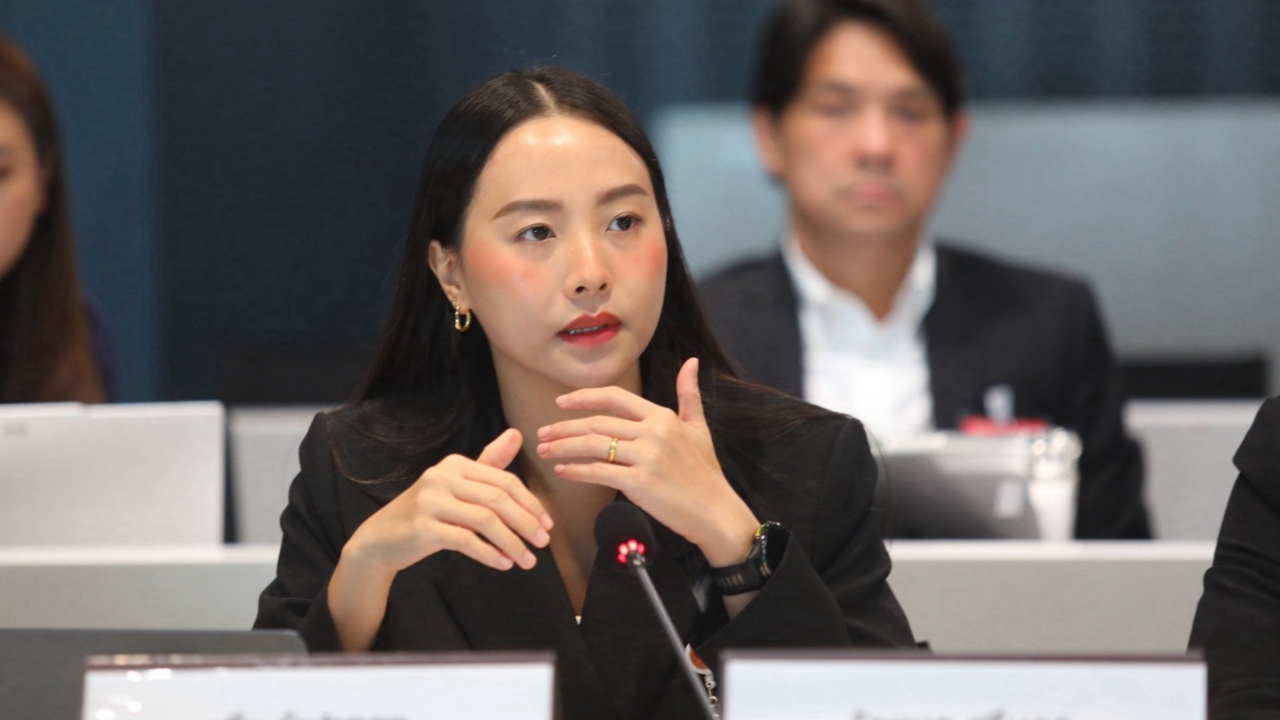
The People's Party insists that its social security bill does not request a lump-sum benefit option but grants the board authority to adjust payments according to social conditions. It urges all parties to prove their sincerity, stating that "social security reform" requires voting for the People's Party's draft as the main bill.
On 16 Nov 2026 GMT+7 at the Parliament Building, the People's Party held a press conference on the 20th Shadow Cabinet meeting. At one point, Ms. Rakchanok Srinok, Mr. Sia Champathong, and Mr. Sahasawat Koomkong, People's Party MPs, jointly addressed the submission of social security bill drafts by the Cabinet, the People's Party, and other political parties, which will be considered by the House of Representatives this Wednesday.
Ms. Rakchanok clarified facts following a People's Party MPs' press conference last Thursday, which prompted responses from various government sectors accusing the People's Party's social security amendment draft of being substantively similar to the Cabinet's draft on the "3 requests" (choice, return, loan) allowing insured persons to select lump-sum or pension benefits. Rakchanok firmly denied these claims and stressed that the People's Party's bill must be read by chapters and provisions considered collectively.
In Chapter 7, concerning old-age benefits, Section 117 stipulates that the criteria, methods, duration, and rates of benefit payments are the authority of the social security board elected by insured persons and employers. Section 118 opens the option to choose between lump-sum or pension payments. The People's Party does not agree with the Cabinet's approach but legally allows flexibility to adapt to social and economic conditions over time. The ultimate decision rests with the elected social security board to genuinely manage the fund and safeguard insured persons' benefits, which is central to the People's Party's draft aiming to remove the Social Security Office from the civil service system.
Mr. Sia Champathong, speaking as a laborer and insured person contributing to the fund for over 20 years and a key advocate for establishing the old-age pension fund, expressed understanding of workers' concerns. Field visits revealed workers severely affected by the economic crisis: many factories cutting overtime, some suspending work with only 75% wages, worsening already insufficient incomes amid rising fuel and living costs without government price controls or concrete relief. Thus, some workers' support for the "3 requests" is understandable as they seek lump sums to survive short term.
He pointed out that the Cabinet's social security bill is not a real solution to improve workers' quality of life, highlighting three concerns: first, it contradicts the fund's purpose to support insured persons from birth to death across seven cases, especially old-age pensions providing a safety net when unable to work. Allowing lump-sum withdrawals undermines this security. Second, it threatens fund stability, causing concern among pension recipients about lifelong payments. Third, new workers contributing now will question the fund's sustainability upon retirement. Therefore, the People's Party's draft protects insured persons fully and empowers the board to carefully assess the situation.

Meanwhile, Mr. Sahasawat Koomkong discussed the voting direction in the House of Representatives, recalling that during the 8 Feb election campaign, almost all parties agreed on the need for social security reform. Now is the time for all parties to fulfill their promises to workers by turning campaign commitments into law, as insured persons have long faced ineffective management issues, including investments in the SKYY9 building, IT and public relations budgets, and attempts to interfere with board elections.
He stated that the social security fund can no longer be fixed by "patching" but requires reform based on three key principles:
1. Transparency: openness about investment, procurement, and benefits must be straightforward and clear.
2. Connection: management must be linked to the insured persons and employers who truly own the contributions, with accountable leadership.
3. Professional management: selection of executives must be public, decisions documented and auditable, with workers setting goals and experts implementing actions collaboratively.
Mr. Sahasawat further noted serious concerns with the Cabinet's draft, including risks from the "3 requests" measures and attempts to appoint "social security senators" by empowering an audit committee unconnected to insured persons. Therefore, the People's Party calls on the House to approve the principles of all social security bills from the Cabinet and parties for joint committee review. However, only the People's Party's comprehensive reform draft, presented by Ms. Rakchanok Srinok and colleagues, fully outlines restructuring to remove the social security fund from the civil service by repealing the old law and redrafting entirely. The party urges all to vote for its draft as the "main bill" for consideration, debating each draft's merits on the basis of genuine fund reform outside the bureaucracy.
"Let the party name not be an obstacle; instead, let us uphold the promises made to the public during campaigns and jointly create a transparent, accountable, insured-person-linked, and professionally managed social security reform as a historic achievement of this House of Representatives," Mr. Sahasawat concluded.

