

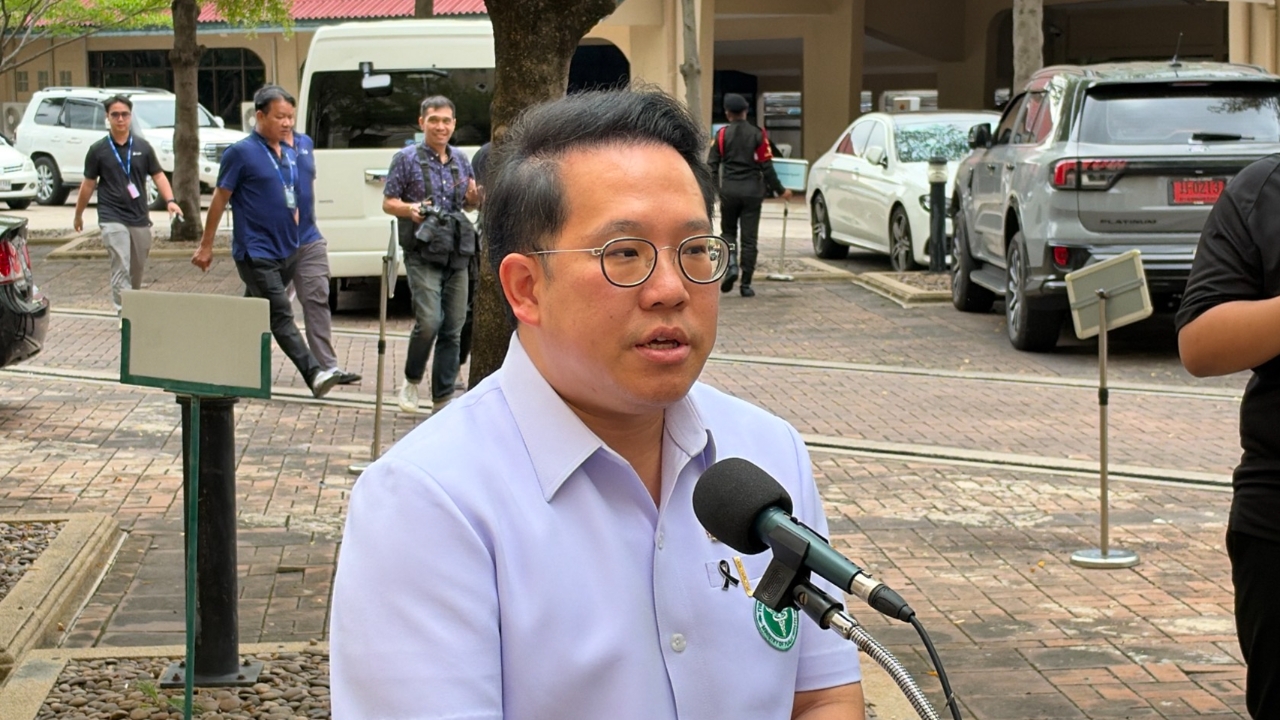
Health Minister Patthana acknowledged high levels of heavy metals in Chiang Rai's water, warning the public to avoid contact with water and sediment. He advised farmers to wear gloves and boots and recommended consuming food from nearby areas. He stressed that boiling water does not remove heavy metals and toxins from the water.
At 09:30 on 17 Nov 2026 at the Government House, Mr. Patthana Prompatan, Minister of Public Health, spoke about toxins found in the Kok, Sai, and Ruak rivers affecting public health in Chiang Rai Province. Last week, he ordered the Department of Health and the Department of Medical Sciences to inspect heavy metal levels in these rivers. Their tests confirmed the presence of heavy metals and arsenic at concentrations potentially harmful to long-term health. The Department of Health communicated to local residents to avoid direct contact with water and sediment because swallowing or inhaling contaminated water could allow toxins into the body. Symptoms may not appear immediately, as toxins can accumulate over time, posing a long-term health risk. The government is working on solutions, but meanwhile, residents are urged to avoid exposure when possible.
Mr. Patthana said that Deputy Minister of Interior Je-sed Thaiset visited the area and confirmed that water from the Provincial Waterworks Authority (PWA) is clean and safe for regular use. However, there is concern about village tap water, which many locals rely on. Authorities recommend frequent testing of this water. The Ministry of Public Health has tasked the Department of Health and the Department of Medical Sciences to assist local governments in testing food, vegetables, and fish. If avoiding local food is impossible, residents are advised to diversify their diet with produce from nearby areas to reduce toxin intake. This is the ministry's preliminary guidance. Residents experiencing severe diarrhea, vomiting, or stomach illness are encouraged to seek immediate medical care at health personnel centers or Subdistrict Health Promotion Hospitals (SHPH) to check for toxin residues.
Mr. Patthana added that farmers who must work in the affected areas should wear gloves, socks, or waterproof boots to avoid direct contact with contaminated water, especially where heavy metal concentrations are high. Areas not affected or with contaminant levels within standards can continue normal activities but still need to prevent other diseases. The ministry continues to recommend protective gear such as gloves and boots as a medical precaution.
When asked whether the provincial public health office has reported cases affected by arsenic, Mr. Patthana said patients have been continuously identified. However, investigations must determine whether illnesses result from long-term, high-level accumulation of arsenic and heavy metals. While some patients show elevated levels requiring caution, it cannot yet be confirmed that their illnesses are caused by long-term arsenic exposure, as other diseases may be involved. The provincial health office is closely monitoring the situation.
Asked about common symptoms, Mr. Patthana said both skin diseases and gastrointestinal symptoms like nausea, vomiting, and diarrhea have been observed. These symptoms are common to many illnesses. Therefore, when patients present with such symptoms, local doctors test for heavy metals in the body simultaneously. If arsenic and heavy metals are detected, patients may receive advice on further avoidance measures.
Mr. Patthana said that boiling water before use does not remove heavy metals. Therefore, the public should exercise caution when using water from affected sources.