

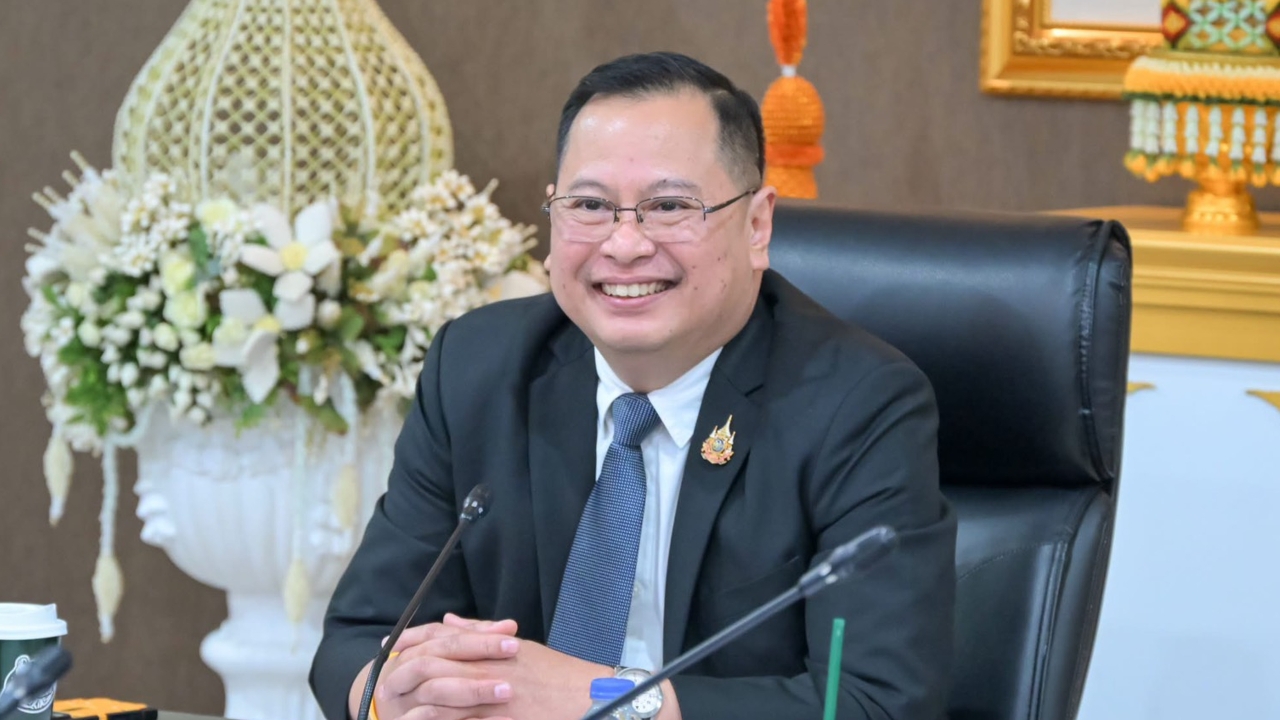
Pakorn led the Peace-Building Committee's second meeting to acknowledge 64 amnesty petitions, dismissing those from the southern border as unconstitutional. Ticha acknowledged that Section 112 cases do not qualify for amnesty. Attention is on the upcoming subcommittee review of Thaksin's cases next week.
At 13:30 on 17 Nov 2026 GMT+7 at the Office of the Permanent Secretary to the Prime Minister (OPSPM), Government House, Deputy Prime Minister Pakorn Nilprapunt, as Chair of the Peace-Building Committee,
presided over the second meeting of the Peace-Building Committee for 2026. Committee members included Police Lieutenant General Ruthphol Naowarat, Minister of Justice; Chatchai Bangchuad, Permanent Secretary to the Prime Minister's Office and committee secretary; Piyasiri Watwanarangkul, Permanent Secretary of Justice; Wuttisarn Tanchai, legal expert; Yutthaporn Isarachai, political science academic from Sukhothai Thammathirat Open University; and Ticha Na Nakorn, human rights expert.
Before the meeting, Pakorn expressed gratitude to all subcommittee members for their work and outcomes achieved so far. He described it as a positive sign toward restoring social harmony and emphasized that it serves as a lesson to prevent future conflicts, urging future generations not to repeat past mistakes regardless of the circumstances.
Later, at 15:20, Pakorn stated after the meeting that 64 petitions had been reviewed, with more incoming. He highlighted a lack of verification, noting that upon receiving petitions, they must be checked by relevant agencies for duplication and whether those agencies can act within their authority. If so, action can proceed without waiting for the Committee's decision. Many cases have already been addressed, mainly by the subcommittee chaired by the Permanent Secretary of Justice. Previously, 4-5 cases were pending at the Bangkok South Criminal Court before the Peace-Building Act took effect, but these could be handled immediately by the court's authority.

Pakorn explained that two additional matters were considered: first, the format for decisions, initially based on procedural and administrative law, including reasoning; second, a security case from the Pattani Provincial Court was submitted for the Committee's review. The Committee established that political expressions covered by the Act must comply with the Constitution. Any action contradicting the Constitution falls outside the law's scope. The law requires political expression to aim for political power within a democratic monarchy and not challenge the state's form. However, the submitted petition detailed behavior violating Section 1 of the Constitution, which defines Thailand as an indivisible kingdom. The behavior aimed at separatism, so it falls outside the law's application.
Pakorn noted that the Committee shared broad views, acknowledging that social peace is not achieved solely by this law but through multiple channels, including security laws that can offer non-prosecution measures. Chatchai Bangchuad, Permanent Secretary to the Prime Minister's Office and former Secretary-General of the National Security Council, explained that rulings must align with this law and the Constitution. He emphasized to the public that social peace arises from genuine sincerity among all parties. Political and differing opinions are normal and beautiful in a democratic monarchy, but violence aimed at destruction is unacceptable. Our democracy focuses on reasoned debate.
The Deputy Prime Minister reiterated that this law is not the only path to social peace; all parties must cooperate to prevent a recurrence of conflicts from over 20 years ago. Signs indicating a return to such conflicts should be stopped, and everyone should unite to develop the country forward, working together more reasonably.
He added that the meeting reviewed Senator Dewarit Maneechai's proposal for the government to consider leniency for those prosecuted under Section 112 or political cases, suggesting remedial measures. While beneficial, many issues fall under the National Human Rights Commission's (NHRC) and courts' jurisdiction. The Deputy Secretary-General of the NHRC took this matter for further action. Regarding other cases, such as those filed by former Prime Minister Thaksin Shinawatra, these will be considered first by the subcommittee chaired by the Permanent Secretary of Justice. The Justice Secretary indicated that urgent meetings could be held on weekends if needed, recognizing that citizens' suffering has no schedule. The priority is to act swiftly. Deputy Secretary-General Chatchai, as Committee secretary, was tasked with following up.

Yutthaporn Isarachai, political science academic from Sukhothai Thammathirat Open University and Peace-Building Committee member, stated that the reconciliation process under the 2026 Peace-Building Act is only one tool and not a comprehensive solution ensuring no one is left behind. From the legislative drafting stage, it was acknowledged that complete resolution is impossible. One Committee role is to propose pathways toward the future. The meeting agreed on the need to assess what remains unaddressed or unachievable, which will guide future directions.
Yutthaporn added that many other processes exist to achieve social reconciliation, which is a critical challenge. However, when politicized, attention focuses on specific cases. He believes less emphasis should be placed on individual cases and more on how this law can help Thai society break free from cycles of conflict over the past 20 years and progress into the future. This is his key message.
He affirmed that, as an academic involved in studying and drafting the law, all Committee members work transparently and straightforwardly.
Ticha Na Nakorn, Peace-Building Committee member, said the Committee's review must follow constitutional guidelines. During discussions, Senator Dewarit Maneechai's proposal regarding bail rights for those prosecuted under Section 112 was debated. Such cases fall outside the Peace-Building Act's criteria. Nonetheless, the National Human Rights Commission representative expressed willingness to discuss this with the courts, which the Committee saw as the best channel and hopes it will proceed. Although 96% of those eligible have been granted bail, only about 1% of the prison population falls under this group—a concern for human rights and reconciliation advocates.
“We thank Senator Dewarit for his concern and submitting letters twice to the Committee. The Committee Chair will send a thank-you letter to him and to the National Human Rights Commission, which will engage in direct discussions with the courts. We hope the 96% bail rate can reach 100%,” Ticha said.
A reporter noted that the subcommittee chaired by Permanent Secretary of Justice Piyasiri Watwanarangkul is scheduled to meet next week, possibly reviewing former Prime Minister Thaksin Shinawatra's cases—one of the 64 petitions submitted.
Thaksin has filed three amnesty petitions, all of which the Committee will consider together.
