

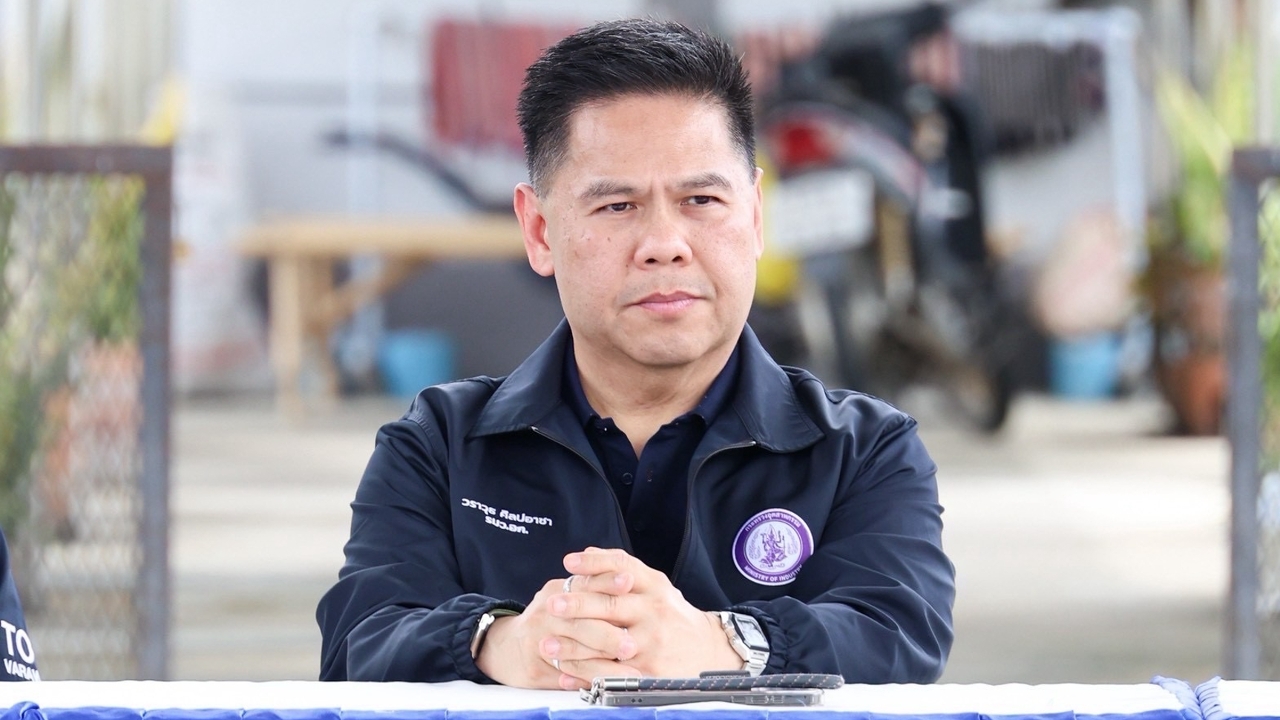
Worawut refutes allegations by a PPRP MP accusing Thailand of being merely a transit route for mineral capital groups, stating that the Ministry of Industry has drafted a strict control announcement since June 2026 and expects it to be enforced by late January 2027.
On 17 November 2026 GMT+7, Worawut Silpa-archa, Minister of Industry, commented on MP Phattharaphong Leelaphat from Chiang Mai representing the Palang Pracharath Party, who claimed Thailand is being used solely as a transit route for minerals by capital groups and urged the government to urgently push legislation controlling mineral imports. Worawut responded that the Ministry of Industry has not been idle on this issue and has continuously sought preventive measures. Previously, the Department of Primary Industries and Mines (DPIM) drafted a Ministry of Industry announcement concerning the types and conditions of minerals requiring import permits into the kingdom or continental shelf, or export permits out of the kingdom or continental shelf, B.E. …
This announcement revises and tightens the criteria from the previous versions issued in 2017 and 2019 to enhance economic security, environmental protection, and public safety. The purpose is not to ban mineral imports but to require permits so that the DPIM can systematically trace mineral origins and mining coordinates, especially for minerals imported from neighboring countries. It is necessary to verify whether the minerals come from mines with proper concession licenses to prevent Thailand from serving as a transit point or becoming involved in mining activities that cause cross-border environmental damage. The Ministry of Industry began implementing this announcement in early June 2026.
Worawut explained that the new draft announcement notably adds five types of minerals requiring import permits: wolframite, lead, copper, gold, and rare earth elements. Statistical data over the past 2-3 years show significant increases in imports of wolframite, lead, and copper, prompting enhanced measures for these minerals. Although no irregularities have been found in gold and rare earth element imports, additional measures are set as a precaution since they could contribute to contamination in various waterways. Importers must submit additional documentation, such as proof of identity of the mining concession owner or a legal entity certificate issued by the government of the mineral’s origin country, along with a certificate of origin (C/O).
“Although we do not have authority over mining regulation in neighboring countries, we have not been complacent. We have continuously supported efforts to solve arsenic and heavy metal contamination in border water sources such as the Sai and Kok rivers. We have reviewed the export of chemicals used in mineral processing and metal smelting to see if their exports from Thailand have increased, but found no irregularities. For example, cyanide, a key chemical in gold extraction, has not been exported for several years. Requiring mining location coordinates enables us to use technology to monitor the area and assess links to environmental problems, providing critical data for future measures if a mine is clearly impacting Thailand,” said Worawut. .
Worawut further stated that before drafting the announcement, the DPIM held consultations with representatives from relevant agencies such as the Pollution Control Department, Customs Department, Ministry of Foreign Affairs, the Mining Council, and the Federation of Thai Industries to ensure comprehensive, appropriate, and stringent measures that do not impose undue burdens on compliant operators. The principles and draft announcement will be posted on the central legal system website to solicit public feedback according to legal procedures. The process is underway, including principle and draft consultations, before considering final approval and submission to the cabinet. The Ministry expects the announcement to be enforced by late January 2027.