

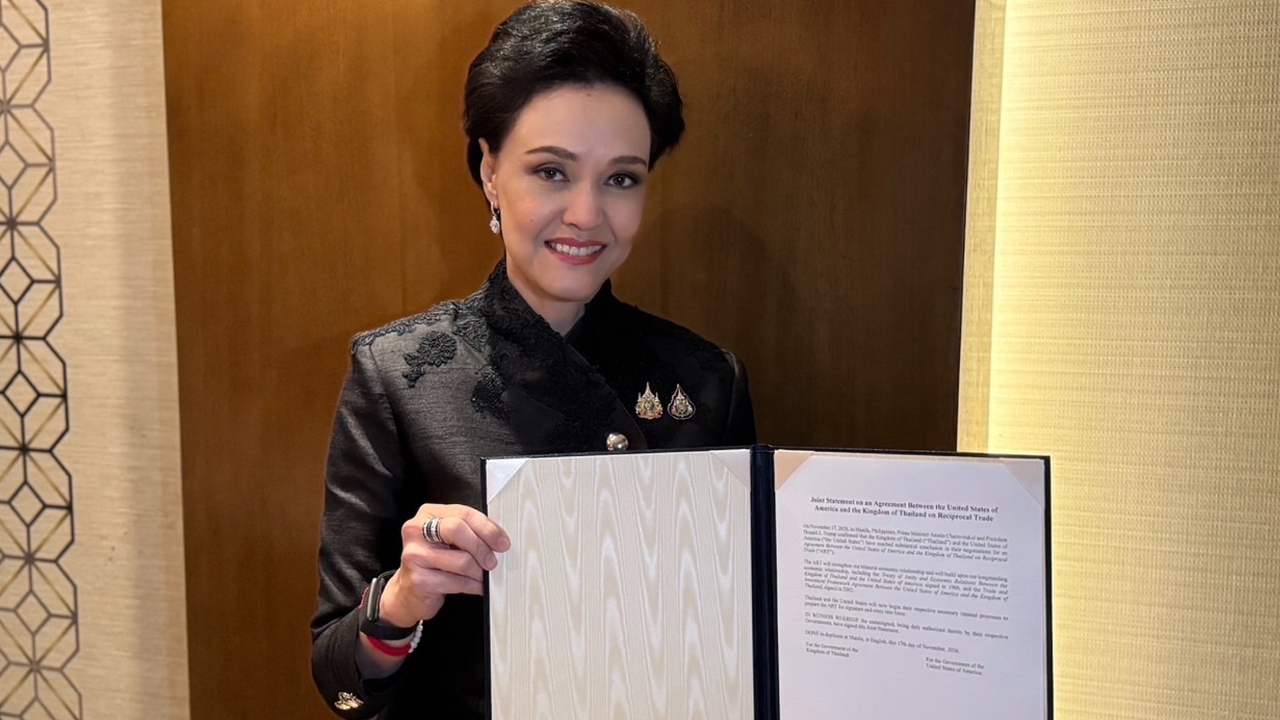
Supachai reveals the behind-the-scenes of the Thai-US ART deal, emphasizing careful negotiations to protect national interests, securing a Section 301 tariff guarantee at 10%, equal to countries with ART coverage, safeguarding an export market worth 2.37 trillion baht and 1.25 million jobs linked to it.
On 18 Nov 2026, Supachai Sutthampan, Deputy Prime Minister and Minister of Commerce, disclosed following the signing of the Joint Statement on the Thai-US Agreement on Reciprocal Trade (ART) in Manila, Philippines, on 17 Nov 2026, that both sides have reached the key substantive conclusions of the ART agreement. The remaining step is legal text refinement before each country proceeds with its internal processes.
Supachai stated that Thailand’s negotiation process was thorough to ensure that all conditions remained within acceptable limits for the country and did not cause undue harm to farmers, SMEs, industrial operators, exporters, consumers, investment, or domestic employment.
“We took our time because we wanted to ensure what we agreed on followed the principles and framework we set and would not excessively harm the country’s interests. If we had conceded easily, this would have ended last year, but we negotiated until we reached what we consider the best possible outcome,” Supachai said.
The Deputy Prime Minister and Minister of Commerce noted that an immediate priority is to negotiate with the US to reduce the Section 301 tariff rate on forced labor issues from the current 12.5% down to 10%, matching countries that already have ART agreements like Cambodia, Indonesia, and Malaysia.
Supachai said that signing the Joint Statement provides Thailand with a foundation to argue that, although the final ART agreement is still being drafted, both sides have agreed on the key points and thus Thailand should be treated on par with countries that have signed ART agreements.
“Now that the statement is signed, negotiations continue immediately. Since the key substantive agreement is reached and the leaders of both countries have signed, we ask to be considered as if we are in the same position as countries that have signed ART. From here, we must proceed to negotiate a reduction to 10%,” Supachai explained.
Supachai pointed out that the US is Thailand’s number one export market. In 2025, Thai exports to the US were valued at about 2.37 trillion baht, supporting approximately 1.25 million jobs domestically. This agreement thus boosts confidence for exporters, SME factories, and many workers.
“At least we have protected the country’s top export revenue. Both large and small businesses trading with America can be more confident that they can continue exporting and remain competitive with other countries,” Supachai said.
Supachai clarified that opening the US market does not mean unconditional access. Thailand already has FTAs with several countries including ASEAN, Australia, and New Zealand. Additional product openings focus on providing consumers and businesses more choices, especially for products Thailand cannot produce, has insufficient supply of, or that are essential for food and energy security.
For products that could impact domestic producers, Thailand can still use quota mechanisms, limit imports, or apply remedial measures, as well as assess domestic demand, supply, and production capacity before opening markets to avoid undue harm to Thai businesses. Currently, under US tariff structures, some Thai exports are exempt from additional measures, while others remain under Section 301 or Section 232. Thailand still has room to request further exemptions, with details to be disclosed during legal and public consultation phases.
Following this, Thai and US legal teams will enter about a two-month phase to refine the draft agreement’s wording before submitting it to the Cabinet, then moving to public hearings and parliamentary consideration. This entire process could take several more months before the ART agreement comes into force.
“The key point today is that we have reached a joint conclusion. Thailand’s top export market is protected to a degree, and we have greater clarity in competing with other countries. Remaining details will be disclosed and explained to the public through all procedural steps,” Supachai said.
Regarding US controls on advanced chips, Supachai said preliminary data shows that restricted chip types account for only about 0.7% of Thailand’s total chip imports, so broad impacts are not yet evident. However, the Ministries of Commerce, Digital Economy and Society, and Finance will continue to jointly assess further details.