

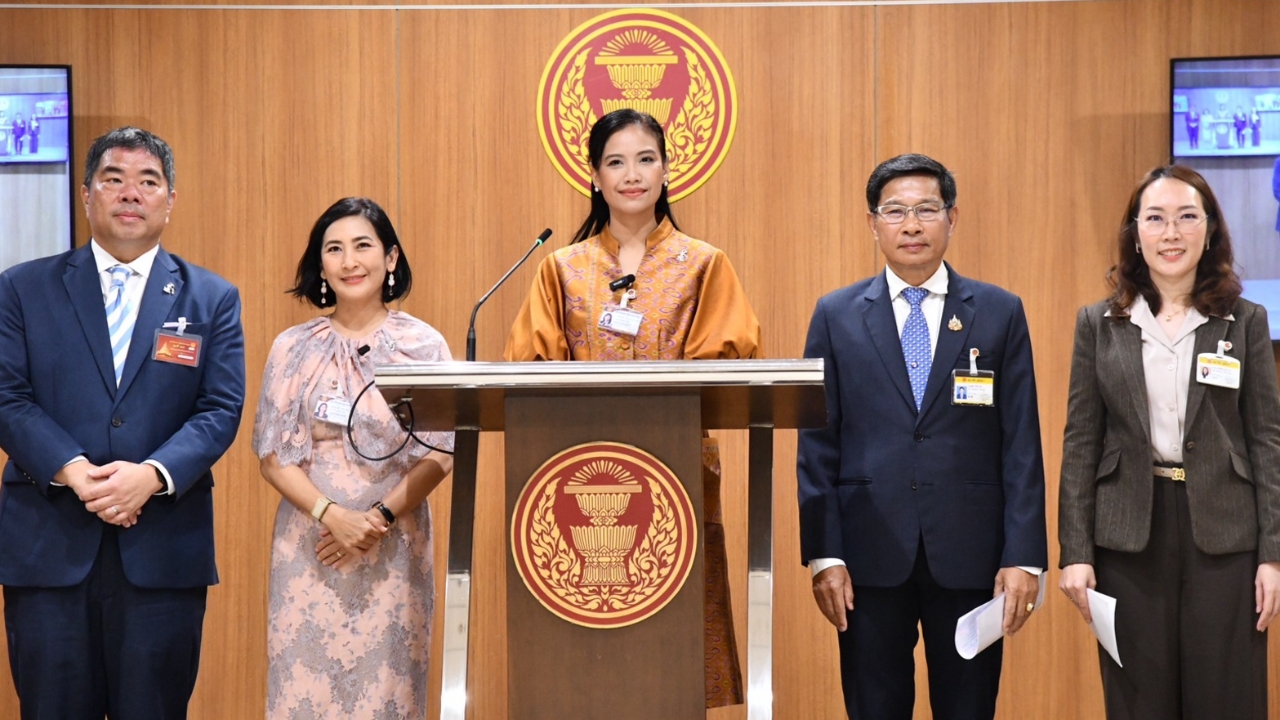
Democrat Party MPs and Senators criticize the government, urging swift resolution of toxic contamination in the Kok River and hazardous waste. They advise the Prime Minister to lead a unified government integration by chairing a Single Command to address the crisis of water and food contaminated with toxins and order asset freezes on the responsible companies.
At 11:00 a.m. on 18 Nov 2026 at the Parliament, Ratklao Intawong Suwankhiri, a list MP from the Democrat Party, addressed the issue of arsenic-contaminated Kok River affecting Thai citizens who use the water for drinking and fishery. She said the problem has reached a critical level, yet the government has only begun to respond, despite the root cause being rare earth mining in Myanmar, which severely impacts the river and local communities. There is also an escalating problem of illegal industrial waste disposal in Thailand. It is time for the Prime Minister to recognize the severity by invoking Section 9 of the National Environmental Quality Promotion and Conservation Act B.E. 2535 (1992) to declare the affected areas under emergency coverage, as the crisis endangers the health and lives of Thai people. The PM should not allow separate agencies to work in isolation but must chair coordination across all involved ministries, allocate central funds to resolve the issue, and transparently disclose pollution data to the public, identifying contaminated sites for systematic restoration.
She cited Japan's response to Minamata disease, where the government did not allow the responsible companies to go bankrupt or disappear, but used a bond mechanism to compensate affected citizens. Special laws required the companies at fault to bear the costs of compensating all affected patients, even though the remediation took over 30 years. Therefore, the Thai government should implement measures to freeze assets of the responsible companies to prevent evasion or bankruptcy and enforce laws similarly. The government must conduct pollution inspections comprehensively across all affected sites.
Kardee Liewpairot, a Democrat Party list MP, said regarding industrial waste imports to Thailand, she proposes amending regulations to allow imports of metal scraps only if melted into ingots and strictly for the needs of domestic factories. This aims to prevent Thailand from becoming a dumping ground for global industrial waste. The Ministry of Industry must halt issuing W.8 permits and review all existing permits for electronic scrap imports. Customs should intensify inspections of goods from exporting countries and improve information exchange, especially concerning toxic substances. She emphasized that violations should not end with fines but include criminal prosecutions and asset seizure investigations through the Anti-Money Laundering Office, as involved companies have historically closed, changed names, and reopened without taking responsibility for society or the public.
Chucheep Uakarn, a Senator from Prachinburi, said permitting industrial waste from abroad to be disposed of in Thailand is a huge mistake. Locals question how authorities could allow valuable materials to be extracted abroad while toxic industrial waste is dumped in Thailand. The current government must urgently resolve this, holding polluters accountable instead of neglecting the issue. However, state mechanisms have been slow. Questions arise about how Customs allowed industrial waste into Thailand and how the Department of Industrial Works permitted waste disposal plants in agricultural and green zone areas. The Prime Minister should coordinate inter-agency work and revoke permits for industrial waste disposal plants outside BOI zones. He asked if Thailand will continue to be the world's dumping ground.
Senator Maneerat Khemawong said local residents have voiced concerns about transboundary pollution in the Kok, Mae Sai, Ruak, and Mekong Rivers for over two years. Yet, officials have only made photo ops, such as ministers showing drinking water on site, while the crisis now is beyond recovery, threatening health and causing serious diseases. She urged all sectors to act urgently and proposed establishing a Single Command center to specifically manage the issue, as clean water remains scarce and agricultural products’ safety is questioned. There is also a lack of proactive diplomatic measures. The government should implement economic measures to pressure polluting countries to manage mining activities safely for downstream nations. She called on the government to declare disaster zones, control mineral imports and exports, and demanded that Industry Minister Warawut Silpa-archa personally respond to her parliamentary questions on 30 Nov 2026.