

"Akniti" advances in Tokyo to kick off the "Second Take-off" strategy, promoting "Made with Thailand" to transform Thailand's K-Shape economy to a V-Shape, anchoring specialized chips and shifting automotive SMEs toward the aerospace industry.
On 18 November 2026, Mr. Akniti Nitithanprapas, Deputy Prime Minister and Minister of Finance, revealed that leading the Thailand team alongside private sector representatives, he embarked on a roadshow in Japan to meet with Japan's Minister of Economy, Trade and Industry (METI), the Japanese Minister of Finance, the Japan Business Federation (Keidanren), as well as executives from strategic industries and leading financial institutions. This initiative drives the "Second Take-off" strategy to elevate Thailand’s economy to a high-income country, building on the success of the "First Take-off" in the 1980s when Japan relocated automobile and electronics manufacturing bases to Thailand.
During this visit, Thailand presented the core concept under the word TRUST to position itself as a reliable connector in global supply chains amid trade wars and geopolitical divides. The approach shifts perceptions from merely a manufacturing base labeled "Made in Thailand" to a true collaborative partner producing "Made with Thailand." The focus going forward is on quality investment and creating quality jobs through the BOI’s Skill Bridge program, aiming to train 80,000 Thai personnel to support future target industries such as artificial intelligence (AI).
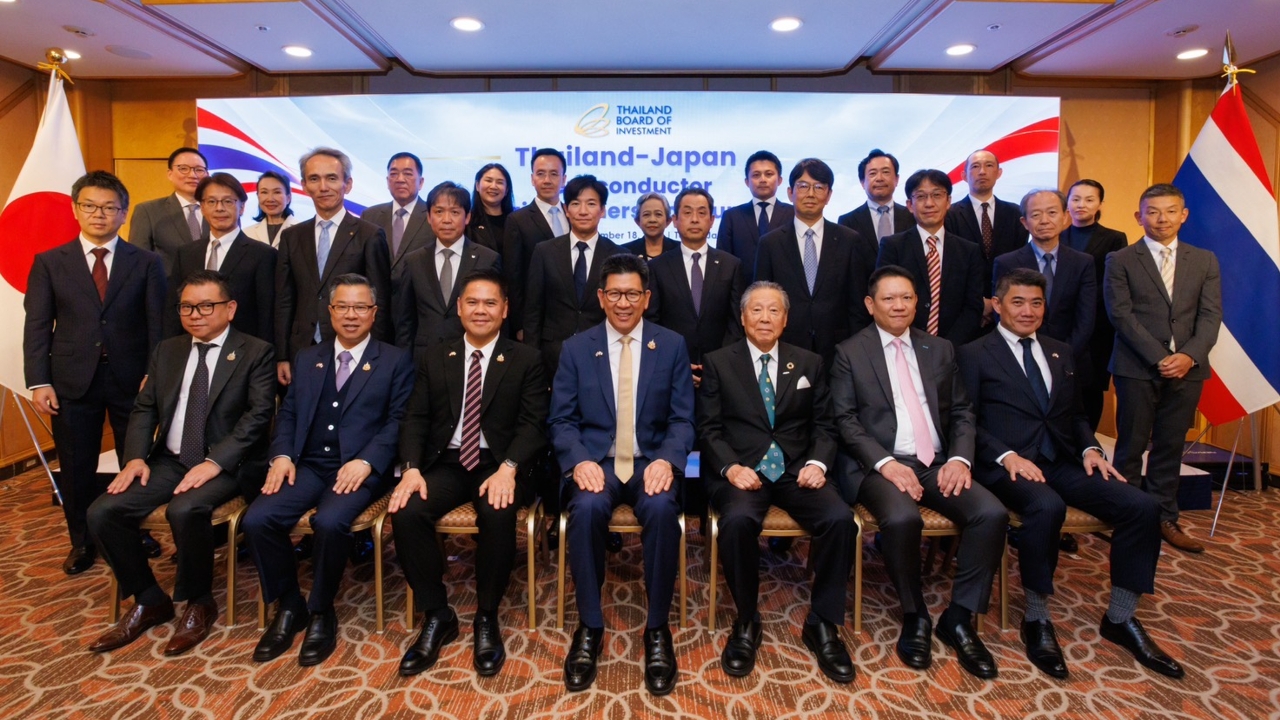
On 18 November, the Thailand-Japan Semiconductor Strategic Partnership Roundtable Meeting was held to negotiate in the semiconductor strategic industry, a key spearhead for technological transition. Eleven Japanese companies participated. Mr. Akniti stated Thailand emphasizes three specific niche markets where it already holds global strength: photonics, or data transmission technology via light with the world’s top three producers based in Thailand; power units, the intelligent systems managing battery electrical and thermal energy; and sensors for medical devices and autonomous vehicles. Japan was invited to collaborate in further developing these sectors.
"The government chooses to drive the country’s growth through investment, likened to planting a tree that requires time to establish strong roots for sustainable long-term stability, rather than borrowing future funds to stimulate short-term consumption that quickly fades. Actual investment in GDP grew by 16% in Q3, yet Thailand still faces a K-Shape economy where new industries thrive while traditional labor and businesses lag behind. The government is accelerating workforce skill development to lift the lower economic segment to meet the upper, forming a sustainable V-Shape growth together."
Mr. Narut Therdsteerasak, Secretary-General of the Board of Investment (BOI), disclosed that meetings were held with Japan’s three major financial institutions: Mitsubishi UFJ Financial Group (MUFG), Sumitomo Mitsui Banking Corporation (SMBC), and Mizuho Financial Group. The discussions focused on financial support and facilitating business matching between Japanese companies and Thai entrepreneurs. Japanese investment in Thailand last year reached over 110 billion baht, the highest in 10 years, with promotion requests totaling 45 billion baht in the first nine months of this year.
Currently, Japanese investment in Thailand focuses on three main areas: 1. Upgrading existing production bases to automated, digital, and energy-saving technologies, including research and development; 2. Expanding into new economies, particularly electric motor-driven vehicles (xEVs), components for data centers, and advanced semiconductors, with leading Japanese companies such as Toshiba, Sony, ROHM Integrated, Nichicon, and Fujikura already having midstream production in Thailand. The BOI encourages expansion upstream, such as integrated circuit design and wafer manufacturing; 3. Deepening collaboration through advanced personnel development in AI and electronic components to upgrade Thailand’s existing supply chains into future-oriented supply chains together.