

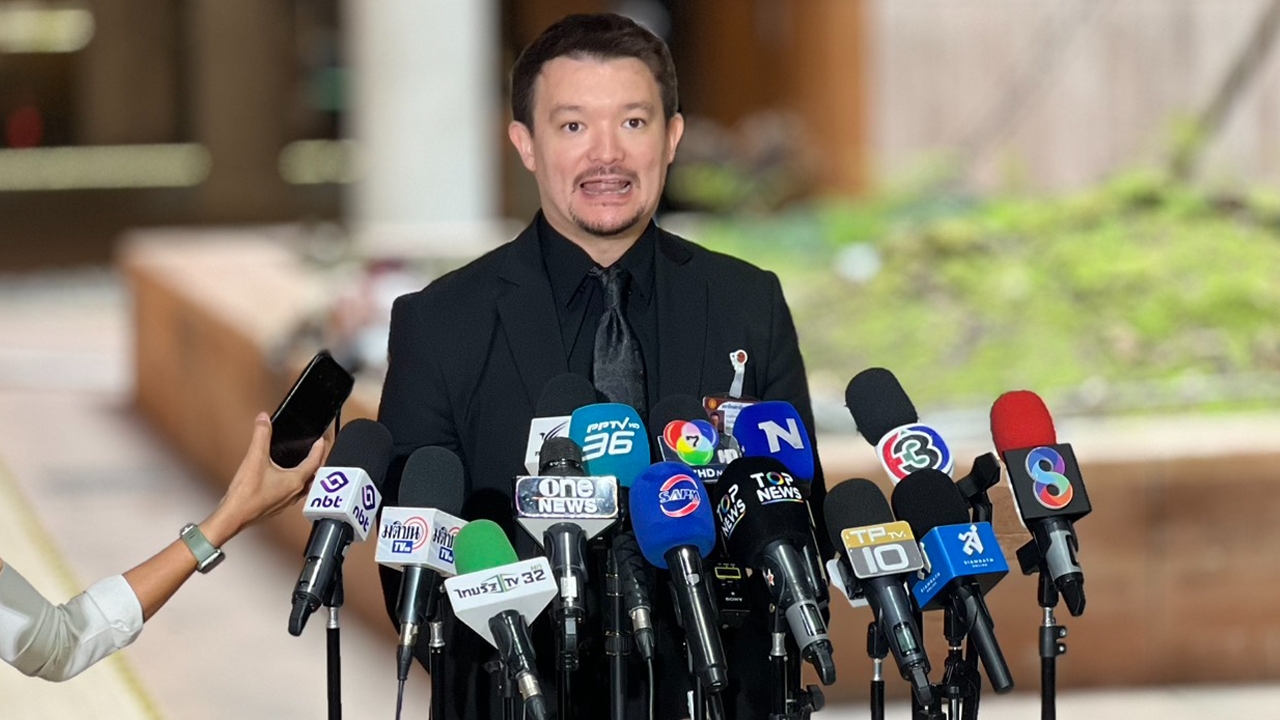
Patrapong urged the government to resolve the cross-border toxic water problem, criticizing Thailand for failure and lack of progress, while Myanmar and China have already advanced negotiations.
On 18 Nov 2026, Patrapong Lee Laput, Chiang Mai MP of the Prachachon Party, serving as chair of the House Committee on Disaster Prevention and Mitigation and subcommittee chair studying cross-border water pollution, said after a meeting that it is clear the government has neglected the issues of haze, PM2.5 dust, and cross-border toxic water, allowing these problems to worsen and impact citizens without seriously addressing their root causes. This delay is reflected in last week’s meeting between Thailand’s Foreign Minister and Myanmar, which only resulted in moving the Joint Working Group (JWG) meeting date from 30 November to 25 November, with no trade measures or controls on mineral or chemical imports and exports. Meanwhile, Myanmar has already held internal meetings, but Thailand has yet to prepare for joint discussions.
Patrapong added that during recent talks between the Chinese and Thai Prime Ministers, the toxic water issue was addressed only through a draft Memorandum of Understanding (MOU) supporting inspection equipment collaboration between Chinese research institutes and Mae Fah Luang University, which remains unsigned. This clearly shows government neglect in tackling the root cause. If the root problem is not solved, the impact on the people will inevitably be severe.
Patrapong noted a positive development in Chiang Rai’s agricultural response plan, which is to be presented to the Permanent Secretary of the Ministry of Agriculture and Cooperatives on 19 November. It divides risk zones by proximity to water—within 200 meters and 500 meters—and the subcommittee recommended including areas flooded with residual mud in 2024, riverbank zones along the Mekong, and uncontaminated control areas. The Ministry of Agriculture and Cooperatives will submit this plan to the subcommittee for review.
Regarding domestic disaster zone declarations, Patrapong said he has followed this issue since last year. Chiang Rai province explained there are no criteria for such declarations and impact assessments are needed. He proposed that the Pollution Control Department (PCD) set criteria for provinces to use in declaring disaster zones. However, the Department of Disaster Prevention and Mitigation has been waiting for over a year for a letter from the PCD, which now plans to hold a meeting on 19 November. The subcommittee will closely monitor progress.
On long-term solutions, Patrapong said plans remain vague but praised Chiang Rai province for clear contingency preparations in case the Provincial Waterworks Authority’s Mae Sai branch water becomes unusable. This includes preparations for drinking water and a five-year health response plan by the Department of Disease Control, while other agencies have yet to demonstrate clarity.
Patrapong proposed that for the joint meeting with Myanmar on 25-26 November, the Thai government host it in Mae Sai district, Chiang Rai, instead of a hotel in Bangkok, so both sides can see the local impacts firsthand. He urged demands for Myanmar to establish comprehensive checkpoints covering all mining areas, some of which lie outside the Wa region. He also emphasized that the Ministry of Natural Resources and Environment must present complete information before negotiations, warning that without full data, Thailand will gain no benefit from the talks.