

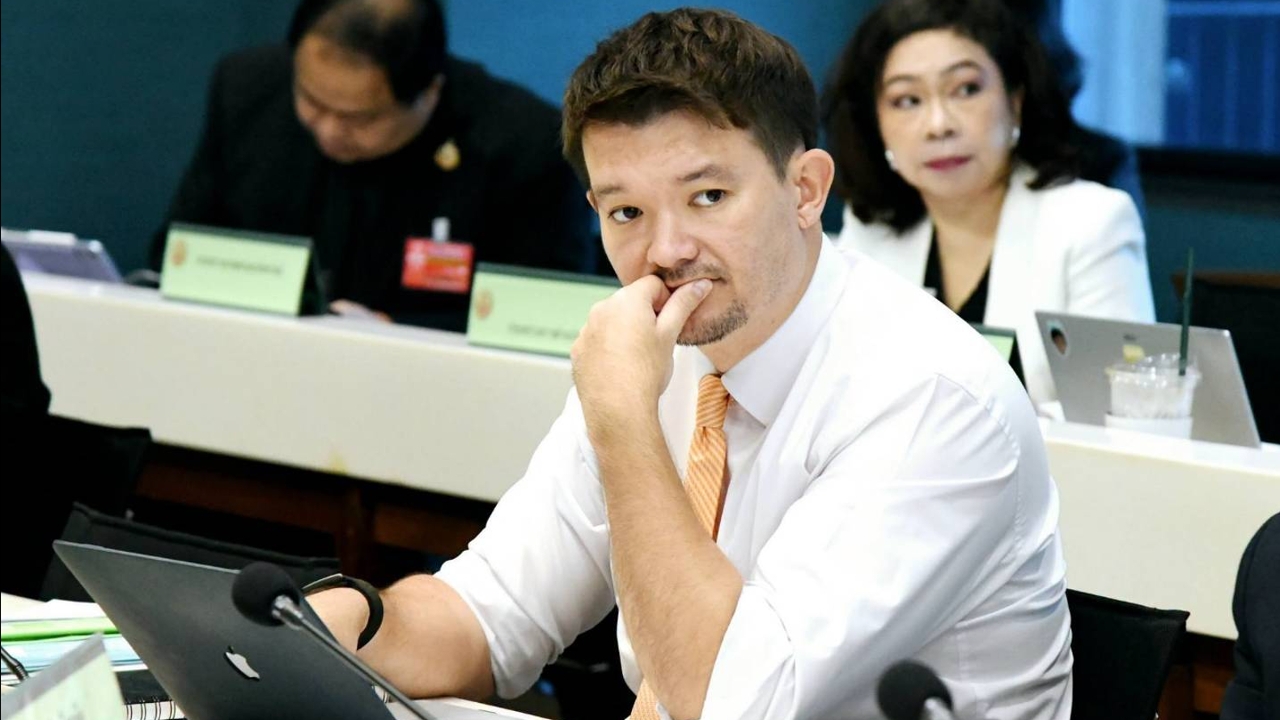
Patthapong revealed that the subcommittee established to address water toxicity issues has never convened a meeting in over a year, reflecting the government's idle mechanism working carelessly and ineffectively.
On 18 Nov 2026, Mr. Patthapong Lilaphat, MP for Chiang Mai from the Prachachon Party, spoke about progress in resolving cross-border water pollution from neighboring countries' mining operations. This has severely affected the Kok-Sai-Ruak river basins in Chiang Rai and northern Thailand. He disclosed seven officially confirmed facts from government agencies for the public to consider the government's failure and inefficiency in protecting water sources and Thai lives.
First, during discussions between Thailand's Foreign Minister and Myanmar's military leader Min Aung Hlaing on 12 Nov, there was a push to move the Thailand-Myanmar Joint Working Group meeting forward from 30 Nov to 25 Nov. However, the Thai side has not held an internal meeting, so as of now, Thailand’s proposals and positions for the 25 Nov negotiations remain unclear, while Myanmar's government has already held preparatory meetings.
Second, in the 14 Nov talks between the Thai and Chinese prime ministers regarding transboundary water issues, only a draft Memorandum of Understanding (MOU) to support water quality monitoring between Chinese research institutes and Mae Fah Luang University was prepared. However, no signing occurred because both sides disagreed on key content and terms.
Third, the Ministry of Foreign Affairs confirmed that in prior bilateral negotiations, trade measures, controls on mineral imports and exports, and restrictions on chemicals used in mining were never raised with Myanmar or China. Furthermore, there has been no follow-up on the People's Party’s proposal for China to enforce its environmental laws on Chinese investors mining in Myanmar.
Fourth, regarding the emergency disaster zone declaration, which has been requested since 2025 to allow use of emergency funds for urgent relief of affected citizens, the Department of Disaster Prevention and Mitigation (DDPM) is still awaiting a response on declaration criteria from the Pollution Control Department (PCD), reflecting severe bureaucratic delays.
Fifth, demands from Chiang Rai province and local communities to establish a laboratory for analyzing toxic residues in water, soil, agricultural products, and related chemicals have been made since 2025. However, Chiang Rai recently reported that the central government cut all budget requests for this laboratory.
Sixth, under the leadership of Anutin Charnvirakul, the government appointed a special subcommittee on 31 Oct 2025 to address this issue. Yet, this subcommittee has never convened a meeting in over a year. Meanwhile, the monitoring working group under this subcommittee last met in April 2026 and is only scheduled to meet again tomorrow (19 Nov) after more than seven months of inactivity.
Seventh, the international negotiation working group responsible for direct talks with pollution source countries has never convened a meeting since its appointment.
Patthapong concluded that these seven confirmed facts from government agencies reveal a state of 'neutral gear' and severe governmental neglect. He questioned the government and Thai society: with the toxic contamination crisis threatening health, environment, and the economy daily in northern Thailand, how can this national crisis be resolved when state mechanisms operate carelessly, appointed committees never meet, and international diplomacy lacks effectiveness in protecting national interests? He warned that the country cannot overcome this crisis under such governance.