

The House of Representatives rejected the "major reform" Social Security Act draft by the People's Party but approved the principle of the "minor amendment" draft by Sahaswat. Meanwhile, "Ice Rakchanok" posted an apology for failing to advance the bill.
At 19:10 on 18 Nov 2026 GMT+7, after members completed debate on all five Social Security Act drafts, the assembly voted to approve in principle four drafts: the Cabinet's draft, Sahaswat Khumkhong's draft (MP for Chonburi, People's Party), Thongtham Vechayachai's draft (party-list MP, Pheu Thai Party), and Thanaporn Wichan's draft (party-list MP, People's Party). The assembly rejected the draft by Ms. Rakchanok Srinok (party-list MP, People's Party) and chose the Cabinet's draft as the main bill for the second reading.
The People's Party posted on their page and Facebook that although the House just approved in principle the "minor amendment" Social Security Act drafts by Sahaswat Khumkhong (which adjusts fund management structure and governance) and Thanaporn Wichan (which links maternity leave benefits with labor law), alongside the Cabinet's draft and coalition parties, the House decided to adopt the Cabinet's draft as the principal bill for consideration.
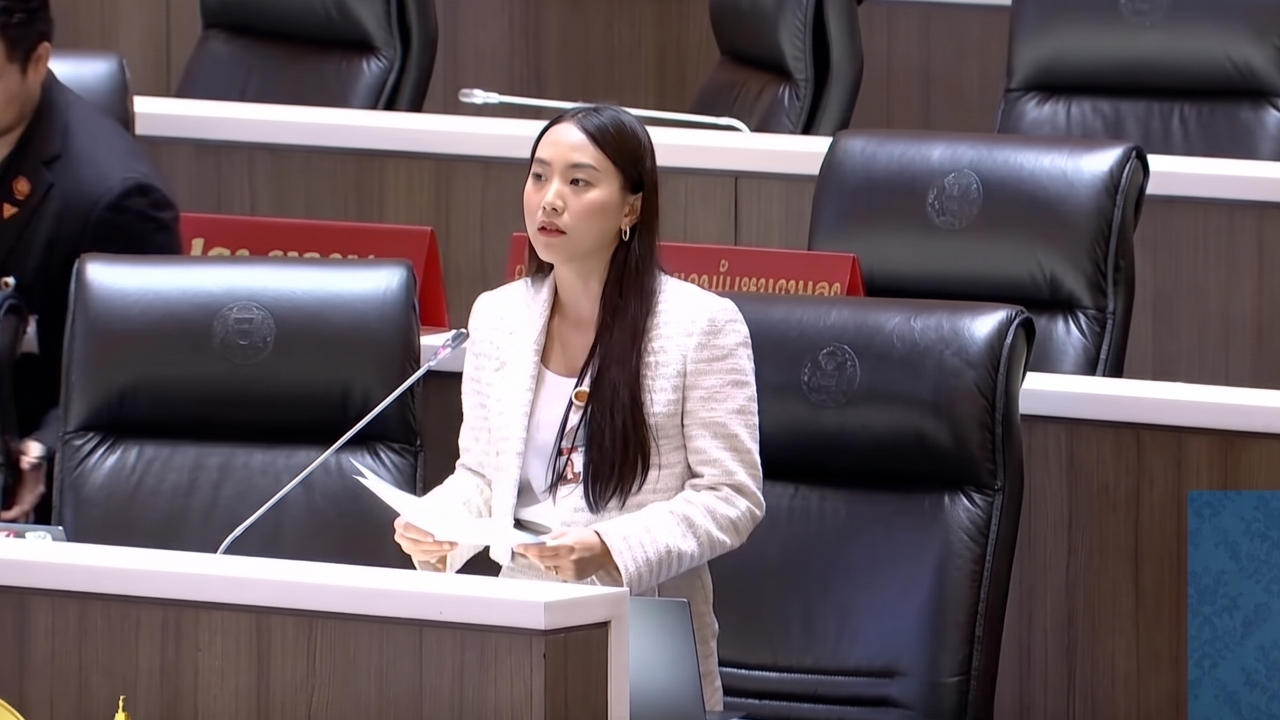
What is most disappointing and raises questions is that the House majority voted to "defeat" the Social Security Act draft by Rakchanok Srinok, the People's Party's "major reform" version aimed at overhauling the entire social security fund structure.
Looking back to election campaigning, all political parties had promised the public to seriously "reform social security," to prevent ongoing problems of opacity and inefficient management.
The People's Party page also noted that government leaders such as Prime Minister Anutin Charnvirakul and coalition partners like Pheu Thai had agreed during debates and campaigns that it is time to reform the social security fund, manage it professionally, and restructure it for efficiency, transparency, and accountability like the Government Pension Fund (GPF), to rescue the fund's crisis and maximize returns for workers.
Since the civil servants' savings are professionally managed with expert committees and transparent investment disclosures, the over 3 trillion baht belonging to insured workers, the country's largest fund, deserves the same professional management standards. Among all social security bills presented to the House today, Rakchanok's "major reform" draft proposed the most comprehensive fund structure reforms, such as:
1. Restructuring the organization to a professional entity like the GPF by making the fund a legal entity, enabling financial and investment experts to manage the 3 trillion baht fund flexibly to generate returns and manage risks systematically.
2. Returning power to contributors by mandating that the board, elected by insured persons and employers, selects and contracts the chief executive officer (Social Security Office Secretary-General) based on ability and accountability to the fund owners.
3. Updating benefit structures to reflect modern realities by defining insured categories as “with employer” and “without employer” to include freelancers and platform riders, and allowing the board to adjust seven types of benefits immediately according to economic conditions without waiting for major legislative amendments.
These proposals are the core of elevating the social security fund to professional management as promised by all parties during campaigns. However, when it came time to act, this draft was the only one voted down by government MPs at the first reading, while the Cabinet's draft accepted as the main bill lacks sufficient reform commitments.
The statement further asks, “The big question workers must ask the government and coalition parties is: where did the promise to reform social security with professional management go?”
“Or were those promises mere rhetoric to win votes, but once in power, they chose to freeze the 3 trillion baht fund under the old structure and political interests?”
The People's Party affirmed it will continue vigorously fighting in the special committee to reintroduce key principles of fund structure reform—transparency, reduced administrative costs, and protection of workers’ benefits—because this fund represents the hard-earned savings and future of all workers, not just civil servants or politicians.
Meanwhile, Ms. Rakchanok Srinok shared the People's Party's post and wrote, “Sorry for not succeeding.”