

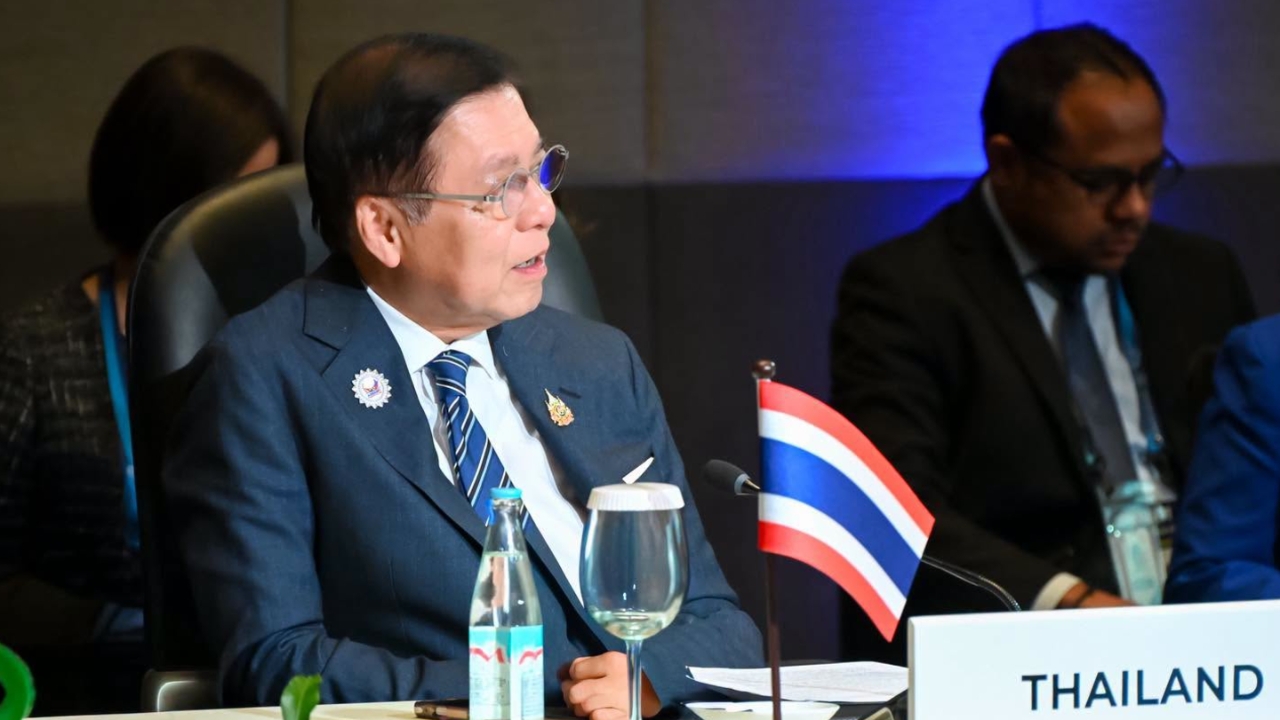
The Foreign Ministry clarifies the interview with Sihasak, stressing that the opening of the Thai-US trade market follows a negotiation framework that considers Thai farmers, not an unrestricted free trade approach. It also explains that the US advanced chip control measures do not affect legitimate operators.
On 19 Nov 2026 GMT+7, Ms. Jaitai Upakarnitikaset, Director-General of the Information Department and spokesperson for the Ministry of Foreign Affairs, addressed media inquiries regarding Deputy Prime Minister and Foreign Minister Sihasak Puangketkaew's interview with Bloomberg on 17 Nov 2026 GMT+7. The topics included the signing of the joint statement on the Agreement on Reciprocal Trade (ART) between Thailand and the US, market opening, and the US temporary measures to prevent leakage of advanced chips.
The Foreign Ministry spokesperson explained that the market opening issue mentioned by Mr. Sihasak was a response to a specific question from the interviewer. He cited agricultural products important to both countries, currently under negotiation to reach mutually acceptable conclusions. Market opening must follow the agreed product lists and conditions by both parties, not unrestricted free trade, with the government prioritizing the impact on farmers, producers, and domestic operators.
Regarding the signing of the joint statement, it signifies that Thailand and the US have reached key conclusions in negotiations, marking important progress in protecting Thailand's economic interests and competitiveness, as the US is Thailand's top export market. According to the Ministry of Commerce, in 2025 Thailand's exports to the US reached 2.37 trillion baht, supporting over 1.25 million domestic jobs. However, the ART draft must still undergo internal procedures, including legal review, stakeholder consultation, public understanding efforts, and cabinet and parliamentary consideration according to legal steps.
On the issue of the US temporary measures to prevent leakage of advanced chips and their impact on Thailand's goal of becoming a data center hub, Mr. Sihasak clarified in the interview that these measures are not specifically aimed at Thailand. Although there may be some practical effects, they help build confidence that Thai data centers use chips properly and appropriately. The Thai side will continue discussions with the US on this matter.
The Foreign Ministry spokesperson added that the US measures are temporary and require prior licensing for advanced chip exports to countries under these controls, except for exports to US-based or US-headquartered companies. Initial discussions with the US indicate these measures do not target legitimate operators but aim to block illicit exports and unauthorized access to advanced chips. Currently, Thailand regulates data center investments following the guidelines of the Data Center Business Policy Committee to maximize benefits from the country's digital infrastructure investments.