

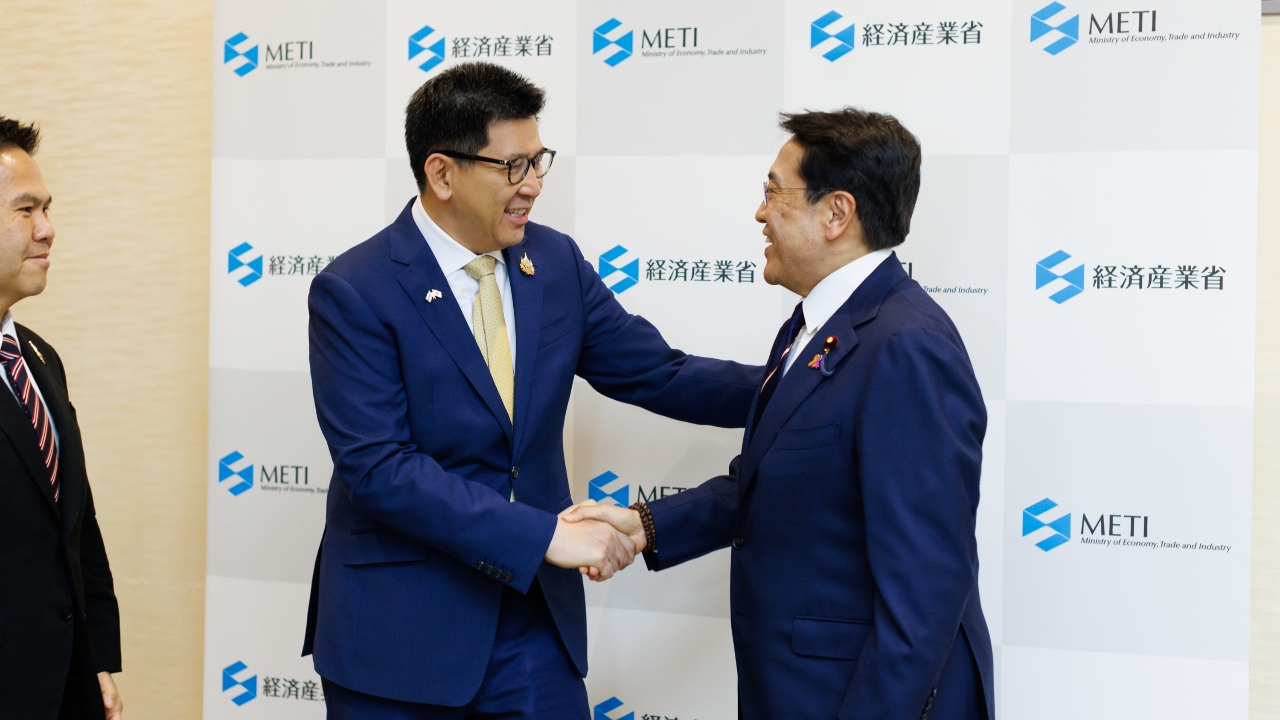
"Akaniti" met with METI and JETRO in Tokyo to spark a new wave of investment. Japan proposed tax measures to support manufacturers using parts made in Thailand, alongside policies encouraging the replacement of old vehicles with new ones, while aiming to develop the automotive base into satellite and AI industries.
On 19 Nov 2026 GMT+7, Narit Therdsteerasak, Secretary-General of the Board of Investment (BOI), revealed that Deputy Prime Minister and Finance Minister Akaniti Nitithanprapas, together with Warawut Silpa-archa, Minister of Industry, and their delegation, held talks with Ryose Akazawa, Japan's Minister of Economy, Trade and Industry (METI), and Norihiko Ishiguro, President and CEO of the Japan External Trade Organization (JETRO), in Tokyo, Japan. The discussions aimed to expand investment and industrial cooperation between Thailand and Japan and to encourage Japanese companies to upgrade their production bases in Thailand.


METI welcomes four key cooperation areas.
In talks with METI Minister Ryose Akazawa, who directs and coordinates Japanese government support measures, both sides reaffirmed their long-standing partnership in developing Thailand's industries. The Japanese side proposed tax incentives to support investors who genuinely produce and use parts in Thailand. Meanwhile, Deputy Prime Minister Akaniti emphasized prioritizing investors who build domestic supply chains. Key cooperation points included:
1. Strengthening the automotive supply chain and workforce development. The Deputy Prime Minister encouraged Japanese companies to increase connections with Thai parts manufacturers and SMEs to engage in new production bases and supply chains, while upgrading worker skills to support industry transition. Japan suggested Thailand consider measures to promote replacing old vehicles with new ones and to consult automakers in designing effective policies.
2. Cooperation on biofuels and circular economy. Both sides agreed to jointly develop biofuels that support the automotive industry, agriculture, and energy security, alongside waste management and recycling of vehicles, parts, and batteries. Japan mentioned trials of biofuels by Japanese automakers, knowledge exchange on circular economy, and collaboration with JICA to develop end-of-life vehicle management systems.
3. Expanding the automotive industry base into space and quantum technology. Japan proposed leveraging Thailand's strengths in precision engineering and parts manufacturing as a base to enter the satellite supply chain. Additionally, Japan offered cooperation on Optical Quantum Computing and developing a quantum industry ecosystem in Thailand.
4. Cooperation in AI, semiconductors, and carbon credit markets. Japan proposed using bilateral economic and industrial dialogue mechanisms to align industrial, tax, and investment policies to accelerate concrete cooperation ahead of the leaders' meeting marking the 140th anniversary of Thai-Japanese diplomatic relations in 2027.
JETRO connects Japanese investor networks.
In discussions with JETRO, a key organization supporting Japanese companies doing business and investing abroad, Thailand proposed building on the long-developed automotive production base and supply chains to advance into future automotive parts, semiconductors and advanced electronics, medical and health industries, space industry, clean energy, as well as high-value research and development activities.

JETRO emphasized that Thailand remains a crucial investment base for Japanese companies and has potential to accommodate regional consolidation and restructuring of production bases into Thailand. JETRO is ready to communicate Thailand's potential and support measures to headquarters and Japanese investor networks worldwide, listen to business needs, and link Japanese companies with government agencies, educational institutions, and Thai entrepreneurs. Meanwhile, upgrading productivity, technology, workforce skills, and business environment will be key to maintaining existing investments and attracting new high-value projects amid competition from other ASEAN countries. Based on this cooperation, Thailand invited Japanese firms to expand investment in target industries and use Thailand as a production base for export to global markets. Both sides will jointly maintain the strength of existing industrial bases while creating new supply chains to drive Thai-Japanese cooperation toward a new wave of economic growth, or "Second Take-Off." The BOI is ready to work with both agencies to turn Thailand's potential into real investment projects and create opportunities for Japanese companies and Thai entrepreneurs to jointly develop technology, personnel, and supply chains under the "Made with Thailand" concept.

