

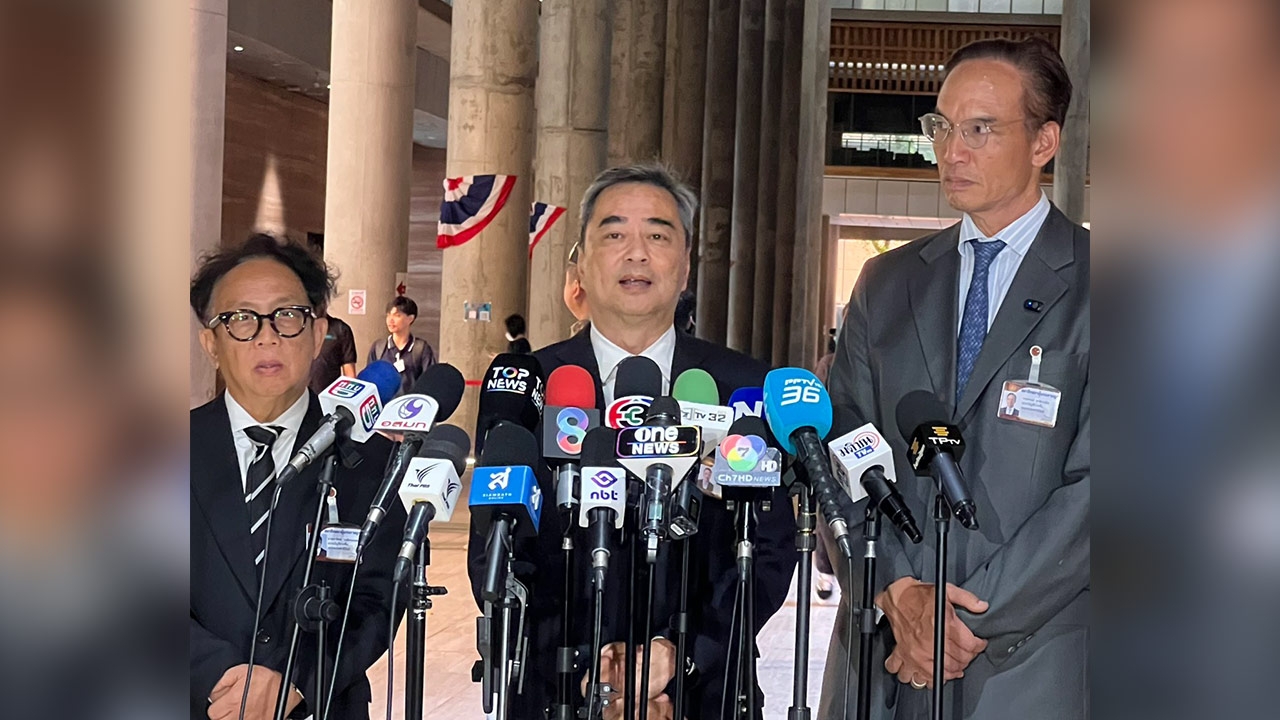
Abhisit urges Anutin's government to clarify the terms of the reciprocal trade agreement signed with Trump, fearing Thailand could suffer major disadvantages after having to open its agricultural market worth 78 billion baht, reduce import taxes to zero, and suspend digital tax collection.
On 19 Nov 2026 GMT+7, Abhisit Vejjajiva, leader of the Democrat Party, commented on the joint statement on the Reciprocal Trade Agreement (ART) signed by Prime Minister Anutin Charnvirakul and U.S. President Donald Trump on the sidelines of the 49th ASEAN Summit in Manila, Philippines. After following this issue, he expressed concern about potential impacts from trade negotiations between Thailand and the U.S., noting that President Trump clearly stated the benefits the U.S. would gain from the agreement.
Abhisit questioned whether the content announced by the U.S. president has been officially accepted by the Thai government, as the Thai side has only described it as signing a broad cooperation framework. He asked why the Thai prime minister, who was present with the U.S. president, did not clarify or challenge any details that might negatively affect Thailand.
Among concerns is the opening of the Thai market to U.S. imports by reducing customs tariffs to zero without clarifying if any product categories would be exempt. This includes opening the agricultural market valued at about 2.6 billion U.S. dollars annually, approximately 78 billion baht, covering products like chicken, pork, corn, and soybeans, which could directly compete with Thai farmers’ produce.
Another issue is accepting U.S. product standards, especially for pork, where Thailand previously enforced health-related controls, as well as standards in public health, pharmaceuticals, and medical devices. If Thailand must accept only U.S.-recognized standards, it could undermine Thailand’s consumer protection and inspection systems.
There is also concern about opening markets for technology industries and digital services, including conditions that Thailand may have to forgo collecting taxes from digital service businesses. Abhisit views this as an economic benefit that Thailand might lose.
Abhisit questioned the benefits Thailand will receive in return, noting that the government only mentions a reduction of U.S. import tariffs on Thai goods from 12.5% to 10%, a mere 2.5 percentage point decrease, without clear details on how the U.S. will allow increased Thai market access or any changes to import rules and conditions.
He also questioned the certainty and sustainability of the tariff reductions, especially since the previously mentioned 19% tariff was canceled by a U.S. court ruling. He urged the government to clarify how much additional tax burden Thailand would face if it does not quickly reach an agreement or refuses to open its market as requested by the U.S.
Another concern is the compensation mechanism for those affected by trade liberalization, particularly the FTA fund, which has a total of no more than 5 billion baht, with about 500 million baht in the Agriculture Ministry’s share. Given that the value of U.S. agricultural products potentially competing in Thailand reaches about 78 billion baht per year, he questioned whether the existing compensation funds are sufficient to cover the expected impacts.
Abhisit warned that this decision impacts not only Thailand-U.S. trade relations but could also affect negotiations with other trading partners, especially China and the European Union, which might use the conditions Thailand accepted with the U.S. as a benchmark to demand additional benefits from Thailand.
He called on the government to transparently disclose details and its stance in negotiations, and to clearly explain to the public what tangible benefits Thailand gains, rather than allowing the U.S. side to be the only party announcing the benefits it receives.
He emphasized that if Thailand ultimately has to exchange opening its agricultural markets, accepting product standards, and losing digital service tax revenue for only a 2.5 percentage point export tariff reduction to the U.S., the government must answer whether this trade-off is worthwhile, since Thai farmers may bear the greatest impact.
Abhisit concluded by questioning if these negotiations require significant sacrifices from Thai people, especially farmers, then the government must clearly answer what Thailand is sacrificing in exchange.