

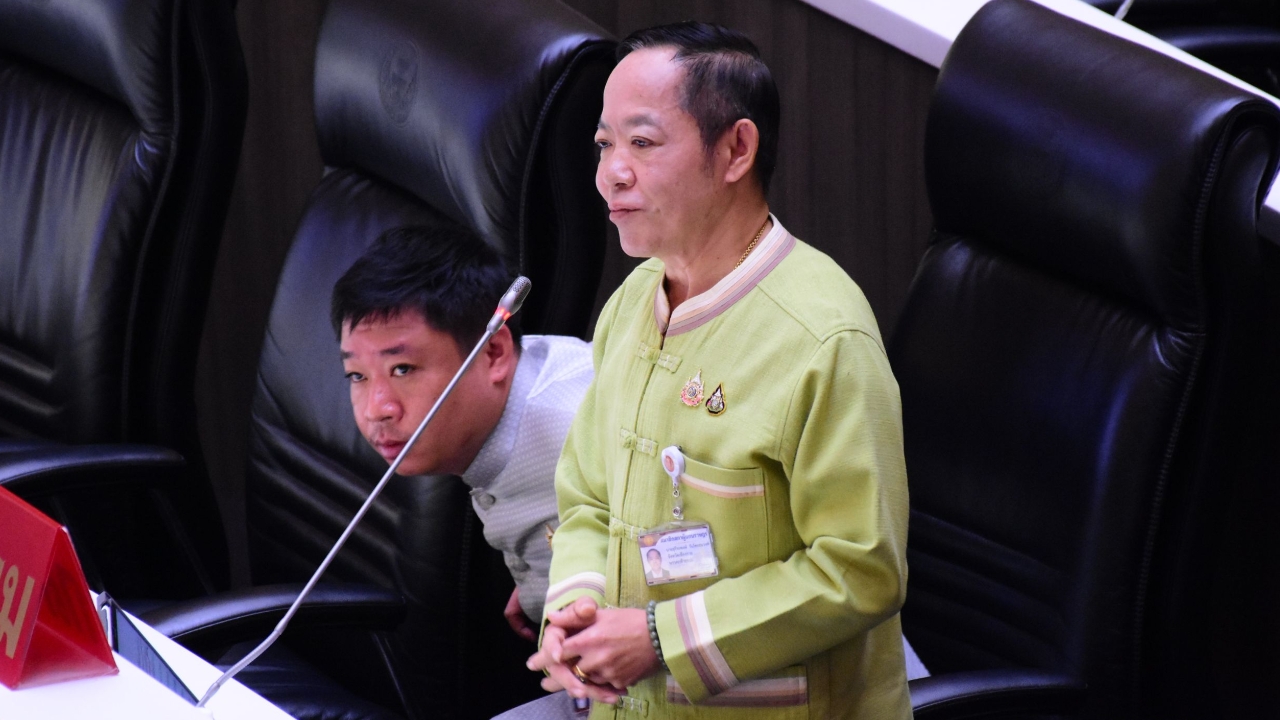
Sutheeraphong, Chiang Rai MP from the Kla Tham Party, urges the government to urgently resolve the river contamination crisis. Meanwhile, Minister Suchart is preparing to discuss with Myanmar on 25-26 Nov and explains the government's plan to designate the Kok, Sai, and Ruak rivers as pollution control zones.
On 19 Nov 2026, Mr. Sutheeraphong Wanchai Thanawong, Chiang Rai MP from the Kla Tham Party, raised a live question in the House of Representatives, urging the government to swiftly address the contamination crisis in the Sai, Ruak, Kok, and Mekong rivers caused by mining operations in neighboring countries. This has impacted the health, economy, and livelihoods of local residents. He posed three key questions demanding the government tackle the root cause, secure clean water sources, and restore water quality to ensure safe consumption for the people.
Mr. Sutheeraphong said that currently, more than 20 mining operations in neighboring countries continue to pose risks of chemical and heavy metal contamination in natural water sources. This affects agriculture, fisheries, and water production, especially in the Kok River, which supplies raw water to over one million people. Abnormalities in aquatic animals have also been observed, including smaller sizes and unusual wounds.

At the same time, the impact has spread to agriculture, with farmers in Mae Chan district suffering from rice prices suppressed to only 7 baht per kilogram due to contamination concerns, although official test results are not yet available. Farmers along the Mekong River in Chiang Khong district also face risks of having their products rejected due to arsenic concerns in the soil.
Additionally, groundwater tests in Ban Kaen, Huai So subdistrict, Chiang Khong district, revealed arsenic levels 40 times above the standard, prompting warnings for residents to avoid drinking and using the water for cooking. This shows the crisis severely threatens daily life safety.
Mr. Sutheeraphong raised three questions to the government: 1. What measures will be taken to coordinate with neighboring countries to stop or suspend upstream mining operations affecting Thailand? 2. How will clean water sources be secured for consumption and agriculture across all areas, and within what timeframe? 3. What measures will be implemented to restore surface water, groundwater, and water supply systems to control contaminant levels to safe standards?

Minister of Natural Resources and Environment Suchart Chomklin responded on behalf of the Prime Minister that the ministry divides work into two areas: internationally, Deputy Prime Minister and Foreign Minister Sihasak Puangketkaew coordinates with Myanmar and Shan State to hold an operations committee meeting on 25-26 Nov in Thailand. The Thai side will request access to inspect sites and establish sediment trap points on the mining side. Locals oppose sediment traps in Thailand fearing sediment dispersal during floods. The government plans to secure alternative water sources by drilling 10 groundwater wells and surveying additional large groundwater sources. The Pollution Control Department will test aquatic animal quality twice monthly and report results to relevant agencies to inform the public about consumption safety. The Ministry of Agriculture will inspect soil for residue clarity. The Prime Minister prioritizes resolving contamination issues in Chiang Rai's rivers with centralized management. Deputy Prime Minister Yossanan Wongsawat, overseeing the northern region, is actively addressing the problem. Initially, the government will declare pollution control zones around the Kok, Sai, and Ruak rivers to expedite solutions. Stronger measures are under discussion with relevant agencies, and the Ministry plans to propose a new environmental law to the parliament to empower the minister with enforcement authority and improved problem-solving capabilities.
