

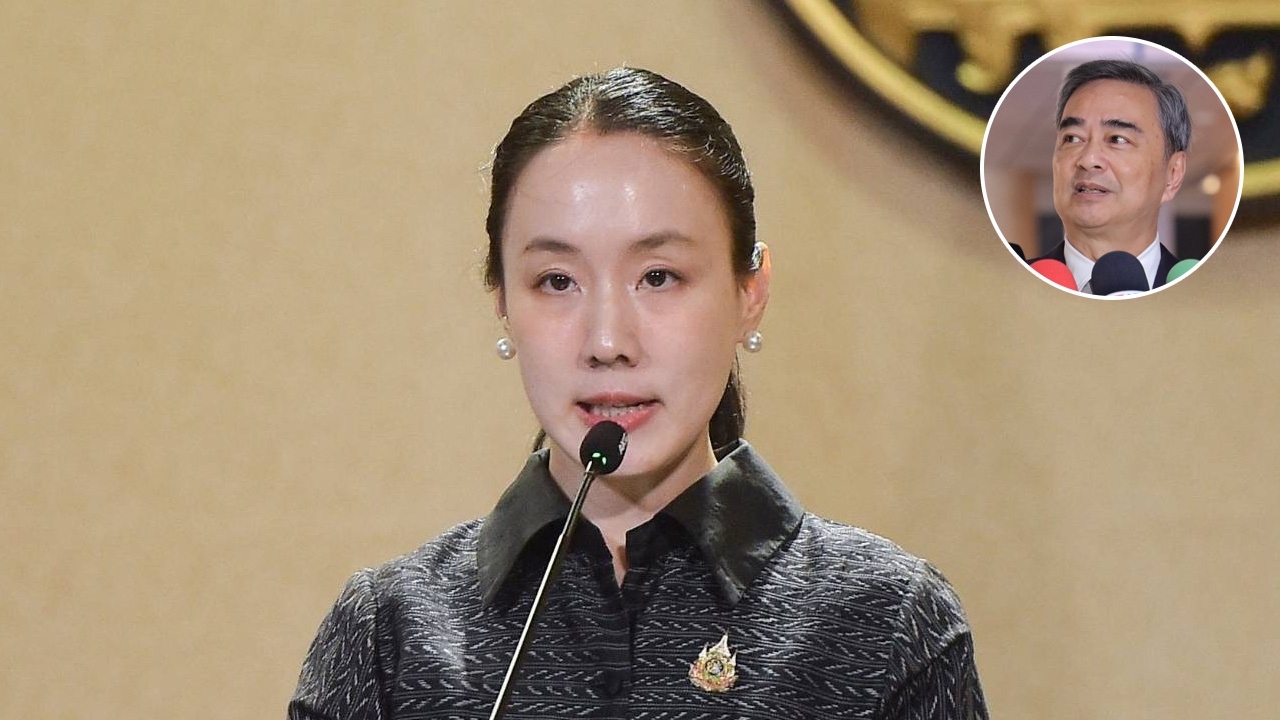
The Deputy Government Spokesperson explained the US trade negotiation issue, highlighting that the figures mentioned by President Trump have been publicly disclosed since 2025 and are not part of a new deal. She questioned former Prime Minister Abhisit on whether he was truly unaware and cautioned against focusing only on imports while neglecting Thailand’s export markets.
On 20 November 2026, Ms. Lalida Pertwivatana, Deputy Spokesperson of the Prime Minister’s Office, addressed former Prime Minister Abhisit Vejjajiva’s criticism of trade negotiations between Thailand and the United States. She said the government welcomes concerns but insists critiques should be based on complete information, especially separating the Framework Agreement under negotiation and disclosed since 2025 from the ART trade agreement, which is still in procedural stages.
“The figures President Trump mentioned, regarding purchases and market access, are not from a newly reached agreement on 17 November but are elements already present in the original negotiation framework and publicly disclosed. It’s surprising that Mr. Abhisit, a former Prime Minister, is unaware of this or that his party’s economic team failed to fully verify the facts before criticizing,” Ms. Lalida said.
The Deputy Spokesperson clarified that the purchase figures from the US reflect private sector plans subject to business conditions, not government budget purchases or forced acquisitions. Market opening offers more options for businesses and consumers, especially for goods Thailand cannot produce sufficiently and must import. Having multiple import sources helps manage costs and reduce supply chain risks amid climate and geopolitical volatility.
“Market opening does not mean forced purchasing. Businesses remain free to choose from which country, at what price and terms. More choices are better than restrictions. I want to ask Mr. Abhisit whether he wants Thai businesses to have more options or to close them off, risking higher production costs,” Ms. Lalida said.
Ms. Lalida emphasized that the Joint Statement signed by Prime Minister Anutin Charnvirakul on 17 November confirms key ART negotiation points but is not a final binding agreement. Legal details and internal procedures of both countries still need to be developed, unlike the previously disclosed framework agreement. Some ART details remain under a non-disclosure agreement (NDA).
“The government is not hiding information but must comply with international negotiation rules. Once the NDA restrictions are lifted, the government will disclose details, seek public feedback, and follow parliamentary processes as required by law. Mr. Abhisit, as a former prime minister, surely understands that international agreements have steps. It is therefore puzzling why he mixes already disclosed information with incomplete agreements. Those interested can review ART examples already signed by other countries on the White House website,” Ms. Lalida said.
On the urgency of negotiations, the Deputy Spokesperson said Thailand must maintain competitiveness with countries that have ART agreements while the US still has tariff measures under other laws like Sections 301, 232, and 122, which pose risks to Thai exporters. Having an agreement helps clarify and reduce trade uncertainties, though it does not automatically exempt all tariffs. Some countries are still negotiating ART without success.
Ms. Lalida said that reducing tariffs from 12.5% to 10%, though a 2.5 percentage point difference, is significant for Thai exporters with low profit margins. Small tariff differences can determine orders when competing with other countries, especially if new tariffs arise, such as under Section 301 on Structural Excess Capacity.
“Mr. Abhisit may see 2.5 percentage points as minor, but for exporters, it could mean cutting profits to keep customers or losing orders to competitors. We are talking about Thailand’s export market to the US worth about 2.37 trillion baht annually, including investment confidence from domestic and foreign sources. Reduced competitiveness impacts not just exporters but also factories, investments, and Thai employment,” Ms. Lalida said.
Regarding concerns about agricultural products, the Deputy Spokesperson noted that the US is Thailand’s second-largest agricultural export market after China, worth over 170 billion baht yearly. The cited 80 billion baht worth of agricultural imports under criticism are within the previously negotiated framework, not automatically representing damage to Thai farmers. It is necessary to distinguish which products are essential raw materials Thailand must import, which compete with domestic production, and which require special protection.
“Mr. Abhisit worries about Thai farmers, which the government also prioritizes. But Thai farmers do not sell only domestically; Thailand exports over 170 billion baht of agricultural products annually to the US. Focusing only on 80 billion baht of imports without considering export income ignores one side of farmers’ interests. The government must support both farmers potentially affected by imports and those needing to maintain export markets,” Ms. Lalida said.
The Deputy Spokesperson confirmed that the government prioritizes sensitive agricultural products, considering protective measures by product alongside maintaining consumer safety standards. It does not allow all products to enter freely without conditions and must consider production chain security, business costs, and domestic investment opportunities.
“Respectfully to Mr. Abhisit, just because you do not know something does not mean it does not exist. Government scrutiny is good but should be based on complete publicly available information, clearly distinguishing what is already agreed, what is still in process, and what is not yet effective. If there are still doubts, the government is ready to explain because managing the country requires looking at the overall system benefits. It is not enough to question what is lost by opening markets; we must also consider what Thailand will lose if competitiveness is not maintained, such as export markets, investment, and job opportunities,” Ms. Lalida said.