

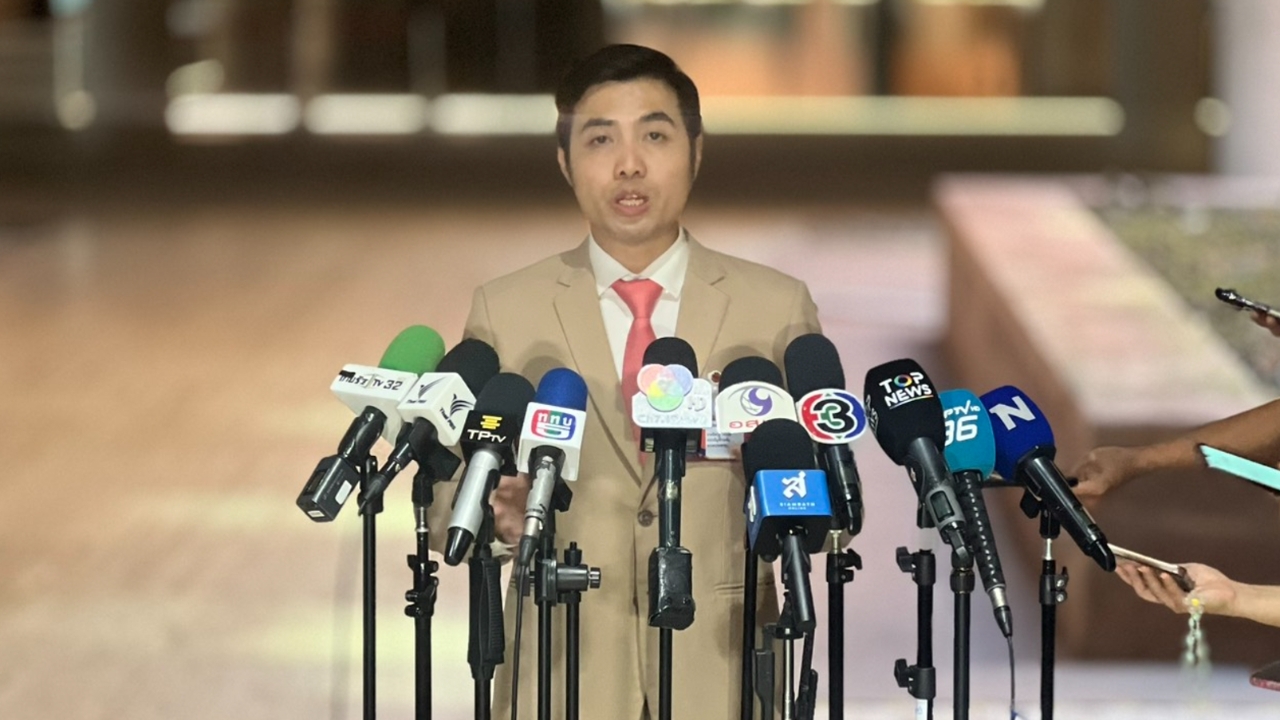
Toto Piyarat pointed out that the Gen Z group's protests are a fundamental right reflecting calls for the government to listen. He warned officials not to provoke or block the protests, fearing the situation could escalate, and stressed that the People's Party is not behind the demonstrations.
On 20 November 2026, Mr. Piyarat Jathep, party-list MP and Deputy Secretary-General of the People's Party, spoke about the Gen Z youth's political protest scheduled for that day (20 Nov). He said that it must be recognized that protest is a fundamental right of the people. When citizens have demands, they can exercise indirect power through the House of Representatives, which currently has active members. However, if the House cannot convey the people's voice to those in power, protesting directly is an exercise of power protected by the constitution and law.
Regarding whether the protest might escalate into violence or pressure the government to meet its demands, Mr. Piyarat said it is impossible to guarantee or predict the future direction or intensity of the protests or how far the demands will go. In principle, youth and all citizens have the right to demand what they want. The protesters have set clear hours from 3:00 to 7:00 p.m. and have legally notified authorities. Therefore, there should be no provocation or escalation, especially from state officials, as past experiences show that many escalations have been triggered by government agents stirring tensions.
Regarding the Gen Z youth's demand using the phrase "Get Out" directed at Prime Minister Anutin Charnvirakul, Mr. Piyarat said it is the people's right to call for the Prime Minister's resignation, and the Prime Minister should listen to the people's voice. Previously, the Prime Minister met with Kamnan Mano and heard demands publicly. Thus, now that citizens and youth are expressing their stance, the Prime Minister should show spirit by returning from the APEC meeting to encourage and listen to the youth's voices. If future protests occur near the Government House, he hopes the Prime Minister will also listen to their demands.
Regarding the coalition of three groups in this protest and whether it marks the start of a new political movement among young people leading to intensified protests like in 2020, Mr. Piyarat said that looking back at 2020, many saw youth as sparking the movement, but the initial spark came from lawyer Anon Nampha at Democracy Monument, discussing reform issues.
Whether this protest will similarly serve as a starting point or develop like the 2020 movement is unclear. However, monitoring trends and the situation, he sees that this gathering was not impulsive or just for fun but resulted from discussions and consensus. Therefore, it is not surprising if protests expand or future demonstrations are scheduled, especially if the government remains silent and unresponsive to youth demands.
When asked about concerns linking the People's Party to the protests, Mr. Piyarat said political parties and politicians should not view citizen protests as forbidden, shameful, or antagonistic to political parties. Ultimately, politicians must reduce pressure and resolve issues arising outside parliament by bringing citizens' demands into parliamentary discussion and proposals.
If citizens still have hope in parliament to push desired directions, outside demands will carry less weight or pressure. The key is how to make demands, advocacy, and oversight happen within parliament so that people see hope and then return to normal life. Today's protests may question why representatives' work does not meet people's expectations, causing them to protest on their own.
Regarding speculation that the People's Party might be behind the protests to pressure the government before the no-confidence debate in early December, Mr. Piyarat confirmed the party does not expect any protest group to be seen as fully orchestrated by it. The party focuses on parliamentary work, scrutinizing the government and advancing policies to communicate with the public. External movements are independent; the party monitors and listens to all demands to convey them through parliament to the government.
Asked if working outside parliament alongside opposition duties inside parliament is another way to pressure the government, Mr. Piyarat said the opposition must scrutinize the government. The direction may align with external movements, which is normal. Likewise, if the People's Party became government and citizens protested, it would not mean the opposition is behind those protests.
Protesters might use opposition information to present their case, or the opposition might bring citizens' external demands into parliament—this is a normal mechanism for checks and balances. Even if objectives or demands are similar, it does not imply organization or orchestration behind the scenes.
Regarding the government's response, particularly the Education Minister's advice to schools not to punish students participating in protests, Mr. Piyarat viewed this as a positive sign showing understanding of youth's right to protest, a lawful right. Prohibitions or government pressure could become triggers escalating the situation.
Regarding the National Police spokesperson's concern that youths might break the law and that parents encouraging or supporting such acts could be liable, Mr. Piyarat said it is a legal issue that can be clarified. However, officials must communicate carefully, as partial or selective information might cause misunderstandings that police are threatening youths or parents, which is undesirable.
He urged all police officers to remember that all protesters, regardless of generation, are citizens and that youth are like everyone's children. If they break the law or misunderstand it, officials can warn and advise them but should avoid intimidation, provocation, or challenges. When youths, especially teenagers, feel threatened or challenged, they may push harder and accelerate their demands.
Mr. Piyarat also emphasized that state officials have tools and mechanisms to handle protesters but no one can predict exactly what will happen if the situation escalates. Therefore, officials should avoid provoking or challenging protesters.
When asked about potential government measures to block protests, noting that temporary fences were installed around Democracy Monument for construction and improvement, Mr. Piyarat said he has communicated continuously with officials and, as a former protest leader, does not understand the rationale of some government agencies choosing to block areas.
He gave the example that when protests are scheduled at Democracy Monument, protesters standing on its base might be seen as a victory for them and a defeat for the government, prompting the erection of corrugated iron fences to enclose the area. He called this mindset strange, saying if he were in charge, he would open the area to let protesters stand or hold activities on the monument and take photos within the allotted time, then disperse to avoid traffic disruption.
If the government encloses the area preventing protesters from using the monument, they may stand on the street instead, affecting traffic and making management or control more difficult.
Mr. Piyarat concluded that sometimes government agencies do not understand how to handle protest groups, and blocking areas may lead protesters to see it as a challenge or competition between protesters and officials. Therefore, government agencies should shift their thinking to facilitate citizens' proper exercise of protest rights rather than focusing on area closures.