

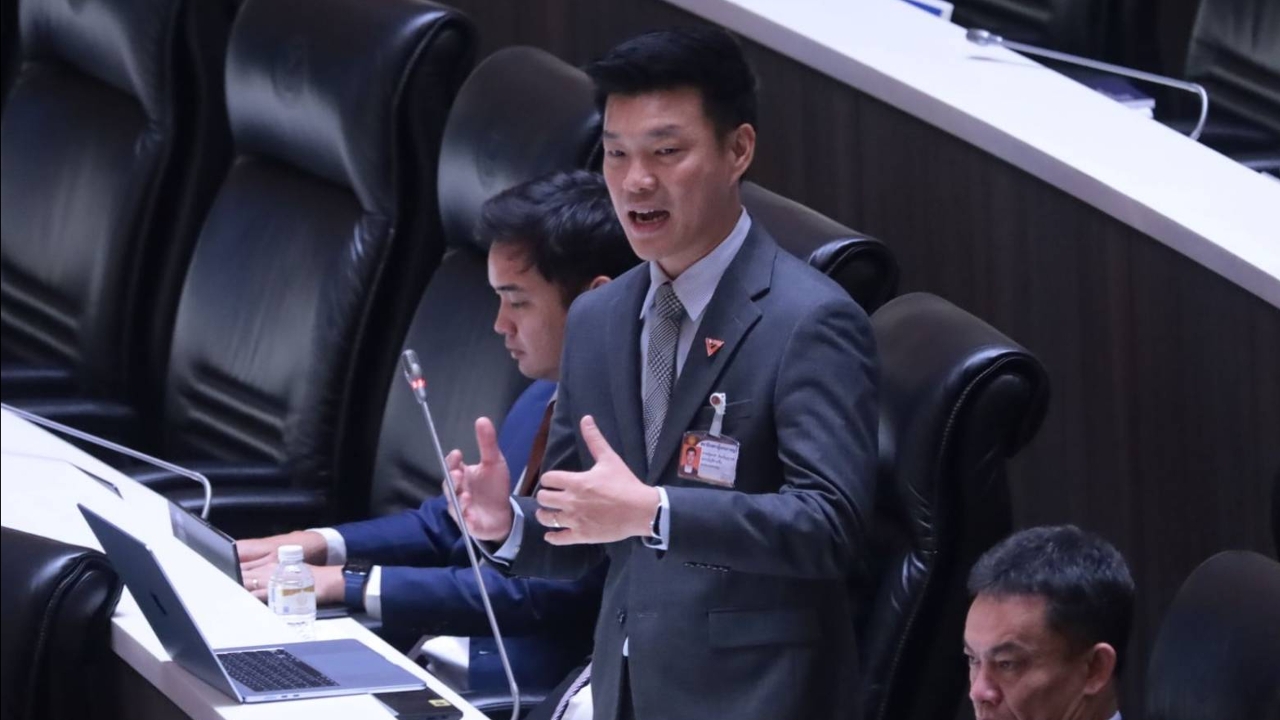
Nattapong proposed a motion urging the government to conduct a Pre-budget consultation for the 2028 fiscal year, recommending full disclosure of budget requests from all agencies, reform of the procurement system, review of tax benefits, and collection of windfall and consolidated land taxes to generate state revenue fairly and equitably. Tags: [budget proposal, Pre-budget consultation, government procurement, tax reform, windfall tax, land tax, fiscal policy]
On 20 November 2026, during a session of the House of Representatives, a motion was considered requesting the House to study and offer recommendations prior to the preparation of the 2028 fiscal year budget (Pre-budget Consultation) for the Cabinet to implement. The motion was introduced and debated by Mr. Nattapong Ruangpanyawut, leader of the People’s Party and opposition leader in the House of Representatives. Tags: [House of Representatives, Pre-budget consultation, budget process, opposition leader]
Mr. Nattapong stated that the parliamentary budget review process has limitations because once the annual budget bill is submitted for consideration, parliament can only make minor reductions. Therefore, allowing parliament and the public to give input before the budget is drafted is crucial and aligns with OECD guidelines. Tags: [budget process, parliamentary limitations, OECD guidelines, public participation]
However, although the government held a Pre-budget workshop on 5 November, three major shortcomings were identified: Tags: [Pre-budget workshop, government process, shortcomings]
1. Missing key issues, as the workshop discussion groups focused solely on expenditures without addressing state revenue generation, despite Thailand facing a continuous decline in the state revenue to GDP ratio and limited fiscal space.Tags: [workshop shortcomings, revenue generation, fiscal challenges]
2. Insufficient time, since hundreds participated but the discussion time was limited, preventing comprehensive feedback from attendees.Tags: [limited discussion time, public participation]
3. Lack of concreteness, especially in presenting directions and key projects from political leaders who set policies, clarifying which projects the government intends to pursue in the 2028 fiscal year.Tags: [policy clarity, political leadership, project planning]
Mr. Nattapong further said he expects three main outcomes from the 2028 budget: realistic perspectives, targeted spending, and fair revenue generation. Comparing the entire budget to 100 baht, only about 17 baht, or 17%, would remain for policy space. Thus, prioritizing projects clearly is necessary, especially regarding the zero-based budgeting approach the government announced it would adopt.Tags: [budget priorities, zero-based budgeting, fiscal policy]
However, from listening to the Budget Bureau's approach during the workshop, which asked agencies to submit requests based on the 2027 budget framework, it is unclear how this will lead to zero-based budgeting if the previous budget serves as the starting point.Tags: [budget framework, zero-based budgeting challenges]
Mr. Nattapong added that when the government submits the 2028 budget bill to parliament, it should separate fixed expenditures that are difficult to reduce, such as personnel and debt servicing, from the budget areas where political leaders can reprioritize. The government should clearly explain which projects are political decisions and how they address national issues. Additionally, it should produce a report on public feedback from the Pre-budget process alongside the budget bill, indicating which proposals it accepts or rejects and why, to prove the consultation is not merely symbolic.Tags: [budget transparency, fixed expenditures, public feedback report]
Another issue is the disclosure of budget requests from all agencies at the start of the process, enabling the public to compare these with the government's submitted draft budget and verify which projects were added or removed.Tags: [budget transparency, public scrutiny, budget requests]
Simultaneously, the government should provide parliament and the public a comprehensive view of all state funds, including off-budget items such as the Social Security Fund, DE Fund, and USO Fund, which still raise concerns about transparency and spending efficiency.Tags: [state funds, off-budget funds, transparency]
Mr. Nattapong emphasized that value-for-money spending should not be limited to cutting annual expenditures but must include reforming the public procurement system, covering spending by government agencies, state enterprises, public organizations, and local governments. He proposed strategic procurement through a central agency overseeing procurement direction across the government system.Tags: [public procurement reform, strategic procurement, government spending]
This does not mean centralizing all procurement in one agency but creating mechanisms to reduce costs by pooling purchases of similar goods and setting procurement standards aligned with national development strategies. For example, South Korea has a central procurement agency, and Denmark uses joint pharmaceutical purchasing to reduce costs. Thailand should consider such approaches to improve spending efficiency.Tags: [procurement strategies, cost reduction, international examples]
Mr. Nattapong continued that Thailand faces a declining state revenue to GDP ratio, making it necessary to review tax expenditure measures granted to investors to assess revenue loss and whether the benefits justify it. For instance, tax incentives for Data Center businesses involve large announced investments, but questions remain on the tax revenue loss versus environmental and energy impacts.Tags: [tax expenditure review, investor incentives, fiscal impact]
Furthermore, the government should consider imposing a windfall tax, such as on the six major oil companies in Thailand, which earned nearly 100 billion baht in profits in the first half of the year—an increase from about 30 billion baht in the previous year—due to rising oil prices amid Middle East conflicts. The government should decide whether to tax these excess profits to help citizens affected by the situation.Tags: [windfall tax, oil companies, fiscal policy]
Another proposal is to levy progressive consolidated land taxes based on the total land value or holdings nationwide to target wealthy large landowners rather than taxing each plot individually. Currently, about 5% of the population owns land titles covering around 80% of the country. Consolidated land taxation could raise over 100 billion baht annually, which could fund welfare system development.Tags: [land tax reform, wealth inequality, fiscal revenue]
Taxation is not only a tool for raising state revenue but also for promoting social equity, as seen in Finland’s tax and welfare systems reducing income inequality. What Mr. Nattapong wants from the 2028 budget is transparency in overall fiscal status, budget allocation aligned with problems and value, and reform of revenue systems to ensure fairness, so that the Pre-budget consultation leads to concrete changes in budget preparation.Tags: [tax fairness, social equity, budget transparency, fiscal reform]