

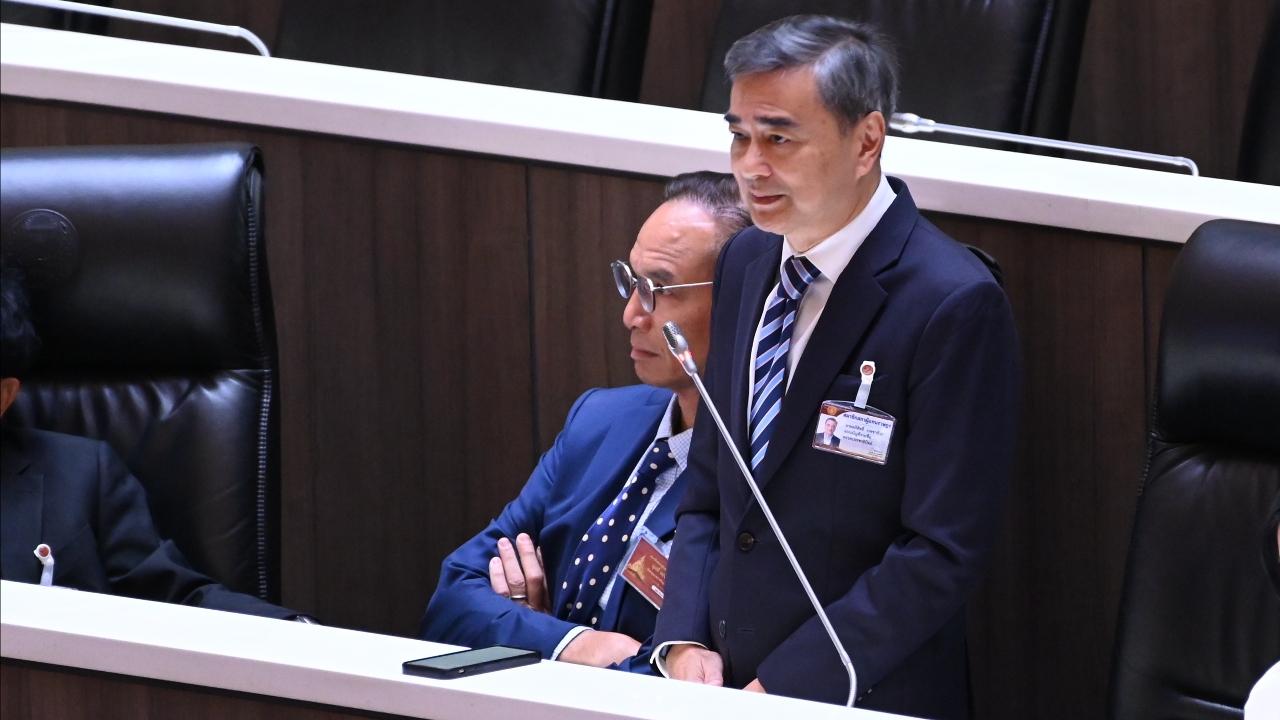
Abhisit urges the government to undertake a major budget overhaul for the 2028 fiscal year, proposing tax system reform and the use of local funds to avoid shifting the burden by raising VAT to 8.5%." ,
On 20 Nov 2026 at the Parliament, during the House of Representatives session for Pre-Budget Consultation on the 2028 fiscal year budget, chaired by First Deputy Speaker Mallika Jirapantwanich, Abhisit Vejjajiva, leader of the Democrat Party and member of parliament, spoke about the country's financial crisis. He warned that the current budget preparation risks violating financial discipline and budgetary laws. The 2028 budget is not a normal situation as the government has borrowed 400 billion baht, pushing public debt close to the 70% ceiling. Meanwhile, the proportions of investment budget and deficit are dangerously close to legal limits, especially with lease payments counted as investment and 100 billion baht in the central budget used for flood relief, likely leaving less than 60% as actual investment budget as assumed.
Abhisit further noted that the Budget Bureau's assumption to raise the value-added tax (VAT) from 7% to 8.5% to cover an estimated revenue shortfall of 100 billion baht should be a last resort, not the first option. He urged the government to review revenue losses from other sources first, such as tax exemptions from investment promotion (BOI), land tax, inheritance tax, and wealth tax. He also expressed regret over the government's agreement with the U.S. not to tax digital services, a rapidly growing sector where Thailand collects below potential revenue. If VAT increase is necessary, he suggested applying an earmarked tax approach, dedicating the additional revenue specifically to eldercare.
Abhisit also proposed that the government clarify details of state enterprise investments, off-budget funds, and accumulated local government funds to determine which projects should be in the budget, which belong to state enterprises, or involve private investment partnerships. He urged the government to amend laws and regulations that hinder using local government reserves. He criticized the idea of setting a 10% budget ceiling as a step back from zero-based budgeting, effectively endorsing last year's base budget despite the country's looming budget sufficiency crisis. Regarding reducing government expenses, he stated that existing civil servant welfare rights should not be cut, but a new pension and healthcare system should be designed for newly hired civil servants, as the current system is unsustainable.
He cited the civil servant healthcare welfare budget of 100 billion baht, half of which is spent on medicines, with three-quarters of prescriptions being costly original-brand drugs that are 30-70% more expensive than generics. Changing prescription practices could save substantial funds. The top ten prescribed drugs mainly relate to diabetes. Therefore, the government should urgently implement preventive policies, such as sugar taxes and promoting healthier public behaviors.
Abhisit added that beyond regular budget burdens, the government has about 1 trillion baht of hidden debt under Section 28 (assigning state financial institutions to policy projects), with no clear repayment plans yet. He reiterated the Democrat Party’s stance as a constructive opposition ready to engage on difficult issues to find joint solutions.
"Today's measures are no longer sufficient. Taking painkillers like paracetamol or paradon won’t do. We need surgery. Saying let's raise VAT to 8.5% or close small schools is not the best answer. It's time to seriously discuss these matters. We are now at a crisis point regarding Thailand’s budget status. I urge all members, both government and opposition, to use this process and listen seriously," Abhisit said. Abhisit concluded his remarks.