

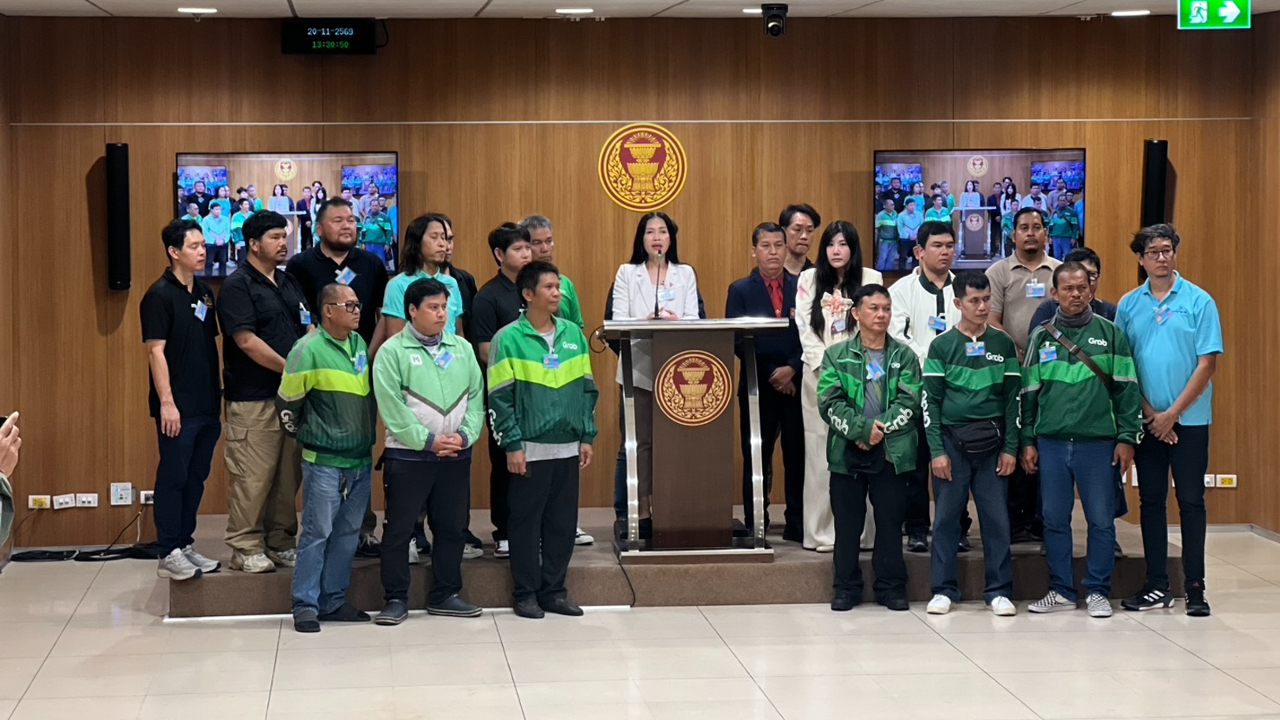
A deaf community group submitted six demands to the Labor Committee requesting a review of the criteria for issuing public driver's licenses after discovering occupational restrictions on digital platforms that cause deaf individuals to lose job and income opportunities.
On 20 Nov 2026 GMT+7, Mr. Natthaphon Tuipae, a representative of the deaf rights advocacy group, submitted a letter to Mr. Sia Champathong, a party-list MP of the Prachachon Party and Chair of the Labor Committee of the House of Representatives, requesting consideration to amend issues and reduce barriers to working as passenger or goods transport drivers via digital platforms such as Grab, Bolt, and Lalamove.
Mr. Natthaphon stated that digital platforms currently play a crucial role in employment and income generation for the public, including deaf individuals who are capable of driving cars and motorcycles professionally like others. However, they face problems due to Department of Land Transport regulations requiring public driver’s licenses and proper vehicle registration by law, resulting in some deaf people being unable to obtain the license under current criteria.
The advocacy group views these restrictions as directly impacting rights to work, income access, and workplace equality. They emphasize that hearing impairment need not hinder driving ability if individual competence is assessed and appropriate safety measures tailored to each person are implemented.
The demands call on the Labor Committee to take up the issue for study, examining problems, limitations, and impacts on deaf individuals’ access to passenger transport driving careers via digital platforms.
They request coordination and invitation of relevant agencies to discussions, including the Department of Land Transport, Ministry of Labor, agencies promoting and developing quality of life for people with disabilities, platform service providers, and deaf representatives, to collaboratively find solutions.
They urge promotion of reviewing the criteria and conditions for issuing public driver’s licenses for both cars and motorcycles, based on individual driving capability assessments, and establishing suitable testing methods for deaf individuals, prioritizing the safety of drivers, passengers, and road users.
They seek to promote pathways for deaf people to work through digital platforms legally and fairly, including adjusting platform systems and conditions to accommodate deaf drivers without discrimination due to disability.
They call for support of necessary technology and communication measures, such as text or visual alert systems, passenger communication tools, and appropriate aids to enable deaf individuals to work safely, efficiently, and equally with others. They also request follow-up on implementation and progress reports to ensure these proposals lead to concrete regulatory and practical changes rather than mere acknowledgment of the issues.
Mr. Sia said this issue should not have arisen because this group works honestly and straightforwardly to support themselves but faces legal restrictions preventing them from obtaining public driver’s licenses. The Labor Committee will discuss the matter in meetings and invite relevant agencies to explore possible solutions to unlock this problem for these workers. He emphasized that labor issues are urgent and the Committee will prioritize this agenda promptly to resolve the problem.