

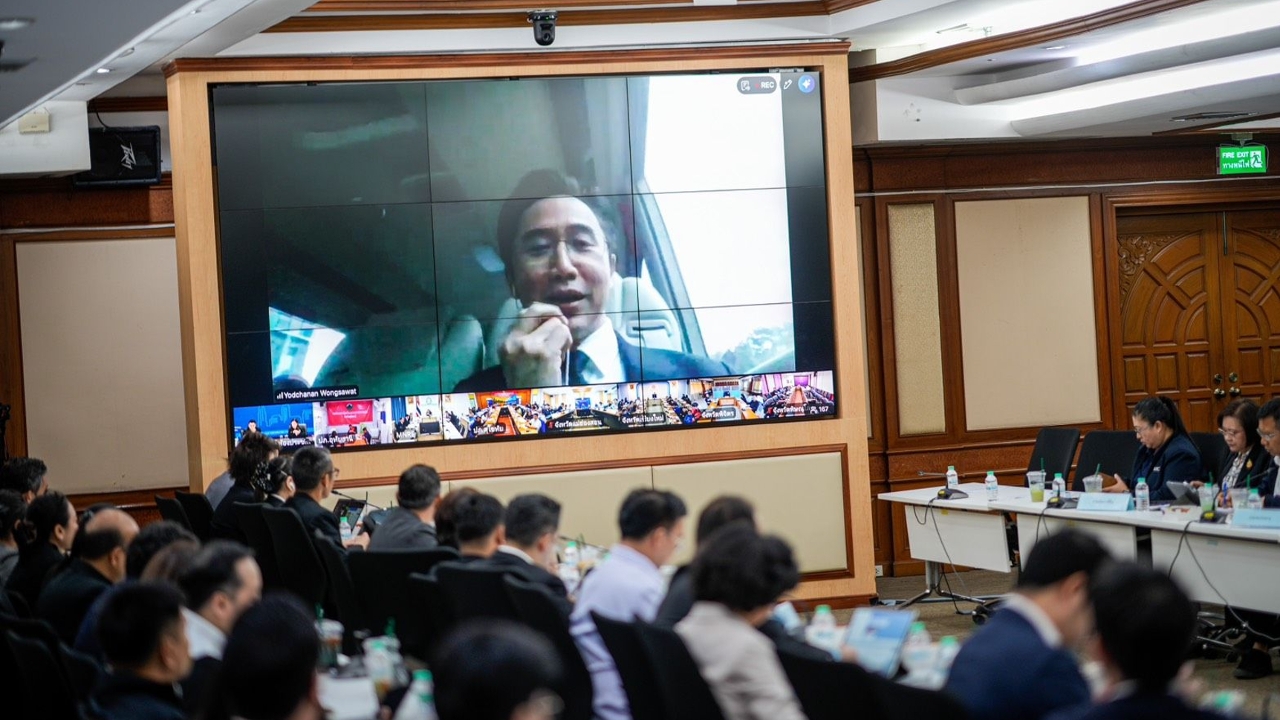
Yotsanan revealed that after joining the Prime Minister's delegation to meet Xi Jinping, he discussed with Thai, Myanmar, and Chinese parties to resolve arsenic contamination in the Kok and Sai Rivers. He leads the ministries of Higher Education, Interior, and Agriculture in six urgent measures promoting "smart sediment traps" to protect 27,000 rai of rice fields.
On 20 November 2026, Mr. Yotsanan Wongsawat, Deputy Prime Minister and Minister of Higher Education, Science, Research and Innovation, attended the 2/2569 meeting of the Northern Disaster Prevention and Mitigation Committee via Zoom from the People's Republic of China. This followed a visit with the Prime Minister to pay respects to President Xi Jinping and to accelerate six urgent measures addressing arsenic contamination in the Kok and Sai Rivers after a site visit to Mae Sai District on 14–15 November. The meeting at the Department of Disaster Prevention and Mitigation included Deputy Minister Jeset Thaiseth from the Ministry of Interior, Deputy Minister Piyaratch Tiyapairat of the Ministry of Agriculture and Cooperatives, representatives from the Department of Disaster Prevention, Pollution Control Department, Provincial Waterworks Authority, Department of Groundwater Resources, Ministry of Public Health, Department of Agriculture, Department of Fisheries, Ministry of Industry, Budget Bureau, security agencies, and officials from Chiang Mai and Chiang Rai provinces.
On this occasion, Mr. Yotsanan reported progress from talks with President Xi Jinping, stating that under the Prime Minister's leadership and diplomatic efforts by the Deputy Prime Minister and Foreign Minister, discussions have been positive. Both sides acknowledge the problem and agree to cooperate on solutions. They proposed establishing a joint technical working group to inspect and halt toxins at their source. The government will formally discuss all key points at the Thailand-Myanmar-China joint working group meeting on 24–26 November 2026 at the Ministry of Foreign Affairs, basing negotiations on scientific evidence such as measurements from the Ministry of Natural Resources and Environment and isotope analysis by the Ministry of Higher Education, Science, Research and Innovation to precisely fingerprint arsenic sources.
Promoting the “Smart Sediment Trap”
At the meeting, the Ministry of Higher Education proposed designing a “smart sediment trap,” a collaborative research project by the Office of National Higher Education Science Research and Innovation Policy Council, Naresuan University, and the DHI Institute. They explained that most arsenic binds to “fine sediment,” but conventional weirs only trap coarse sand, causing the Sai River to meet standards fewer than 5% of days. The research team created a 523-day digital twin river simulation, developing a system that diverts turbid water into a side channel pond. Controlled by AI, it operates in five steps: trap, settle, suction, squeeze, and return. It adds coagulants only when turbidity exceeds thresholds, slows water flow in settling channels, automatically closes intake gates during floods, and monitors arsenic levels before releasing clear water back to the river with real-time displays accessible to locals. Toxic sediment is suctioned daily, dewatered, lab-tested in batches, then permanently stabilized in cement plants or safely buried in landfill per Pollution Control Department standards. Each ton is weighed and tagged for traceability.
Simulation results indicate the system can remove up to 94.6% of arsenic if three units are installed along the Sai River between kilometers 95–99. This would enable the Sai River to meet standards for 476 of 523 days and allow Mae Sai waterworks to operate daily instead of shutting down 17 days. The meeting approved an 18-month sandbox pilot at the Mae Sai Irrigation Office covering the 2027 rainy season to reduce arsenic runoff by 94%, protecting approximately 27,000 rai of rice fields and 3,356 water users. Additionally, the Royal Irrigation Department and the Office of National Higher Education Science Research and Innovation Policy Council will survey comprehensive sediment trap sites at Ban Muang Daeng, Mae Sai District, and a weir in Chiang Rai on Monday. These figures come from simulations and require confirmation through real-world trials before full construction.

Deploying filtration innovations and test kits immediately
Meanwhile, while awaiting long-term infrastructure, the government plans three-stage clean water management alongside deploying innovations from the National Nanotechnology Center (NANOTEC), NSTDA, including:
Urgent phase and innovations – On 15 November, M-Sense test kits delivering results within 3–5 minutes (cutting lab costs from 800–2,500 baht and week-long waits) were delivered to the Chiang Rai Provincial Public Health Office. Mae Sai District uses them to screen bottled drinking water, ice, school and hospital drinking water samples totaling 30, all passing. Nano-biochar filtration systems have been installed at four Chiang Rai sites, removing up to 99% of arsenic. For example, at Ban Rim Kok, Mueang Chiang Rai District, arsenic in raw water dropped from 0.069 to 0.0035 milligrams per liter—a nearly 95% reduction—at a cost below 2 baht per 1,000 liters. Expansion plans involve collaboration with the Synchrotron Light Research Institute and Department of Science Service to Chiang Mai’s Tha Ton Subdistrict and Mueang Chiang Rai District. Water trucks have distributed over 100,000 liters of drinking water in Tha Ton, while the Royal Irrigation Department has reserved emergency water from three reservoirs supplying Fang and Mae Ai areas totaling over 22.5 million cubic meters.
Medium and long term – The Department of Groundwater Resources plans 14 community groundwater supply systems in two subdistricts of Mae Sai District, replacing systems that previously stopped supplying water. Completion is expected within 120 days post-contract, along with 22 other systems across the region, totaling about 165 million baht in budget to aid roughly 17,600 people. They will urgently seek additional funding from the Cabinet. For the long term, the Provincial Waterworks Authority will expand Fang-Mae Ai-Chai Prakan water systems using raw water from Mae Talob Reservoir to permanently avoid reliance on risky river water. This will be complemented by a three-tiered monitoring system for village waterworks and shallow wells involving local, community, and provincial levels.
Agri-Map to be launched on 15 December
To address economic root causes, the Ministry of Industry is expediting regulations defining mineral types and conditions requiring import-export permits, enabling traceability to origins. They coordinate with security agencies to close loopholes for illegal mineral trafficking, emphasizing Thailand must not become a destination for minerals sourced by river destruction.
In agriculture and fisheries, authorities will collect plant, soil, and water samples at 50 locations in Mae Ai District, Chiang Mai, from 23–25 November before releasing the Agri-Map on 15 December 2026. The map will classify zones as green, yellow, or red. Produce from green zones will receive GAP certification to avoid assumptions that all areas are contaminated. Crops exceeding toxic limits will be purchased for destruction. Fish and shrimp testing below arsenic limits are advised to have guts removed before consumption.
Launching a central data platform
For communication and public assurance, all data-holding agencies will meet this afternoon to expedite uploading verified information to a continuously updated online central platform, allowing citizens transparent access to local situation updates.
Mr. Yotsanan concluded that problem-solving will proceed on two parallel tracks: negotiating the root cause with scientific evidence and protecting drinking water, food, health, and livelihoods of Thai citizens immediately without waiting for upstream water to be clean. “The source may be beyond our borders, but the safety of Thai people is the Thai government's responsibility, and we will fulfill this duty until our rivers are clean again.”