

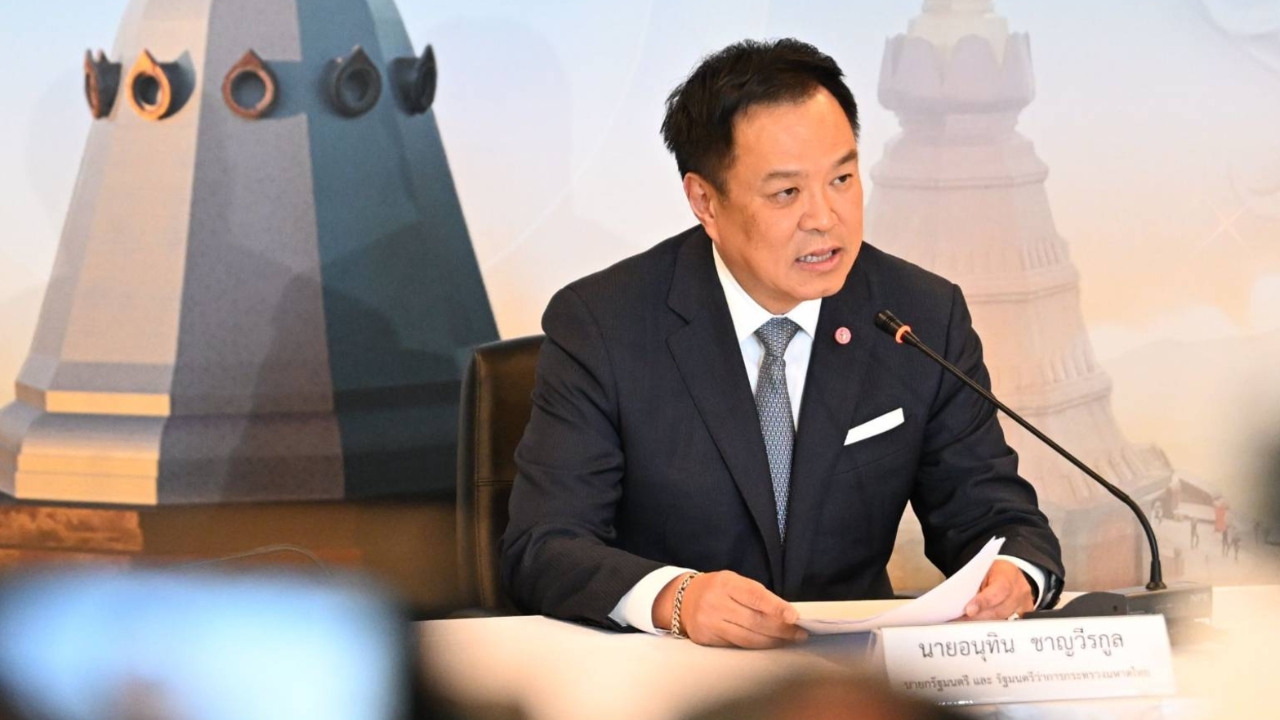
The Prime Minister summarized the ASEAN–APEC meetings, cooperating with China, the U.S., and Russia to open multidirectional trade deals, highlighting digital economy and alternative energy agendas, reaffirming Thailand as a regional economic bridge and gateway to ASEAN trading partners.
On 20 Nov 2026 at 15:50 GMT+7, at Military Airport 2, Wing 6, Don Mueang, Bangkok, Mr. Ekaphop Phianpiset, spokesperson of the Prime Minister’s Office, announced that Prime Minister and Minister of Interior Anutin Charnvirakul, along with Deputy Prime Ministers and Ministers—Sihasak Puangketkaew (Foreign Affairs), Supachai Sutthumpun (Commerce), and Yossanan Wongsawat (Higher Education, Science, Research and Innovation)—held a press conference summarizing participation in the 49th ASEAN Summit and related meetings in Manila, Philippines, and the 33rd APEC Economic Leaders’ Meeting and related meetings in Shenzhen, China. The Prime Minister stated that these forums are crucial for driving Thailand’s economic and foreign policies, including opening trade doors, joint production, attracting investment, and positioning Thailand as a central hub for regional economic cooperation.
The Prime Minister summarized the ASEAN Summit outcomes, with the Thai delegation attending 17 main meetings and holding bilateral talks with leaders from seven countries: the Philippines, Laos, South Korea, Vietnam, Japan, India, and the U.S. The focus was on expanding economic opportunities and strengthening beneficial cooperation for Thailand. Notably, discussions with U.S. President Donald Trump resulted in signing a Joint Statement on Reciprocal Trade to advance trade agreement negotiations, emphasizing the government’s commitment to maintaining the U.S.—Thailand’s top export market—while opening trade opportunities and protecting the interests of businesses and citizens in both countries.
Regarding talks with key ASEAN and Asian partners, the Prime Minister pushed to raise Thai–Lao border trade to a target of 12 billion U.S. dollars by 2027 and accelerate transport connectivity projects, especially the Nong Khai–Vientiane railway bridge, alongside cooperation on drug enforcement. Discussions with Vietnam aimed to expand bilateral trade value to a target of 25 billion U.S. dollars.
With South Korea, cooperation focused on trade, investment, healthcare industries, electric vehicles (EVs), and renewable energy. Japan’s agenda emphasized promoting investment, joint production, and technology transfer to upgrade Thailand’s production base. India agreed to elevate strategic partnership levels, linking ASEAN with BRICS and collaborating on cybercrime prevention.
Additionally, the Prime Minister emphasized Thailand’s role in advancing key ASEAN agendas, notably the ASEAN Digital Economy Framework Agreement (DEFA), which facilitates digital market connectivity among member countries, eases online trade, and increases Thai entrepreneurs’ access to ASEAN markets. Concurrently, efforts were made to promote energy transition cooperation by supporting alternative energy and biofuels derived from agricultural products like palm oil and ethanol to reduce fossil fuel dependence, enhance energy security, and add value to Thai agricultural products.
At the 33rd APEC Economic Leaders’ Meeting, comprising 21 member economies, the Prime Minister presented a vision to position Thailand as a “Trusted Connector” between ASEAN and the Asia-Pacific region, leveraging Thailand’s strategic location and economic potential as a gateway linking trade and investment to ASEAN’s market of over 700 million people. He used this opportunity to meet key economic leaders to expand export markets, attract investment, and strengthen national economic security.
The Prime Minister highlighted important trade outcomes, including Thailand and Peru signing a free trade agreement (FTA) to open opportunities for Thai products and entrepreneurs in Latin America. Talks with Russian President Vladimir Putin advanced negotiations on a free trade agreement between Thailand and the Eurasian Economic Union (EAEU) to increase trade and investment opportunities and expand energy cooperation to enhance Thailand’s long-term energy security.
Meanwhile, discussions with Chinese President Xi Jinping focused on continuing economic and security cooperation, particularly promoting investment in high-value industries, expanding Thai agricultural exports to China, collaborating on cybercrime prevention, and addressing cross-border river pollution affecting local populations. Thailand pushed for concrete cooperation in water quality monitoring and tracking.
The Prime Minister also met with the Hong Kong Special Administrative Region leader to promote linking the Guangdong–Hong Kong–Macau Greater Bay Area (GBA) with Thailand’s Eastern Economic Corridor (EEC), aiming to attract investment in technology and future industries. He visited leading Chinese tech companies BYD and Tencent to study innovations and expand cooperation in electric vehicles, artificial intelligence (AI), and the digital economy, which will boost investment opportunities, workforce skills development, and Thailand’s competitiveness.
In closing, the Prime Minister emphasized that participation in both forums reflects the government’s commitment to proactive economic and foreign policies to maintain existing export markets, open new trade markets, increase investment opportunities, and build cooperation with key partners across regions. The ultimate goal is to create business opportunities, jobs, and higher incomes for Thai citizens. The government will swiftly follow up and implement discussion outcomes and agreements to ensure international cooperation yields tangible benefits for Thailand’s economy and people.