

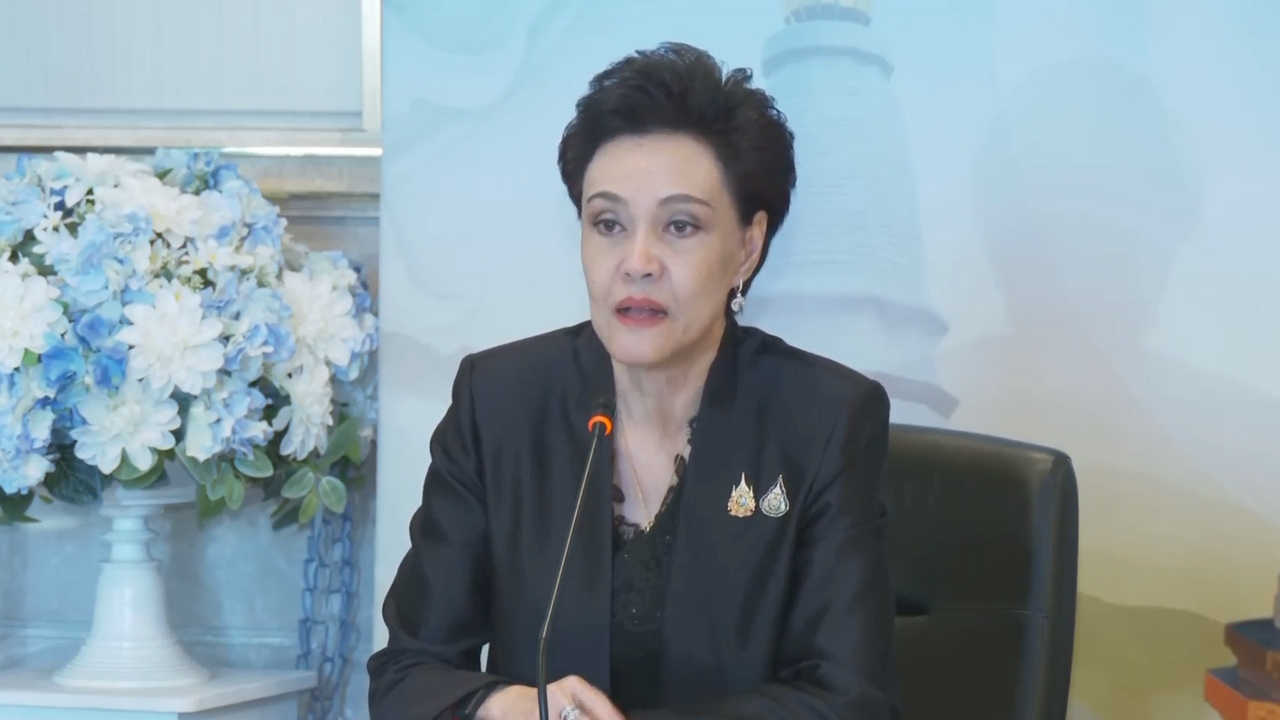
Supachai explained that the Thai-US ART framework is not a binding obligation but rather opens trade opportunities for the private sector to decide based on price and quality. She stressed the need to expedite negotiations to maintain Thailand's top export market status and reduce tariffs to remain competitive.
At 16:16 on 20 Nov 2026 at Military Airport 2, Wing 6 Don Mueang, Supachai Sutthumpan, Deputy Prime Minister and Minister of Commerce, spoke after attending the ASEAN Summit 2026 in Manila, Philippines, and the 33rd APEC Economic Leaders’ Meeting in Shenzhen, China. On behalf of the Ministry of Commerce, she stated that the meetings showed clear differences, providing Thailand opportunities to push forward many proposals rather than just endorsing. Their efforts received acceptance at ASEAN and APEC meetings.
Supachai summarized that the Ministry of Commerce is leading efforts to get 11 ASEAN countries to agree on the ASEAN Digital Economy Framework Agreement (DEFA). Thailand will benefit from having a unified digital economic framework covering payments, shipping standards, and enabling small businesses to access larger markets. Boston Consulting predicts that successful implementation could double ASEAN’s digital economy value to $2 trillion.
Additionally, ASEAN free trade agreements are being updated to modernize longstanding accords by simplifying cooperation procedures, adding environmental and green economy provisions, ensuring transparent and swift trade, and upgrading ASEAN-China agreements to a unified standard.
At the APEC meeting, the Ministry of Commerce requested a bilateral meeting with the U.S. Trade Representative (USTR) following the leaders' agreement. They discussed reducing Section 301 tariffs related to forced labor from 12.5% to 10% so Thailand can have tariff rates equal to countries that have signed ART agreements with the U.S.
Thailand also signed a free trade agreement with Peru, which had been stalled for over 10 years, opening trade opportunities with Peru and Latin America. This includes use of the Chan Kai port to reduce transit time and shipping costs for goods entering Latin America.
Regarding the Thai-U.S. ART framework, Supachai clarified it is a cooperative framework for mutual benefit aimed at creating trade opportunities, not a condition requiring Thailand to accept terms or purchase U.S. goods without restrictions. The agreement must still undergo domestic procedures including Cabinet submission, public consultation, and parliamentary review before proceeding.
Concerning U.S. President Donald John Trump's statement about Thailand purchasing an additional $2.6 billion in U.S. agricultural products, Supachai explained that discussions and framework had been set since early 2025 covering agriculture, energy, and aviation. This does not mean the Thai government must buy all these products but signals intent to allow U.S. goods greater access to the Thai market.
Purchasing decisions will be made by the private sector, not the government directly. Businesses will consider price, quality, and terms; if products do not meet requirements or terms cannot be agreed upon, there is no obligation to buy. The government’s role is to open opportunities for trade, not guarantee purchases to the specified value.
Supachai cited agricultural products Thailand cannot sufficiently produce domestically, such as soybean meal and corn—especially corn, where annual demand is around 9 million tons but production is only 5 million tons. The gap requires imports. Allowing the U.S. as a source meets necessary demand and balances bilateral trade, not importing products Thailand already produces sufficiently or burdening local farmers.
Regarding concerns about opening markets to U.S. products potentially impacting Thai farmers and businesses, Supachai assured that market opening does not mean unrestricted competition. Thailand can impose appropriate protections, including import quotas and other conditions, to prevent harm to domestic producers.
She firmly confirmed the government will not accept imports of meat containing growth-promoting substances that may affect consumer safety. All imported agricultural and food products must comply with Thai standards and laws; there will be no waiver of standards in exchange for trade benefits.
Supachai noted the importance of these negotiations for preserving Thailand’s number one export market, the U.S., which generates significant revenue and employment. Thailand has a trade surplus with the U.S. exceeding $70 billion and possibly rising above $80 billion. Export earnings support approximately 1.25 million Thai jobs. Maintaining competitiveness and market access to the U.S. is vital alongside protecting domestic producers and farmers.
On tariff issues, Supachai said Thailand currently faces a 12.5% tariff, while Malaysia and Cambodia, having already reached agreements with the U.S., have 10% tariffs—a 2.5 percentage point difference. Though seemingly small, this is significant in export value and affects competitiveness. Failure to finalize an agreement risks disadvantaging Thailand compared to countries that have concluded deals. Other countries like Japan and South Korea are also negotiating without tariff conclusions yet.
Supachai emphasized the government’s approach is not only about market opening or tariff reduction but also about considering impacts on all population groups. If agreements negatively affect certain sectors, conditions must be set to mitigate damage, including appropriate assistance and compensation measures. The key principle is protecting national interests across export markets, income, employment, and Thailand’s long-term competitiveness. She urged the public to await official details once legal and domestic procedures are completed.