

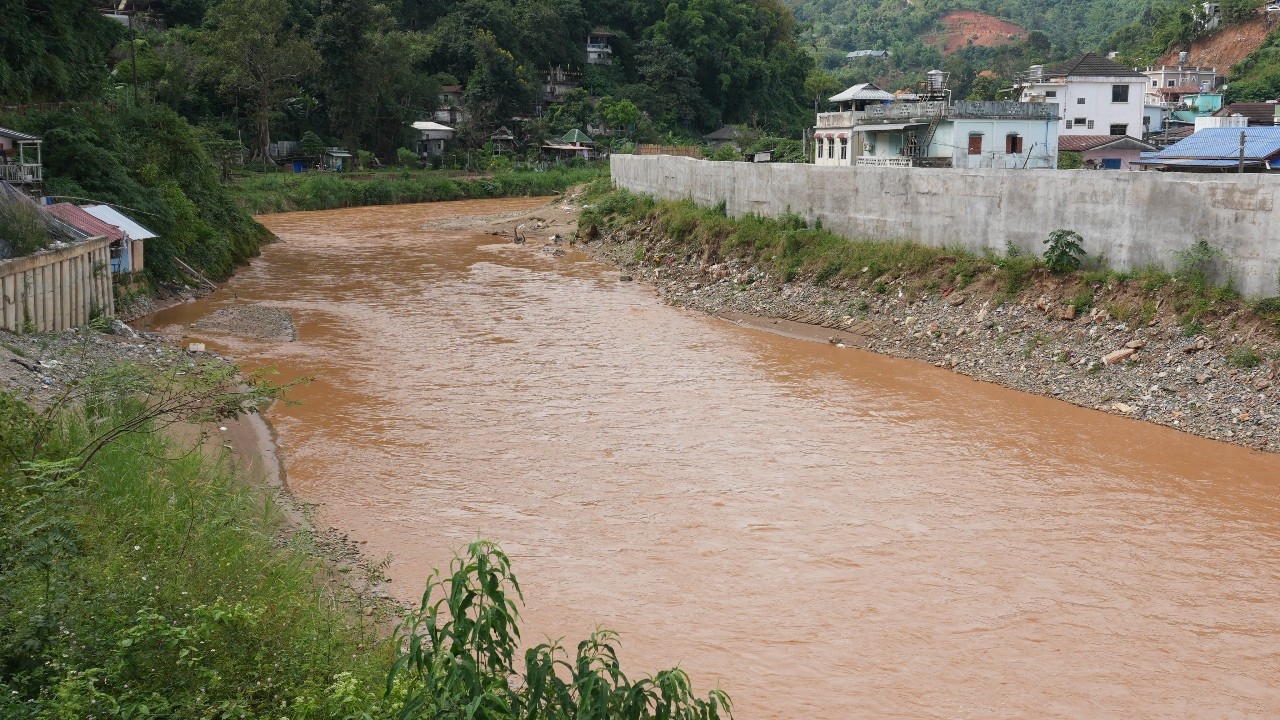
Lalida revealed that Suchat, Minister of Natural Resources and Environment, is preparing to propose the declaration of a "pollution control zone" along 150 kilometers of the Kok River, while also providing the public with opportunities to participate in planning toxin mitigation by monitoring water, soil, and crops, and caring for farmers' health and income.
On 22 Nov 2026, Ms. Lalida Pertwittayatan, Deputy Spokesperson of the Office of the Prime Minister, stated that Mr. Suchat Chomklin, Minister of Natural Resources and Environment, is preparing to propose declaring approximately 150 kilometers of the Thai side of the Kok River as a "pollution control zone." This aligns with the government's policy under the leadership of Prime Minister and Minister of Interior Anutin Charnvirakul to systematically elevate efforts to resolve contamination issues. The key benefit is that local residents will participate in proposing needs and defining remedial measures, while government agencies must develop clear operational plans with assigned responsibilities and timelines.
Ms. Lalida added that Minister Suchat has instructed the Pollution Control Department (PCD) to accelerate these measures. Declaring the pollution control zone will directly benefit the public in five key ways:
1. Participation in planning solutions: residents can propose their needs for government agencies to consider and include in pollution reduction and elimination plans, rather than passively awaiting central mandates.
2. Comprehensive safety monitoring covering water, soil, fish, and agricultural products, providing the public with data to support water use, consumption, and livelihoods.
3. Accelerated rehabilitation of contaminated areas through measures managing polluted water and sediments, including dredging or sediment removal based on scientific principles.
4. Protection of farmers and community incomes by promoting certification of product safety to build consumer confidence, prevent price suppression, and consider assistance for affected local farmers.
5. Mandating government agencies to collaboratively solve problems with clear short-, medium-, and long-term plans, including goals and indicators to monitor progress.
The Pollution Control Committee is scheduled to meet on 27 Nov 2026 before submitting the proposal to the National Environment Board on 2 Dec 2026. If approved, the declaration will be published in the Royal Gazette, and an action plan will be developed jointly with local provinces and residents.
The Deputy Government Spokesperson further revealed that the government is advancing parallel measures, including plans to increase real-time water quality monitoring stations, develop analytical laboratories in Chiang Rai and Chiang Mai, and secure alternative clean water sources. Additionally, a Thai-Myanmar joint working group meeting is planned for 25-26 Nov 2026 to address upstream pollution issues.
"Declaring the pollution control zone is not merely mapping an area but opening opportunities for residents to participate in determining solutions that affect their lives—clean water, safe food, health, and agricultural income. The government wants all agencies to work together with clear goals to ensure citizens see tangible and swift results in resolving these problems."