

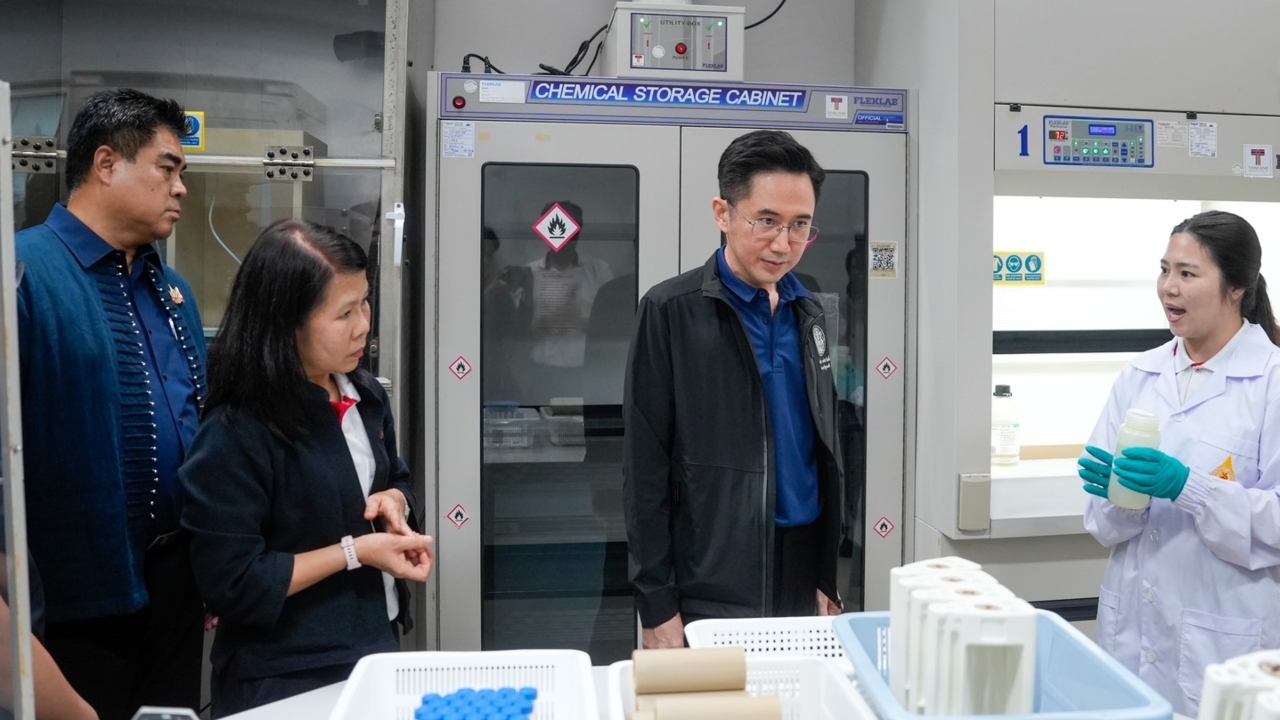
Deputy Prime Minister and Minister of Higher Education, Science, Research and Innovation Yossanan Wongsawat rushed to prepare the heavy metal laboratory at Mae Fah Luang University to collect data ahead of the Thai-Myanmar-China negotiation meeting on 24 November, launching a scientific effort to trace toxic pollution in the Chiang Rai River.
22 November 2026 GMT+7 Mr. Yossanan Wongsawat, Deputy Prime Minister and Minister of Higher Education, Science, Research and Innovation, along with his team, visited Chiang Rai province from 22 to 23 November 2026 to monitor contamination in the Sai River and inspect the quality of local water reserves. Their first task was to tour the heavy metal analysis laboratory within the Central Research Laboratory at the Science and Technology Instrumentation Center of Mae Fah Luang University, where they received briefings and demonstrations of analytical procedures from researchers and lab staff.
Visiting the local laboratory before inspecting water sources reflects a crucial condition for addressing toxic substances in the Sai River. Contaminants such as arsenic and other heavy metals cannot be detected by the naked eye. Clear identification and quantification of elements in the water provide essential baseline data to trace pollution sources from activities like mining or other operations, enabling precise solutions at the source.


The Central Research Laboratory at Mae Fah Luang University’s Science and Technology Instrumentation Center was established in 2018 on a total area of 900 square meters, with analytical equipment installed in 2020. The heavy metal analysis section includes two main rooms: a 30-square-meter microwave digestion sample preparation room and a 27-square-meter elemental analysis room.
The laboratory’s analysis process uses five main instruments working sequentially to minimize contamination errors. It begins with glassware cleaning equipment that washes all glassware used for sample preparation with acid to remove residual impurities, alongside an acid distillation apparatus that purifies AR grade acid before it is used for sample digestion.
During the sample preparation room visit, lab staff demonstrated the preparation steps to Prof. Dr. Yossanan, including placing samples and concentrated acid into pressure- and heat-resistant vessels, then assembling the closed system to reduce contamination and evaporation risks.
The samples then undergo microwave digestion, where microwave energy heats the acid to break down organic and inorganic substances into free elements. The staff explained that each run can process up to 15 sets, taking about one hour including cooling time, preparing samples for heavy metal quantification. A chemical scrubber system removes acid vapors and other fumes to protect operators from harmful inhalation throughout the process.


In the elemental analysis room, equipped with scientific instruments and ventilation systems arranged systematically, researchers explained the operation of the advanced ICP-MS/MS mass spectrometer. Based on atomic spectroscopy, the dual-stage MS/MS system is critical for measuring arsenic, which can have interfering signals. The system locks on mass 75, reacts with oxygen to shift to mass 91, separating interference and achieving more accurate toxic concentration results. Prof. Dr. Yossanan attentively followed the details on screen and reviewed digital map data with researchers to monitor contamination points along the river, correlated with lab findings.
Contamination issues in the Sai River and other affected regional rivers extend beyond local water quality monitoring in Chiang Rai. They are transboundary river concerns that Thailand is addressing diplomatically with Myanmar and China, preparing to discuss pollution sources such as mining and other activities in a ministerial meeting on 24 November, followed by trilateral working group talks on 25-26 November in Thailand. The Chinese government has acknowledged these concerns and pledged full cooperation. After these meetings, Prof. Dr. Yossanan and his team will personally inspect the primary mining sites again.
In the context of international negotiations, local concerns or testimonies alone cannot conclude the matter. The role of a laboratory with systematic analytical processes is to produce reproducible scientific evidence, serving as a crucial negotiation tool to clearly identify pollution sources and advance effective resolution at the origin.
