

“Yotsanan” is advancing a plan to cut off toxic substances in water by enhancing Chiang Rai’s Single Command system, creating a Risk Map covering 5,872 sites, building sediment traps before the December water release, and establishing long-term solutions by negotiating upstream using scientific data.
On 23 Nov 2026, Mr. Yotsanan Wongsawat, Deputy Prime Minister and Minister of Higher Education, Science, Research and Innovation, held a meeting with local officials and related agencies at Chiang Rai Provincial Hall to monitor water quality and expedite measures to address contaminants in the Kok, Sai, and Ruak rivers, focusing on integrating data and upgrading operations across agencies into a unified system.


During the meeting, Yotsanan stated that following the Prime Minister’s directive for urgent problem-solving, management will be upgraded to a Single Command model with Chiang Rai’s governor as the central command coordinating all local agencies. The Deputy Prime Minister will oversee the overall situation, link remaining gaps among agencies, and support urgent additional funding beyond the normal budget. He assigned the Department of Disaster Prevention and Mitigation to urgently survey essential water needs for consumption, especially in Mae Sai district, including water filtration equipment, water systems, groundwater wells, and temporary water trucks.
Comprehensive water quality and agricultural product inspections underway
Tests show all regional tap water meets standards. Of 1,502 village water supplies surveyed, 844 require testing; so far, 380 samples have been tested, all meeting standards. Testing will continue until all sites are covered. Similarly, 271 aquatic animal samples have passed standards, with efforts to expand testing in remaining areas.
Regarding agriculture, the Ministry of Agriculture and Cooperatives reported that all rice samples contained arsenic below the Codex international standard. The Department of Internal Trade is monitoring the rice market to prevent price suppression and has reported that rice is returning to the market but will continue close monitoring.


The Chiang Saen and Mae Sai Agricultural Cooperatives have begun purchasing unhusked rice varieties Khao Dawk Mali 6 and Nan 59 at 9 baht per kilogram, higher than nearby collection points, and are buying jasmine rice from members at 14.50 baht per kilogram. Meanwhile, 260 of 262 vegetable and fruit samples passed standards; discussions with the Ministry of Agriculture are ongoing for those that failed to determine support and compensation for farmers.
Health screenings of urine from residents in five Mae Sai subdistricts have found no affected individuals. Testing of 30 drinking water samples in Mae Sai using NSTDA’s M-Sense kits found no standard violations.
Risk Map to be completed within this week
All inspection data will be integrated into a Risk Map via the SRI Intelligence System, targeting completion within this week. The system compiles data from 40 agencies covering 5,872 sampling points to clearly display water quality and risk levels by area for transparency and verification.
A key approach is to gradually declare safe zones or green zones first, providing farmers with data for decisions on dry-season rice cultivation and boosting market confidence. Areas under watch will have further soil quality tests and contingency measures planned if risks are detected.
Accelerated construction of sediment traps at Ban Muang Daeng to catch inflow before irrigation system
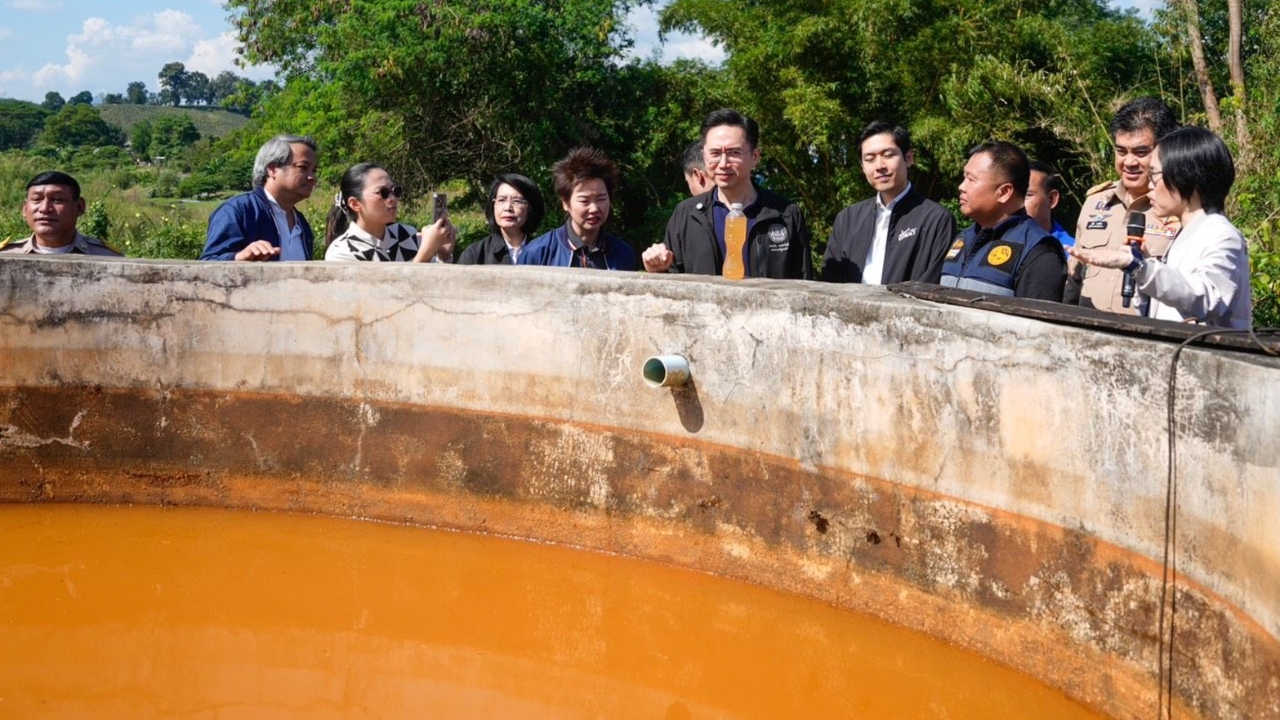
Another critical measure is managing contaminated sediment in the Sai River. Yotsanan visited the irrigation canal at Ban Muang Daeng to oversee construction of fine sediment traps in cooperation with the Royal Irrigation Department and NSTDA, aiming to capture sediment possibly contaminated with arsenic before entering the water delivery system. A continuous sediment removal system will be installed to prevent dispersion. Completion is targeted before the next water release around mid-December, which is vital for about 60,000 rai of irrigated farmland using Sai River water.
Meanwhile, the Ministry of Natural Resources and Environment is preparing to drill 10 groundwater wells as backup water sources; drilling equipment has arrived and work has commenced.

Upstream negotiations proceed with science as foundation in talks with Myanmar and China
For upstream solutions, Yotsanan said that on 22 Nov he met with scientists nationwide to consolidate research and scientific data for discussions with Myanmar and China from 24–26 Nov. Representatives from the province, NSTDA, Science Technology and Innovation Policy Office, and farmers will participate to ensure negotiations are based on scientific facts and affected parties are included.
Additionally, the Mekong-Lan Chang cooperation mechanism will be used to discuss monitoring mining activities on the Myanmar side and push for mining standards before water flows into rivers. Efforts will elevate traceability principles for rare earth minerals to the international stage, with plans to consult the OECD Secretary-General on communication strategies.
All operations will be coordinated through the Emergency Operations Center (EOC) led by the provincial governor, with the Joint Information Center (JIC) as the main communication channel to unify government information and provide the public with consistent updates.
After the meeting, Yotsanan and his team visited Rim Kok Temple in Mae Yao subdistrict, Mueang Chiang Rai district, to deliver a prototype village water supply system that removes arsenic and heavy metals for consumption. Developed by the National Nanotechnology Center (NANOTEC) under NSTDA, the system uses processes to separate fine suspended sediment combined with special adsorbent materials to manage raw water quality issues including turbidity, arsenic, and heavy metals.
Previously, NSTDA piloted this system in Ban Rim Kok, Mae Yao subdistrict, and Ban Muang Ngim, Rim Kok subdistrict, covering over 700 households.
