

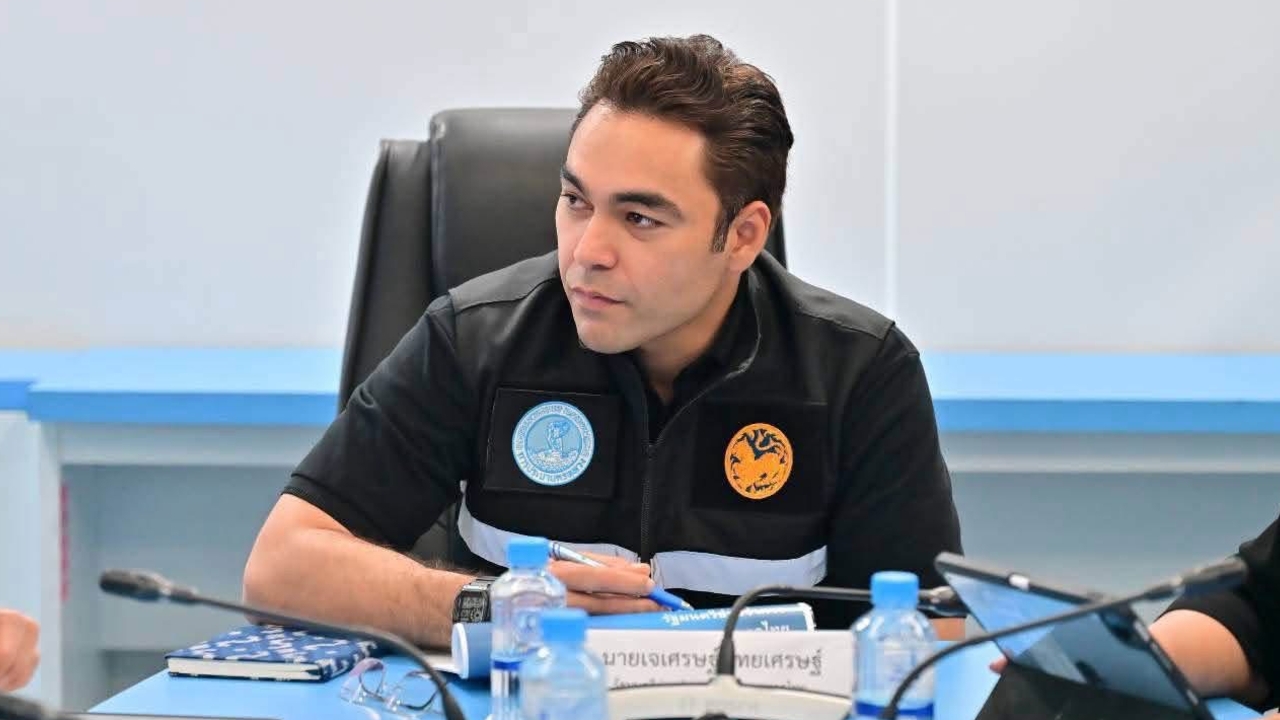
"Je Setth" vows full budget support to advance the fight against water contamination, refusing to let it obstruct aid efforts for Mae Sai residents. He stresses that contamination must be stopped at its source, water sources must be restored, and the downstream must be safe for the community to rely on.
On 23 November 2026, Mr. Je Setth Thaisetth, Deputy Minister of the Interior (Interior Minister 3), updated on progress resolving water contamination in Mae Sai, Chiang Rai. Following the Prime Minister’s declaration to launch a "war on water contaminants" and appointing Deputy Prime Minister and Minister of Higher Education Yotsanan Wongsawat to lead the task force, the government has fully mobilized science, water management, agriculture, health, environmental restoration, and international cooperation efforts.
Mr. Je Setth said that between 24–26 November, Thailand, Myanmar, and China will hold trilateral talks to promote cooperation, sending expert teams to collect water, soil, sediment, and environmental samples. The data will be jointly analyzed to find precise solutions. This effort relies on science; understanding the contamination sources, nature, and root causes is crucial. Field sampling and shared data from all parties will ensure discussions are grounded in facts and scientific evidence.
Mr. Je Setth noted that academics have highlighted budgetary limitations affecting water quality testing in village water supplies, sample collection, data analysis, and monitoring. They urged the government to address the issue seriously and promptly.
Mr. Je Setth said the government is ready to support and does not want budget constraints to halt progress. The Mae Sai crisis management budget has two main parts: 1) the provincial governor’s operational budget of 50 million baht, and 2) the National Disaster Prevention Committee’s fund, with the Deputy Prime Minister authorized to approve up to 100 million baht. If these are insufficient, additional central budget requests can be made. He encouraged officials to report their needs, assuring full effort to secure funding, believing no one would refuse support in such a critical situation.
Mr. Je Setth added that agencies seeking additional actions should clearly specify their needs, including what must be done, the required budget, and any constraints, so appropriate mechanisms can be applied. He pledged to push for continued progress in managing the problem.
Regarding village water supply systems, Interior Minister 3 instructed a swift survey of systems in risk areas. If any systems or water sources are affected, immediate remediation is required. The Provincial Waterworks Authority (PWA) is ready to provide technical support, inspect systems, and help find new water sources. The government will also fund localities facing budget limits to ensure residents have continuous access to clean and safe water.
On agriculture, Mr. Je Setth said Deputy Minister of Agriculture and Cooperatives Ms. Piyaratch Tiyapairat is working diligently. The Department of Agricultural Cooperatives has purchased unhusked rice from farmers and confirmed no contamination was found, restoring market confidence. Rice prices have since returned to normal levels.
Mr. Je Setth emphasized that solutions must proceed simultaneously: stopping contamination at the source, scientific investigation, restoring water sources, safeguarding agricultural products, and assisting affected residents. Cross-border pollution issues must be elevated to international cooperation. The contamination must be stopped at its origin, water sources restored, downstream safety ensured, and citizens cared for. It is vital to inform the public about government actions, their local risk status, and available support if impacted.
Mr. Je Setth concluded that the goal is public safety, water source restoration, and rebuilding trust, all based on real data and scientific principles. He pledged to utilize all available mechanisms to ensure the problem’s resolution yields tangible results.