

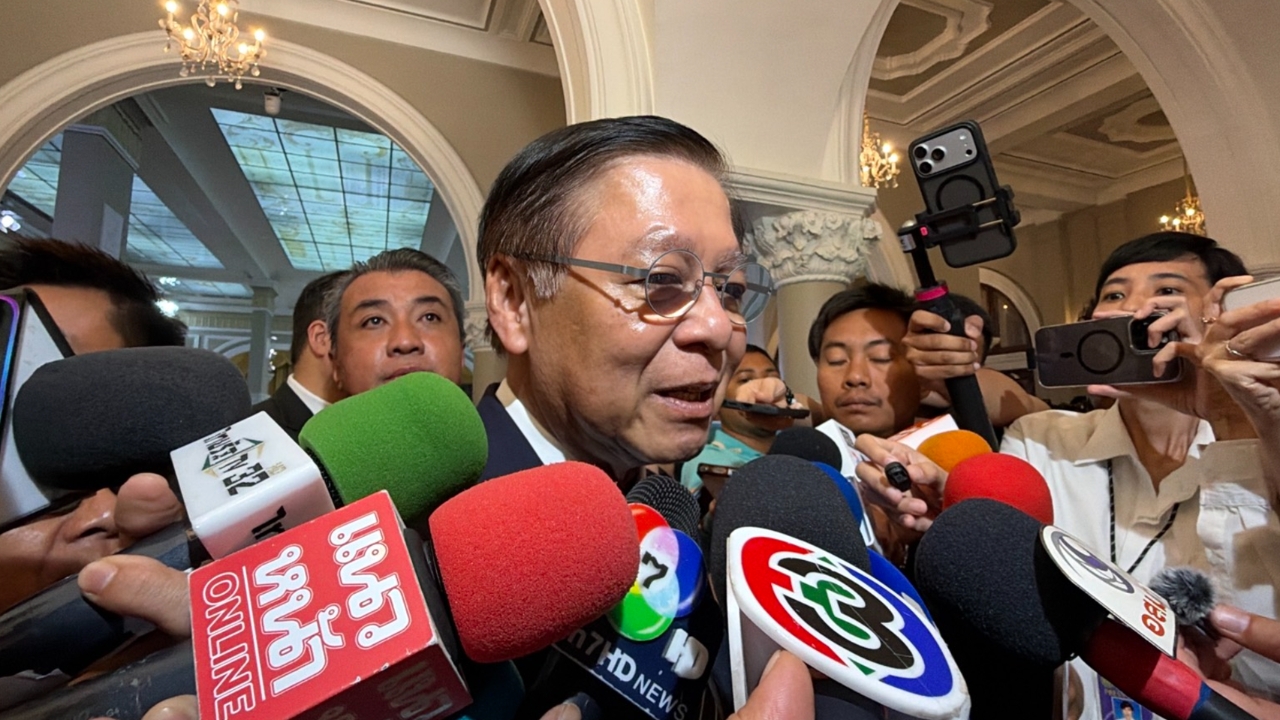
Sihasak revealed a tripartite meeting between Thailand, Myanmar, and China to address toxins in the Kok River, emphasizing the importance of tackling the problem at its source. He confirmed China’s announcement that it does not support mines discharging pollutants into the river and that they will await further measures.
At 09:35 on 24 November 2026 at the Government House, Deputy Prime Minister and Foreign Minister Sihasak Puangketkaew spoke about the tripartite meeting this afternoon (24 Nov) between Thailand, Myanmar, and China to discuss solutions for cross-border toxic contamination in the Sai and Kok Rivers. He said today was a preparatory meeting ahead of the two-day talks scheduled for 25-26 November.
When asked if there would be any conclusions today, Sihasak said it was better to let the working group decide, as they want to solve the problem not just at the endpoint but also at the source. He noted that Deputy Prime Minister and Minister of Higher Education, Science, Research and Innovation Yotchanan Wongsawat had prepared thoroughly. Today’s meeting would involve the Foreign Ministry, the Chinese ambassador, Yotchanan, and Minister of Natural Resources and Environment Suchat Chomklin to underscore the importance of the issue. He stressed cooperation with Myanmar, which shares the river, referencing prior talks with Myanmar’s President Senior General Min Aung Hlaing. Regarding China, he said discussions had taken place with Premier Li Qiang during his visit to Thailand and with Prime Minister Anutin Charnvirakul during the Asia-Pacific Economic Cooperation (APEC) meeting in the Philippines. Chinese President Xi Jinping is well aware of the issue and has expressed understanding of Thailand’s concerns, stating that if any party causes damage—even Chinese companies investing abroad—he will not support them. This principle is being reaffirmed in policy-level talks to seriously address the problem.
When asked whether there would be concrete outcomes from today’s meeting, particularly regarding China’s stance against Chinese companies mining and releasing toxins into the river, Sihasak said China proposed establishing a laboratory at Mae Fah Luang University with participation from experts at Chinese research institutes. However, the focus remains on controlling private mining operators at the source and ensuring stricter caution. He invited Chinese and Myanmar officials to reinforce the importance of full cooperation, following previous meetings between the Thai and Chinese Prime Ministers and the Thai Prime Minister and the Chinese President. He also mentioned his recent visit to Myanmar where he discussed this matter with Myanmar’s leadership.
When asked if ethnic minority groups participated in the discussions, Sihasak replied it was not an issue. The Chinese government is controlling mining activities in Shan State and has tasked the Myanmar government to manage the situation. China has already stated it will communicate its non-support for private entities causing environmental harm. When pressed on how long it would take to see concrete results, Sihasak said meetings will continue and they will await any forthcoming measures.