

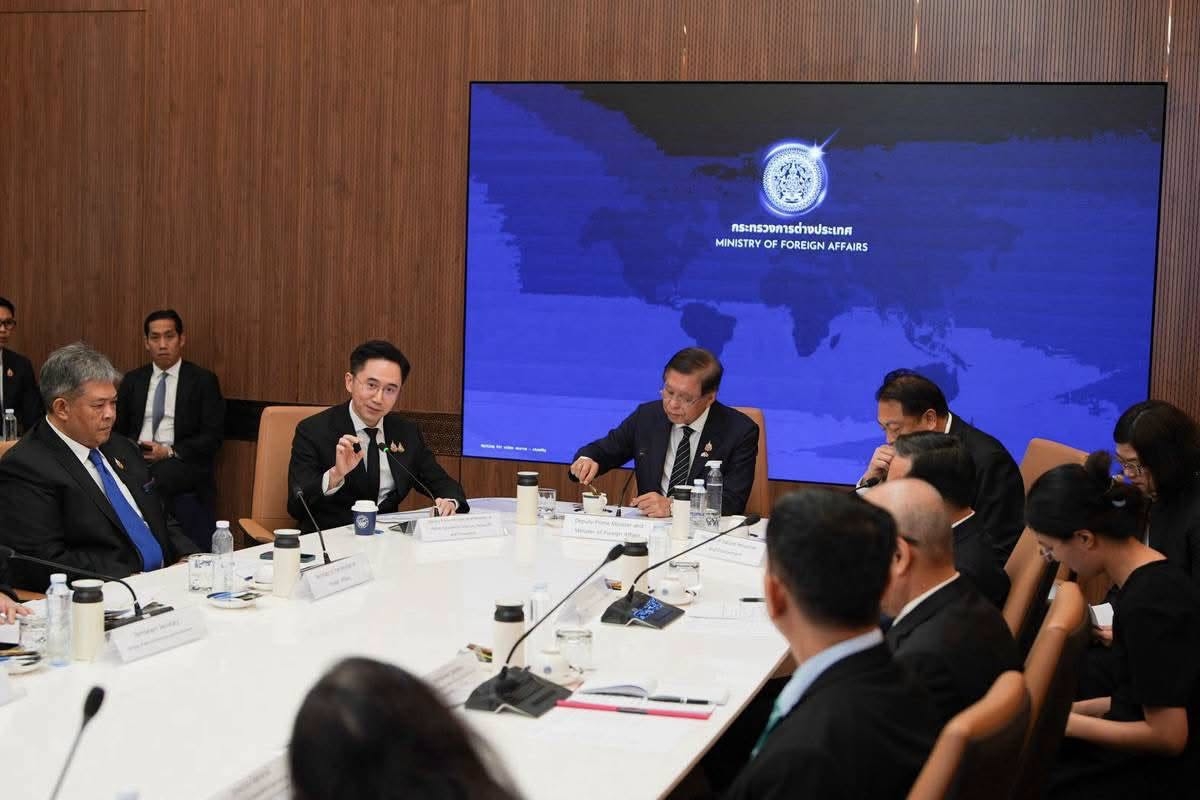
“Sihasak” views the meeting of representatives from three countries as a positive sign after discussions on resolving mining-related toxins. Meanwhile, “Yossanan” plans to order a six-month mine closure after agreeing that water toxins originate from mining activities.
On 24 Nov 2026 at the Ministry of Foreign Affairs, participants of the Joint Working Group on Water Quality Management in Boundary and Transboundary Rivers among Thailand, Myanmar, and China, visited Deputy Prime Minister and Foreign Minister Sihasak Puangketkaew, Deputy Prime Minister and Minister of Higher Education, Science, Research and Innovation Yossanan Wongsawat, and Minister of Natural Resources and Environment Suchat Chomklin.
From Myanmar's side, the delegation included the Permanent Secretary of Myanmar’s Ministry of Natural Resources and Environmental Conservation, Myanmar’s Ambassador to Thailand, and representatives from Shan State. China was represented by Zhang Jianwei, the Chinese Ambassador to Thailand.
Deputy Prime Minister and Foreign Minister Sihasak Puangketkaew said the head of Myanmar’s delegation for the joint water quality management working group for the Sai and Kok Rivers paid courtesy visits to him, Yossanan, and Suchat to discuss future cooperation, emphasizing the urgency and importance. He expressed gladness that the working group was established to collaborate seriously, as the issue affects both Thailand and Myanmar and requires joint solutions.
He added that the leaders have expressed commitment to resolving the problem. When Myanmar’s Senior General Min Aung Hlaing visited Thailand, he reaffirmed readiness to cooperate with Thailand, as did Chinese Premier Li Qiang during his recent visit. Later, Thai Prime Minister Anutin Charnvirakul met Chinese President Xi Jinping at APEC, with China confirming its commitment to support both countries in addressing the issue.
The Deputy Prime Minister and Foreign Minister noted that China drives the Mekong-Lancang cooperation framework for water management. In discussions with Xi Jinping, China acknowledged mining activities in Shan State by Chinese private enterprises and affirmed that any illegal or harmful activities would not be supported. This underscores China’s attention to the issue, reflected by the presence of the Chinese ambassador to Thailand at the meeting.
Sihasak further said it is a positive sign to hold the meeting on 25-26 November chaired by the Permanent Secretary of Thailand’s Ministry of Natural Resources and Environment alongside Chinese and Myanmar counterparts. Myanmar has expressed readiness to develop an action plan. The problem has many dimensions and cannot be solved in a day or two; it requires examining from source to endpoint with scientific support.
Representatives from Shan State and Chinese experts from Yunnan also joined today’s meeting. This involvement of all stakeholders aims to ensure progress in the 25-26 November meeting.
Deputy Prime Minister and Minister of Higher Education, Science, Research and Innovation Yossanan Wongsawat said the discussions clearly showed that arsenic contamination is not natural but comes from mining, specifically in Shan State, which all parties accepted, indicating consensus to address the problem at its source.
Further discussions distinguished between government-controlled and private mines. For government-controlled mines, joint guidelines incorporating Thai and Chinese scientific standards will be applied. For private or individual mines, a request was made via the Chinese ambassador to establish scientific traceability standards for rare earth mineral mining to assist Myanmar’s government in verifying whether mining operations meet standards, providing a framework for collaborative solutions.
“The ambassador acknowledged and understands the issue well. I see this as a positive sign to begin addressing the problem at its source. Tomorrow, the Permanent Secretary of the Ministry of Natural Resources and Environment and relevant networks will collaborate on an action plan. Myanmar is willing to form additional working groups if needed. Further details will be discussed at the upcoming meeting,” Yossanan said.
Yossanan added that the working group meeting will address immediate actions Myanmar’s government can take, alongside parallel actions by private entities. Thailand is already working on-site to monitor water quality and scan for contaminants in agricultural areas. The Ministry of Natural Resources and Environment has increased groundwater drilling points by ten and is working on community water supply. Efforts include a one-stop service center providing data and visual plans for water and agriculture management, plus installing sensors to detect toxins in aquatic animals.
He further noted that dry-season paddy fields can still be cultivated with clearly defined boundaries. Sediment traps are being installed to assure safety before irrigation water release next month. Each mine’s contamination profile will be assessed to design appropriate sediment traps with lab support from Thailand and China, as filtering toxins requires site-specific solutions and sample collection from mines.
When asked about publicly disclosing mine names for accountability and reasons for any nondisclosure, Yossanan replied that he personally supports transparency. Official discussions and investigations will follow; there are several mines involved, and there is no reason for the Thai government to withhold information.
Regarding China’s role in problem-solving and collaboration, Yossanan said he has discussed with the Chinese ambassador that for private mines, most rare earth minerals from Myanmar go to China, which can trace their origin and verify compliance with standards. This is one role China can fulfill, alongside international support. The goal is to raise global awareness about the critical need to manage water quality from the source, which China is positioned to help address.
He noted there are many mining operations, and Thailand alone cannot manage them. Private mines require guidance and financial support. The Mekong-Lancang framework contributes to planning, but actual implementation requires funding decisions. Thailand will not use its own budget for this and expects compensation. “We strive to make this framework clear in discussions,” Yossanan said.
On the government’s consideration of trade measures to ban mineral imports from Myanmar or exports to China and the proposal to close mines near water sources, Yossanan said he personally requests a six-month mine closure, which aligns with current frameworks. The working group will prioritize which mines can comply and which cannot. The Thai Prime Minister has directed the National Security Council to act first to intercept precursor substances for export. The Ministries of Industry and Commerce are reviewing regulations to ban harmful imports to protect Thai people.
Asked about mines located in ethnic minority areas, Yossanan acknowledged the difficulty but said standards require on-site inspections for each mine. For mines that cannot be managed, China’s government assistance will be sought.
When asked whether China has committed to helping or if Thailand merely presented the issue, Yossanan said they proposed the plan and recently shook hands in agreement. China is committed and will collaborate, including joint site visits. The effort requires multiple sectors but currently shows good intent.
Minister of Natural Resources and Environment Suchat Chomklin said all parties are committed, but Thailand suffers the greatest impact. Myanmar sent high-level representatives, including permanent secretaries and various departments. China’s ambassador to Thailand also attended to understand and help resolve the issue, marking a positive sign for cooperation.
Tomorrow will be the joint working group meeting chaired by Rawiwat Puridet, Permanent Secretary of the Ministry of Natural Resources and Environment. The meeting will include exchanges and possibly requests for Thai involvement in Myanmar territory. On 28-29 Nov, a joint field visit with Myanmar will take place in Chiang Rai Province, led by Deputy Prime Ministers and Foreign Ministers Sihasak Puangketkaew and Yossanan Wongsawat.