

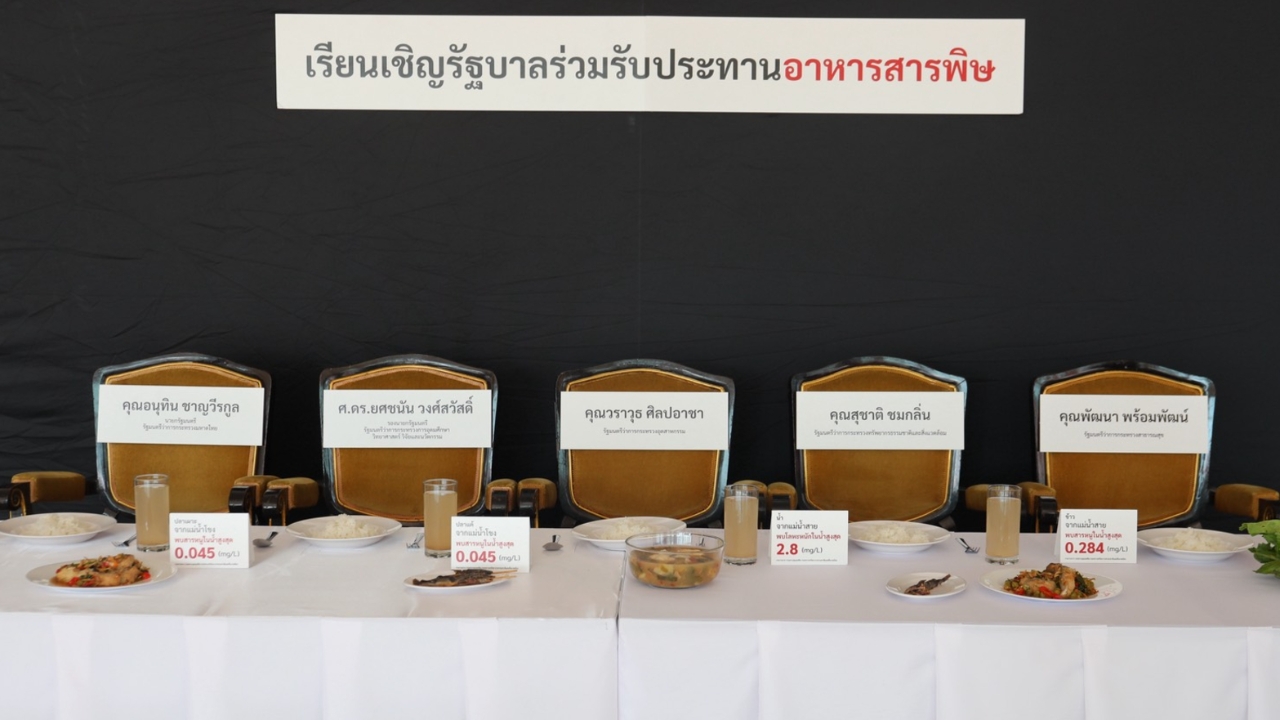
Mae Ai villagers brought climbing perch and climbing gourami fish from the Mekong River, along with rice and water from the Sai River, to prepare food dishes inviting the government to taste. They also submitted a letter through the opposition urging the government to urgently resolve cross-border toxic pollution, as tests found arsenic accumulation in residents' bodies has risen by more than 50%."}],
On 25 Nov 2026, Natthapong Rueangpanyawut, leader of the People’s Party and opposition leader in the House of Representatives, received a letter from a network of residents from Tha Ton area, Mae Ai District, Chiang Mai Province, affected by cross-border toxic contamination from mining activities in Myanmar. He affirmed that the People’s Party prioritizes environmental issues and the resolution of cross-border river pollution continuously, stating the government must swiftly implement domestic measures and international negotiations to address root causes and mitigate impacts on the public.


Natthapong said the problem affects not only health and the environment but also the livelihoods and occupations of local people, especially farmers, who face uncertainty about risk areas. This has led to a blanket suppression of agricultural product prices from northern regions, harming farmers through middlemen and eroding consumer confidence.
He proposed that the government quickly adopt the risk map developed by the subcommittee chaired by Pattharaphong Leelaphat, Chiang Mai MP of the People’s Party, in collaboration with civil society and academic sectors. This map clarifies which areas are truly affected and which can continue normal agricultural activities.

“The government can act immediately to clarify which areas are safe for farmers to work without being unfairly subjected to price suppression by middlemen, thereby restoring consumer confidence,” he said.
Regarding the upcoming Thailand-Myanmar Joint Working Group (JWG) meeting on 25–26 Nov, Natthapong emphasized that the key is not just holding the meeting but producing outcomes that lead to real solutions. Negotiations must cover all six rivers—Kok, Ruak, Mekong, Salween, and Kraburi—and all affected parts of Thailand, not just the currently publicized areas.

At today’s letter submission, residents from Mae Ai brought local fish and river water to the table, inviting the government to taste them, as contamination in residents’ bodies is rising. Part of this is believed to come from exposure and consumption of contaminated water and aquatic animals caught from polluted rivers.
Natthapong stressed that joint testing must expand beyond water quality checks, as Thai agencies have found evidence of arsenic accumulation in residents’ bodies. Comparing samples of 322 people from 2025 and 2026 shows arsenic levels increased by over 50%.


“We must talk beyond water quality now, since clear evidence shows arsenic accumulation in people is increasing. Therefore, discussions in the JWG must go beyond water testing to address how to manage this problem effectively,” he said.
He also called for transparent disclosure of testing processes, including locations, times, and result schedules. For example, if water quality is normal before a mine but toxic after, that provides crucial evidence to identify pollution sources and implement targeted measures against polluters.

On international negotiations, Natthapong said Thailand should use additional multilateral cooperation mechanisms because some mining areas in Shan State and other parts of Myanmar may not be fully controlled by the Myanmar military government. He proposed using the upcoming Mekong-Lan Chang forum, which includes China and Laos, as another channel to jointly address the root causes.
He warned that rare mineral mining could expand into Laos, potentially impacting the Mekong River and northeastern Thailand, where many people rely on the river for farming and livelihoods.
“I truly cannot imagine how many millions of people in the northeast, with vast agricultural land, would be affected if toxic residues reached that region, as happened to the people of Tha Ton who came to brief us today,” he said.


Another issue Natthapong urged the government to address is diplomatic engagement with China, since Thailand may be used as a transit route for mineral imports from neighboring countries before exporting to China. While most value-added benefits from processing into high-tech products like permanent magnets for electric vehicles and electronic circuits go to producing countries, Thai citizens bear environmental and health costs.
He said the Thai government should seriously raise this issue with China, especially regarding oversight of the rare mineral supply chain from origin to end, noting that China itself has laws and measures considering environmental impacts in mining supply chain management.

Simultaneously, Thailand must implement domestic measures under the Mineral Act and import-export laws, issuing subordinate regulations to verify minerals throughout the supply chain—from mining sites and import processes to domestic handling and exports—to prevent Thailand from becoming a transit point for minerals from sources lacking environmental safeguards.
“Today, Thailand is already being used as a transit for minerals from neighbors to China with almost no value added here, while the cost we pay is toxic substances accumulating in our people’s bodies,” he said.
Natthapong concluded that the People’s Party has received the letter and information from the Tha Ton community and is ready to advance these issues in all parliamentary forums, including government oversight, committee mechanisms, and pushing necessary measures to ensure cross-border toxic contamination is effectively addressed, preventing further impacts on local communities.
