

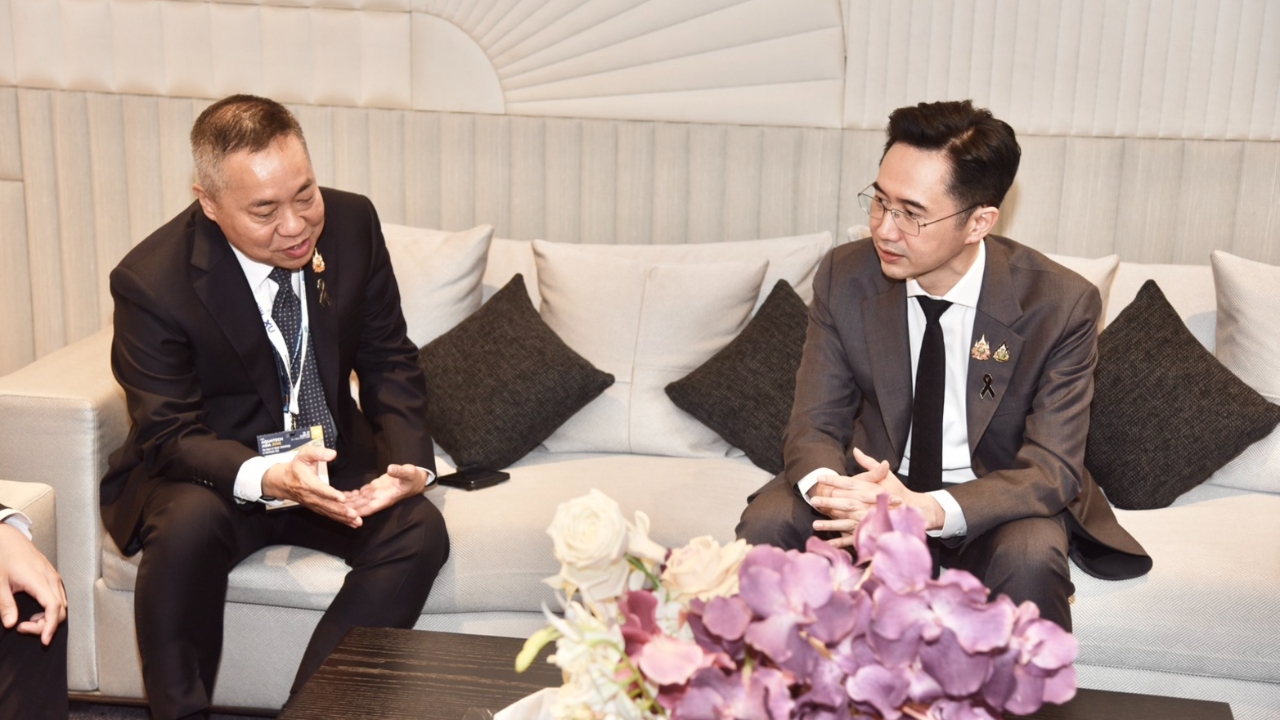
The NSC Secretary met Deputy Prime Minister Yotsanan to report progress on blocking the export of mining chemicals. He plans to propose to the Defense Council a ban on exporting two precursor chemicals on 30 November, ahead of the Cabinet meeting on 1 December. He emphasized his support for expert Chen.
At 12:00 on 25 November 2026, at the Queen Sirikit National Convention Center, General Chaiphruek Duangpraphat, Secretary-General of the National Security Council (NSC), met Deputy Prime Minister and Minister of Higher Education, Science, Research and Innovation Yotsanan Wongsawat to report progress on controlling chemicals exported from Thailand for mining purposes.
Later, General Chaiphruek said after meeting Yotsanan that he reported on efforts to block the export of precursor chemicals from Thailand. The NSC has already sent information to Defense Minister Lieutenant General Adul Boonthamcharoen. He discussed with the Defense Minister in Cabinet about the steps to ban exports of four types, noting that two types are not currently exported from Thailand. Initially, a ban on exporting two types will be announced. This will be considered by the Defense Council on 30 November before Cabinet consideration on 1 December. However, he cautioned not to overlook anything. On the afternoon of 25 November, he convened relevant agencies and private mining businesses to gather useful information, such as whether other chemicals are still being exported from Thailand. If so, those will be promptly submitted to the Defense Council to consider together in the same round.
General Chaiphruek added that he also provided Yotsanan with information that may be useful in future negotiations, including NSC observations from field visits. These include unregistered mines, mines outside any regulatory control, or abandoned mines that pose environmental burdens, increasing the risk of toxins contaminating water and soil. The NSC is fully prepared to support as much as possible, whether in planning or operational details. The NSC has networks across security, private, and academic sectors to support these efforts.
When asked about reports that mines in Laos are also releasing toxins into the water, General Chaiphruek said that inspections so far have found no data confirming the release of toxins or contaminants into nature. The current approach is to monitor the situation.
When asked about reactions from the mining side to Thailand’s planned ban on precursor chemical exports, General Chaiphruek said no reactions have been received yet. Negotiations are ongoing at the national level. He also wished to convey a message to companies and businesses involved in this matter: If you are in Thailand and Thai, these issues have caused severe hardship to the people for quite some time. The impact affects water use and agriculture, from small local points to the national level, including affecting yourselves. Therefore, whatever you can do to help the nation and its people, he urges you to act from the beginning. He believes no one intends for these events to occur, but we must all cooperate and make small sacrifices to reduce harm to the people as quickly as possible.