

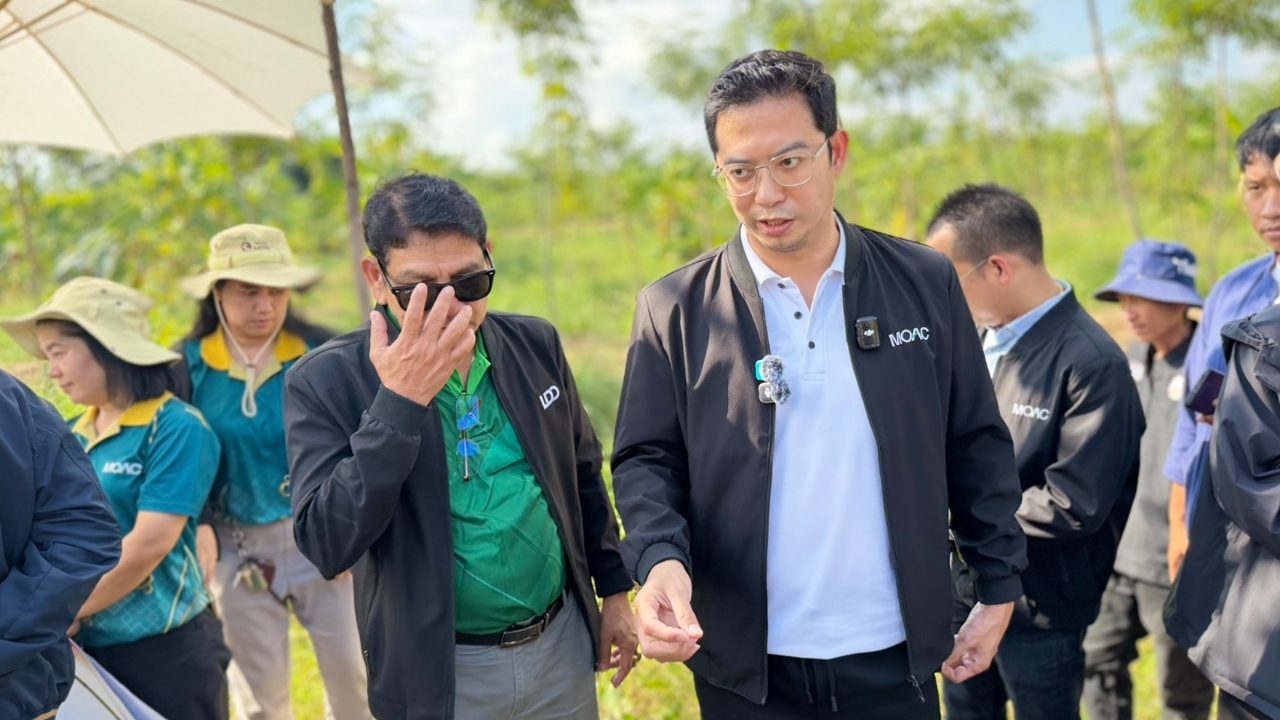
Suriyas instructed Jadet to monitor the collection of water, soil, and agricultural product samples in the three Chiang Rai river basins to create an Agri-Map risk map. He declared that if contamination is detected, the ministry will purchase and destroy the products immediately, emphasizing that rice is safe to eat normally.
On 26 Nov 2026, Jadet Chantra, Assistant Secretary to the Minister of Agriculture and Cooperatives, revealed that he was assigned by Suriyas Jungroongruangkit, Minister of Agriculture and Cooperatives, to visit Chiang Rai province. The mission is to oversee the collection of soil samples in coordination with the Land Development Department, Rice Department, Department of Agriculture, Department of Agricultural Extension, Naresuan University, and Chiang Rai Rajabhat University to monitor arsenic and heavy metal contamination in the Kok, Sai, and Ruak river basins.

Minister Suriyas has ordered all relevant agencies to promptly survey impacts and risk factors affecting agriculture comprehensively and to develop a localized risk map of heavy metal and toxin contamination (Agri-Map) to reassure consumers of agricultural products both domestically and internationally.
Today, the involved agencies collected water, soil, and agricultural product samples along the banks of the three rivers within 200 and 500 meters, covering 65 subdistricts over more than 150 kilometers at 350 locations. Sampling began on 23 November and has now been completed. The samples will be sent to four ISO-certified laboratories under the Rice Department, Land Development Department, Department of Agricultural Extension, and Department of Agriculture for analysis.

It is expected that test results will be available within two weeks. These results will guide the creation of the agricultural risk Agri-Map, establishing area management measures in three levels: red zones, indicating contamination above standards, where the ministry will purchase and destroy all agricultural products to prevent contaminated food from reaching consumers.
For the next planting cycle, farmers will be encouraged to switch to non-food crops such as flowers, with coordination through cooperatives and network partners to ensure market support for their products. Yellow zones are monitored areas possibly affected by arsenic carried by floodwaters during the rainy season. Preventive measures include constructing dikes or earth barriers to contain contamination spread. Farmers are advised to avoid using river water directly for cultivation and instead use rainwater, groundwater tested for safety, or small ponds on farms as water reserves. Green zones are areas without contamination, where the ministry will issue safety certificates to farmers to assure confidence in product sales and agricultural practices.

All collected data will be processed on the Agri-Map platform, allowing farmers and the public to check locations and receive crop recommendations suitable for planting. The Ministry of Agriculture and Cooperatives will deploy staff to communicate quickly and clearly with farmers to build trust in safety standards and national food security.
Regarding the Ministry of Natural Resources and Environment's plan to propose the Kok River bank areas as pollution control zones to the National Environment Board on 2 December, which may affect consumer confidence in agricultural product safety from these areas, the Assistant Secretary to the Minister of Agriculture stated that the ministry enforces strict agricultural product quality checks. Although the pollution control zone designation may proceed before the Agri-Map is completed, preliminary rice sampling by the Rice Department found no contamination. He reaffirmed that the public can consume rice safely as usual.