

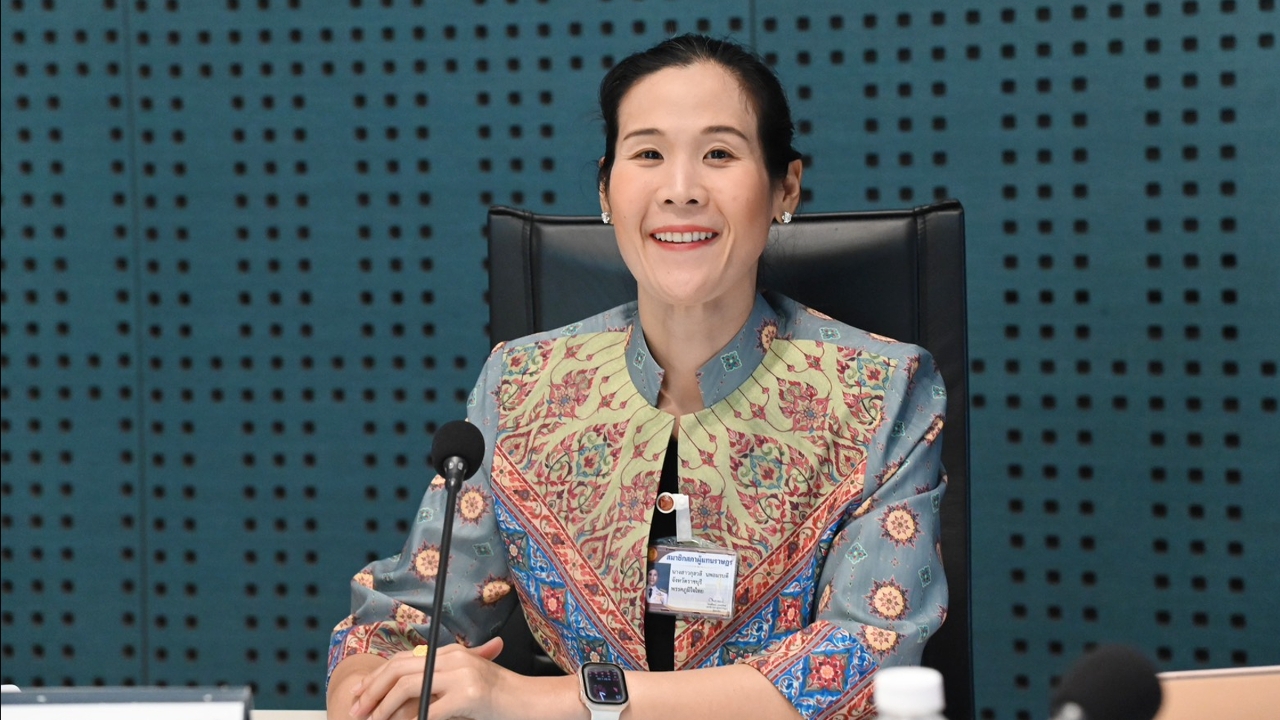
Kulwalee urges controlling chemical exports to Myanmar mines to prevent cross-border toxic pollution, expressing disappointment at the Foreign Ministry's lack of representatives at the meeting, which resulted in insufficient negotiation data. She emphasized, “Monitoring alone is not a solution; merely measuring water values has never stopped toxins.”Tags: [chemical exports, cross-border pollution, Myanmar mines, Foreign Ministry, environmental monitoring]
On 25 Nov 2026 at the Parliament, Ms. Kulwalee Nopamornbodi, Member of Parliament for Ratchaburi from the Bhumjaithai Party and Chair of the Land, Natural Resources and Environment Committee of the House of Representatives, chaired a meeting to monitor the cross-border toxic contamination crisis affecting the Sai, Kok, Ruak, Mekong, and Kraburi rivers. Key agencies were invited to provide explanations, including the Ministry of Foreign Affairs, the Pollution Control Department, the Department of Water Resources, the Department of Fisheries, the Military Border Affairs Department, the Geo-Informatics and Space Technology Development Agency (GISTDA), Chiang Rai Province, and the Provincial Waterworks Authority.
Ms. Kulwalee reported that arsenic levels in the Sai River had abruptly surged beyond safety standards, forcing the Mae Sai water supply to “close valves and stop water delivery,” impacting more than 9,500 households. Meanwhile, sediment in the Ruak River at Chiang Saen has accumulated arsenic at dangerous levels, beginning to affect crops and aquatic animals in various areas. This issue extends beyond the North. The Kraburi River in Ranong Province has suffered from severe red and turbid water due to sediment from mines on the Myanmar side in Kawthaung for more than six years, affecting over 1,250 farming households across more than 30,000 rai, with local fisheries losing over half their income and rare aquatic plants (Cryptocoryne grass) nearing extinction. Despite the province sending letters twice to the Ministry of Foreign Affairs, no response has been received. Satellite images from GISTDA confirm that upstream mines have expanded and water turbidity has worsened significantly, especially since 2022.
Ms. Kulwalee said that today's meeting lacked critical information on international negotiations because the Ministry of Foreign Affairs, despite being invited, did not send representatives to provide explanations due to commitments at a joint working group meeting hosted by the ministry. This absence prevented the Land Commission from obtaining updates on talks with neighboring countries. She expressed disappointment over the Foreign Ministry’s failure to attend and provide information, considering the matter vital to the lives of local people.
“Although the Thai government signed a cooperation framework (MOU/TOR) with Senior General Min Aung Hlaing, leader of Myanmar, on 6 Aug 2026, more than three months have passed without improvement. The situation worsened critically on 5 Nov, forcing the suspension of water supply. Reactive measures focusing only on water quality testing have proven ineffective. We need to address the root cause and act faster,” the Land Commission chair said.
Ms. Kulwalee presented four urgent proposals from the Land Commission meeting: 1. Declare the affected areas (in Chiang Rai and Ranong provinces) as “pollution control zones” or environmental control/protection zones and have provinces collaborate with the Provincial Waterworks Authority to provide clean water and restore village water systems (including training and material support with local governments), using emergency government advance funds to assist citizens immediately. 2. Address the root cause by involving the military in negotiations; government-level committees should include military representatives, and negotiations should escalate from local (TBC) to regional (RBC) and highest-level (HLC) forums to directly engage those controlling the source areas along the northern border and Ranong side.
Ms. Kulwalee added: 3. The Department of Fisheries should adjust its public communications to specify not only which species of fish and shellfish are contaminated but also precisely which areas are affected and which species and areas remain safe for consumption, in order to restore confidence in tourism and Mekong river fish consumption and avoid generalizations that harm honest operators. 4. She proposed that the Provincial Waterworks Authority study the British approach to similar problems, where they invested in permanent sediment treatment systems separating toxins. Construction took several years, and the system has operated continuously for decades because mining sources persist. Since the Waterworks Authority already has similar technology, it should draft proposals for government investment in sustainable long-term solutions.
The Pollution Control Department and the Department of Water Resources, as two working groups under the National Environment Committee’s subcommittee, have already received the commission’s recommendations for further action.
The Land Commission chair emphasized that addressing the root cause requires “cutting the economic lifeline” that supports mining, especially controlling the export of chemicals used in mining (such as sodium cyanide), regulated by the Department of Industrial Works and the Department of Primary Industries and Mines under the Ministry of Industry, together with Customs Department. Previously, the National Security Council reported finding chemical exports linked to mining activities, matching civil society’s prior proposals to the Ministry of Industry about mining sources. To mobilize all parliamentary mechanisms, the commission will forward the issue to the Industry, Foreign Affairs, and National Security Committees. It will also propose elevating border negotiations from local (TBC) to regional (RBC) levels chaired by regional commanders, and to the highest level (HLC) chaired by the Chief of Defense Forces at an appropriate time.
“We will follow up on this matter to the end. The people of Chiang Rai, Mae Sai, Ranong’s Kraburi basin, and all river basin communities must not be left to live with toxins they did not cause.”Tags: [environmental policy, cross-border pollution, chemical exports, Myanmar mining, water contamination, parliamentary oversight] Ms. Kulwalee concluded.