

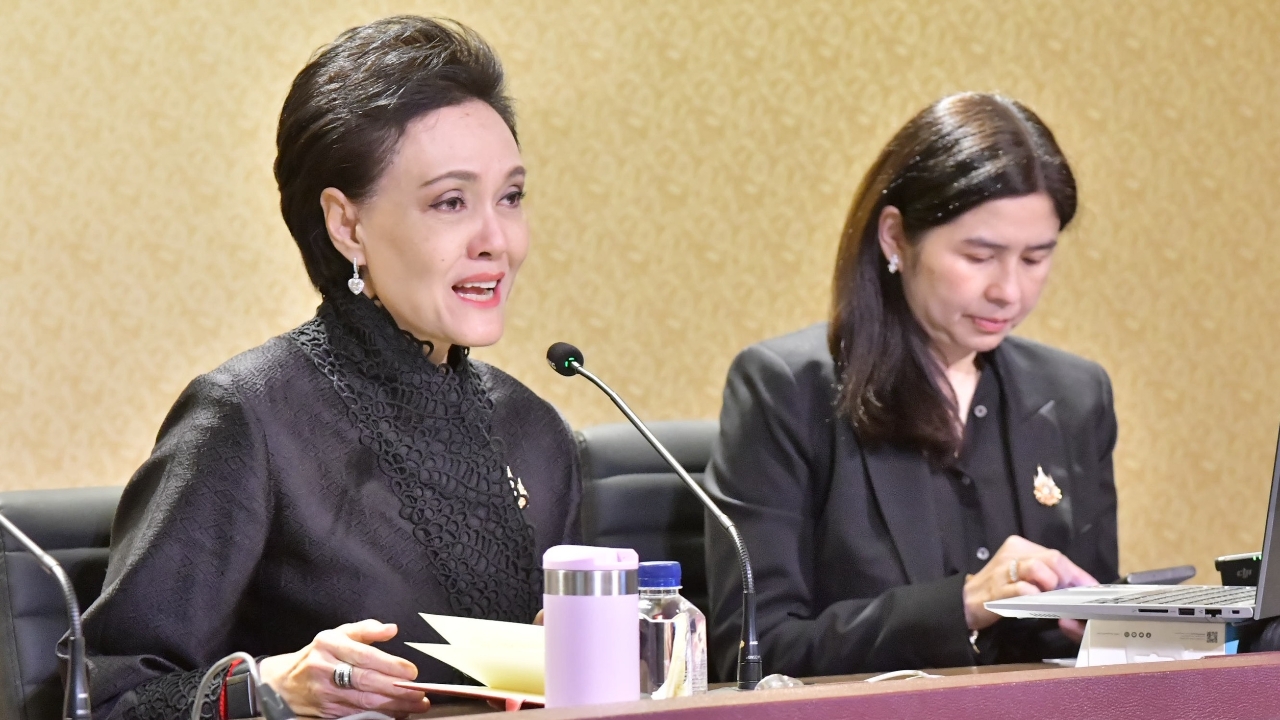
Supachai revealed that the US-Thailand tax negotiation reached an 18% tariff rate, which, despite ART not being signed yet, is equivalent to ASEAN countries. She affirmed the protection of exports, investment, and employment for continued growth, explaining that the US Section 301 tariff products cover only 20% of exports.
At 12:00 on 26 Nov 2026 at the Naree Samosorn Building, Government House, Supachai Suthumpun, Deputy Prime Minister and Minister of Commerce, announced that the US proposed a tariff on Thai goods not exceeding 18%, consistent with Thailand's discussions with the US, matching rates of Malaysia, Indonesia, and Cambodia, which have signed the Agreement on Reciprocal Trade (ART). This helps maintain the competitiveness of Thai products in the top export market.
The US Trade Representative (USTR) announced a draft investigation result under Section 301 concerning structural excess capacity. The investigation covers 14 countries and economic zones, proposing tariffs on Thai goods not exceeding 18%, including the existing Section 301 tariffs related to forced labor imports, without additional increases. This aligns with Thailand's negotiation strategy that led to this tariff rate.
This result reflects that Thailand's strategy to push for concluding ART negotiations and signing a Joint Statement between the Thai Prime Minister and the US President on 17 Nov 2026 during the ASEAN Summit in the Philippines was a correct policy decision. It places Thailand alongside ASEAN countries that have signed ART, such as Malaysia, Indonesia, and Cambodia, all receiving rates not exceeding 18%. The draft investigation also notes the US might impose tariffs up to 25% if discussions or compliance are unsatisfactory. If Thailand fails to conclude negotiations, it could face tariffs 7% higher than neighbors. Countries without ART conclusions, like Vietnam and Singapore, face proposed rates of 35% and 20%, respectively, but reductions may occur if agreements are reached, highlighting ART's importance in US tariff decisions.
Supachai added that the proposed US tariff rate will help preserve the competitiveness of Thai products in the US, Thailand's top export market valued at 2.37 trillion baht in 2025, about 25% of total exports, expected to reach 3 trillion baht in 2026. It also protects agricultural exports worth 170 billion baht (excluding rubber and related products valued at another 160 billion baht) and employment for over 1.25 million people. Maintaining competitiveness in the US market is a key priority for the Ministry.
At this stage, the draft investigation is not yet in force, meaning Thai exports still pay the existing 12.5% tariff until the final investigation result is announced. The USTR will accept written comments by 5 Jan 2027 and hold a public hearing on 25 Jan 2027 before issuing the final decision. Thailand will use this process to clarify facts to achieve the lowest possible actual tariff rate, alongside expediting ART agreement signing.
Regarding ART, the next step involves Thailand and the US jointly refining the legal wording (legal scrub) of the agreement, then submitting it to the Cabinet for approval to proceed to signing. Afterwards, public and stakeholder consultations will be held, with appropriate measures to support potentially affected groups before Parliamentary approval. Subsequently, laws will be amended to comply with the agreement and ratification will be completed to enforce the treaty.
Supachai emphasized that throughout the investigation and ART negotiations, the Thailand team—comprising government and private sectors—has continuously provided facts and engaged with USTR to confirm Thailand has no subsidy policies encouraging excess capacity and that its investment promotion policies comply with WTO commitments. Negotiations prioritize national interests under relevant laws and international standards, with open consultations and efforts to minimize impacts. The government is ready to assist affected parties with proper measures. Before signing, the matter will be presented to the Cabinet and Parliament for approval. Currently, the 18% Section 301 tariff is not yet enforced.
Thailand and the US share a strategically important economic and trade relationship with a long history. The Ministry of Commerce is ready to work constructively with the US to promote fair, transparent, and sustainable trade, strengthening mutually supportive supply chains for the benefit of businesses, workers, consumers, and citizens of both countries.
Supachai also stated that the aim is to protect investment, employment, and income opportunities for Thailand, which is the core message of the Section 301 announcement. Regarding concerns about the 18% tariff being increased further, she confirmed no additional increases will occur, and efforts will be made to negotiate rates below 18%. Currently, the 18% tariff is not yet effective since the US must conduct public consultations with stakeholders domestically and internationally, with Thailand's government and private sectors prepared to provide information. The tariff is expected to be enforced around March 2027. Thailand currently pays a 12.5% Section 301 tariff, with about 2,121 exempt items subject to basic tariffs, representing 60% of exports to the US. Items under the 12.5% Section 301 tariff account for over 20% of exports to the US.
"Ideally, the US would impose zero import tariffs, which we obviously prefer. We will fight fully, though we anticipate it’s unlikely as Thailand has a trade surplus with the US, which tends to increase with negotiations. Market access to Thai products is our right; if we don’t buy, the US-Thailand trade gap cannot be reduced. It’s a good question, but Thailand does not want the US to impose import tariffs," Supachai said.