

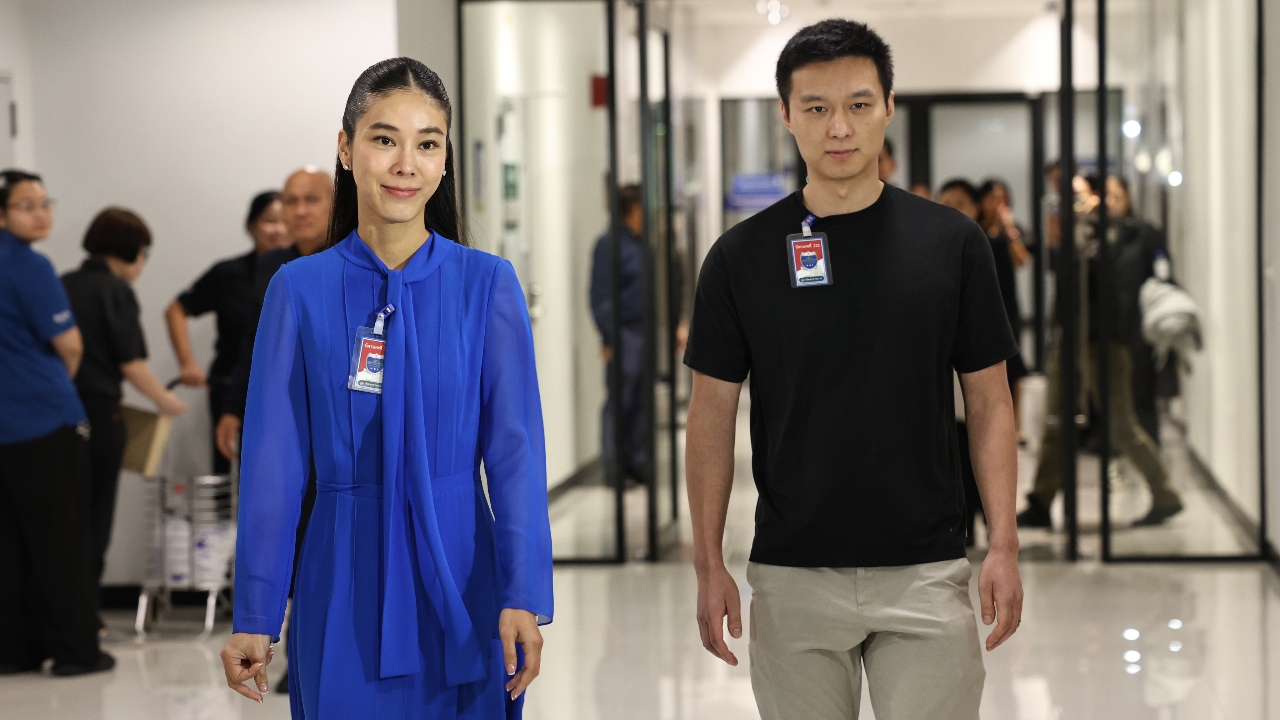
Taiyang Sang, husband of MP Idea Suchada, filed a criminal complaint against Rangsiman Rom, affirming no involvement with scammers. He revealed his profession as a programmer and explained that his 2 billion baht assets came from software sales.
On 26 Nov 2026 GMT+7, Ms. Suchada Sang Taansap, or Idea, MP for Chaiyaphum from the Bhumjaithai Party, posted on Facebook that Mr. Taiyang Sang asked her to share the following message with everyone.
The message states that yesterday (25 Nov), I submitted evidence to police to support a criminal case against Mr. Rangsiman Rom for actions I believe constitute criminal offenses against me. Mr. Rangsiman accused me of involvement with scammers and international crime. These allegations are untrue. I have no connection to any criminal acts and have never been charged or prosecuted by authorities in any country.
I am a programmer; my profession is software development. I began this work at age 15 while living in Australia. My work history has always been publicly available. Anyone can search and verify this information via Google.
I am an Australian citizen, born and raised in Australia. My parents are also Australian citizens. Both worked hard with integrity, dedicating themselves to public service as civil servants in Australia's Ministry of Finance.
The message continues that I have also worked and earned a living honestly. In 2017, at age 20, I moved to Singapore driven by my interest and passion for technology. Singapore is open to tech professionals and offers an environment conducive to work and innovation. I am grateful to Singapore for giving a young man like me the opportunity to live, work, and pursue my passion. During my time there, I devoted myself fully to software development until one day, my software succeeded beyond my expectations.
The software, named Ren Protocol, was developed to enable users to connect and transfer digital assets across different blockchain networks more easily. It is a decentralized blockchain infrastructure. Simply put, it allows Bitcoin holders to use their assets on the Ethereum blockchain network.
Ren Protocol was well received and quickly became widely used in the global digital asset community. It earned users’ trust as a reliable and secure technology for cross-chain digital asset transfers.
Due to this success, one of the world's largest digital asset trading platforms at the time recognized the software's potential and in 2021 offered to purchase it for approximately 2 billion baht. I accepted, selling the software and the entire business, and my development team joined the buyer. This occurred about five years ago.
All steps were conducted transparently and legally while I resided and worked in Singapore, known for its stringent regulatory system. I complied with laws of both Singapore and Australia. This is the main source of my current assets, the result of years of hard work and effort.
The message further states that after selling the software, I met my wife and later moved to live in Thailand. I continue to work seriously in software development and invest in related businesses. Currently, I focus on developing software applied to biotechnology, working on two main projects.
The first project involves developing software to assist research and discovery of new medicines by analyzing atomic and molecular components with potential to become drugs, especially for cancer and neurodegenerative diseases like Alzheimer's and Parkinson's.
For this project, I founded a company and gathered experts to collaborate and advance the project. The second involves developing software that simulates chemical, molecular, and atomic behaviors under various environments and conditions.
This software acts like a simulator allowing researchers to assess early in development whether discovered substances or molecules are likely to have desired effects, avoiding lengthy and complex experimental processes for every option from the start.
Such technology reduces research time, enabling researchers to explore more options and quickly select promising substances before proceeding to rigorous efficacy and safety testing.
For this work, my team developed the world's fastest Quantum Chemistry Simulator, which won the Gordon Bell Prize, one of the highest international honors in high-performance computing, often called the 'Nobel Prize of supercomputing.'
This award recognizes outstanding innovation in high-performance computing applied to science, engineering, and big data analysis.
I hope to share further progress on these projects in the future as they advance and when I can disclose details without compromising business confidentiality or competitive advantage.