

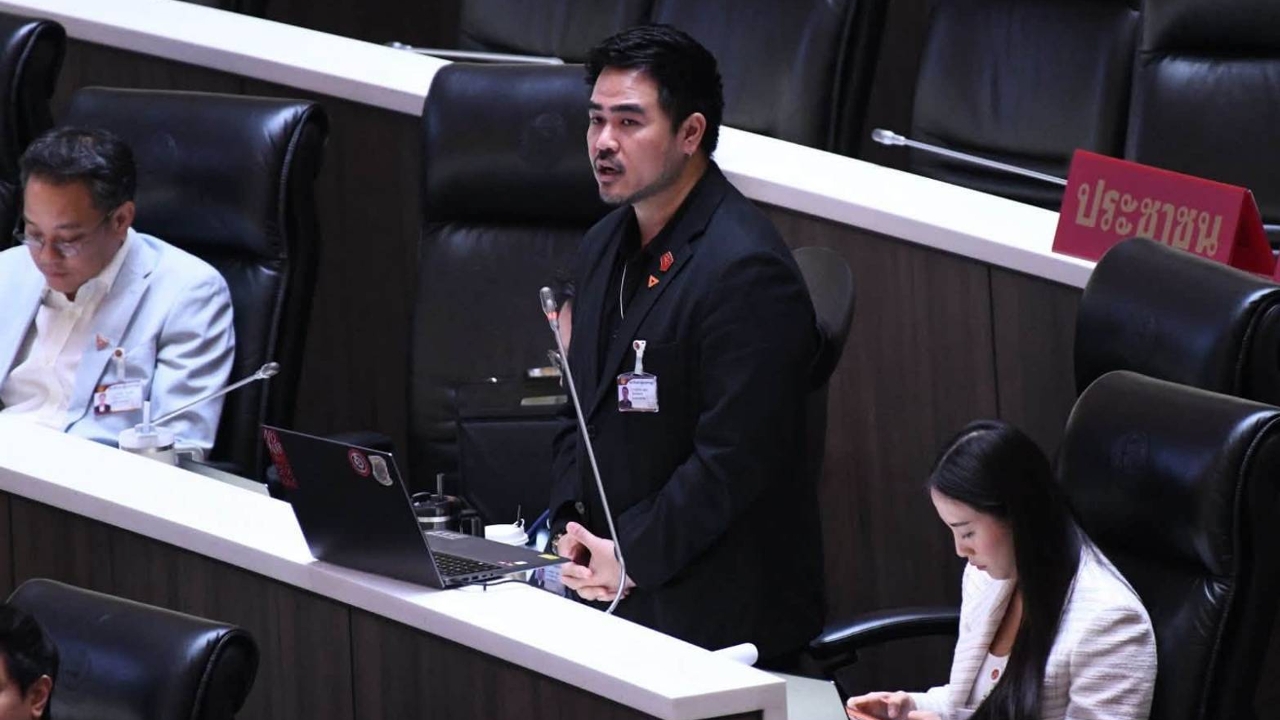
Sahasawat rebuts Chulaphan, saying that reviewing one Social Security board member should not freeze appointments of the other 13, urging prompt appointments respecting the voices of insured workers.
On 26 Nov 2026, Sahasawat Khumkhong, Chonburi MP from the People’s Party, responded to Labor Minister Chulaphan Amornwiwat’s statement that appointing the newly elected Social Security board cannot proceed because regulations do not allow appointing 13 members without complaints first. He also accused the People’s Party of double standards. Sahasawat said the party never demanded halting the review but wants the minister to solve the issue and respect the election results.
Sahasawat stated the previous Social Security board’s term expired on 13 Feb 2026. Insured persons and employers have elected 14 new representatives—seven each—but appointments have not occurred due to a qualification complaint against only one elected member, Thanapong Chuemuangphan, the insured workers’ representative, causing the other 13 members without complaints to remain unappointed.
He emphasized the People’s Party’s position has always been to review the complained member through legal processes, while the other 13 members without complaints should be appointed without delay. The review of one individual should not hold up the entire board’s appointment.
“No one has asked to stop the review; review it fully. If wrongdoing is found, act according to the law. Reviewing one person and appointing 13 others are different matters. Don’t mix them,” Sahasawat said.
Sahasawat also addressed the minister’s claim that regulations do not permit appointing the 13 members first, noting there has been no clear public explanation of which law or regulation restricts this. The 2021 Labor Ministry regulation on Social Security board elections, Article 51, requires compiling a full list of elected members, while Article 60 sets procedures for objection review within 30 days, extendable twice by 30 days each, without stating that one complaint suspends all appointments.
If the Labor Ministry interprets that appointing the 13 members first is impossible, it should publicly explain the legal basis and reasoning, and seek solutions, rather than just insisting regulations do not allow it.
Regarding concerns about staggered appointment dates causing non-synchronized terms, Sahasawat advised the minister to study the previous Social Security board case, where employer representatives resigned after appointment and the ministry appointed alternates later, yet all members’ terms ended together. The Social Security Act, Section 11, provides mechanisms to manage board terms, showing that staggered appointments do not necessarily mean staggered term expirations.
Sahasawat expressed concern over the minister’s statement downplaying urgency about the acting board reviewing next year’s budget and suggesting to wait for problems before addressing them. He said preventing damage before it occurs is a fundamental management principle. Since the previous board still has legal authority, questioning whether the new board should handle the budget they will manage is reasonable and should not wait until damage to insured workers’ funds happens.
He noted the minister said the complaint review is expected to conclude in one day and that once the matter reaches the minister’s desk, approval will follow immediately. He hopes this happens as stated, but if no conclusion is reached, the People’s Party maintains its proposal that the Labor Ministry should urgently appoint the 13 members without complaints by 1 Dec, while continuing to legally review the complained member.
“Reviewing the complained member must proceed, and respecting election results must proceed too. These two are not contradictory. We are not asking the minister to apply double standards but to solve problems, not use them as an excuse for inaction,” he said. Sahasawat concluded.