

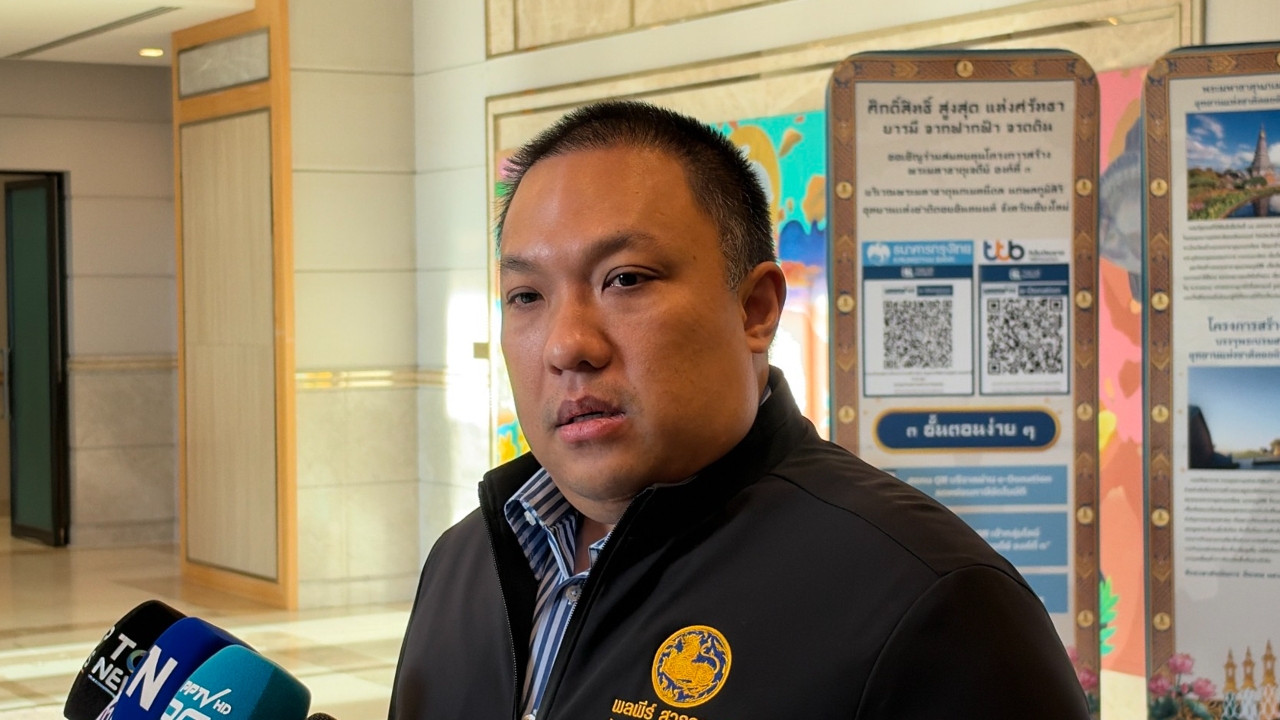
Polpee acknowledged that Ratchaburi residents oppose industrial waste and demand a halt to bringing waste from other provinces for disposal in their area. He stated that the Prime Minister has instructed the Interior Ministry to expedite coordination to assist the Ministry of Natural Resources in resolving the issue. Currently, the Interior Ministry Secretary is surveying landfill sites across four regions.
At 07:10 on 29 Nov 2026 at Don Mueang Airport, Bangkok, Mr. Polpee Suwanchavee, Deputy Minister of Interior, commented on Ratchaburi residents' call to halt the import of industrial waste from other provinces into Ratchaburi. He said he learned that Mr. Warawut Silpa-archa, Minister of Industry, responded in parliament that a private company would be contracted to transport toxic waste, and that the company already has a standard landfill in Ratchaburi. Polpee believes the public is uneasy about storing waste in their province even if the landfill meets standards. Warawut is seeking alternative disposal sites. Before Prime Minister and Minister of Interior Anutin Charnvirakul departed for the Socialist Republic of Vietnam, he instructed the Interior Ministry to assist, noting that although laws fall under the Ministry of Industry and environmental issues under the Ministry of Natural Resources and Environment, Interior Ministry officials must investigate how the waste arrived, whether there were reports or involved parties, if construction permits for buildings are proper, whether buildings conform to approved plans, any modifications, or if waste is buried beneath factories. The Interior Ministry Secretary will issue letters to all provincial governors, assigning the four Deputy Secretaries to oversee their respective regions and submit reports.
Mr. Polpee added that during his visit to Prachinburi Province to follow up on recycling and metal smelting plants, he emphasized to the provincial governor to order all local authorities to inspect every building and immediately suspend use of any with problems, effectively shutting them down. The Prachinburi governor set a timeline for agencies to inspect industrial waste disposal plants with a report due by 30 Nov. If successful, this Prachinburi model will be adopted in other provinces facing similar waste disposal issues.
Asked whether finding sites to receive industrial waste is difficult, Polpee said there are many methods and private areas with underground seals made of concrete or standard tarpaulins, with chemical inhibitors applied to contain chemicals before landfilling, similar to how water is sprayed on dead animals before burial. Several incinerators exist, and the Prime Minister said if residents oppose waste transport to certain areas, incineration should be considered. This is under review. Regarding transport, the Interior Ministry's equipment and vehicles, operated by the Department of Disaster Prevention and Mitigation, can facilitate safe movement. Deputy Minister Jeseth Thaises confirmed this capability, adding that the department has sealing equipment to prevent toxic leaks, drips, or airborne contamination during transport.
When asked about discussions with residents following public alarm, Polpee said talks are ongoing with the provincial governor. So far, no industrial waste has been moved, and it is understood that Ratchaburi residents are uneasy and want waste to be incinerated elsewhere.
When asked if waste can be destroyed immediately upon finding a suitable site, Polpee said he believes that would be ideal but the proposed site must be examined first. If it has legal ownership, belongs to locals, and affects water sources, farmland, or forests, NGOs protecting forest areas may raise issues. If there is a nearby incinerator capable of burning this type of waste, it would be preferable to incinerate there.
Polpee emphasized that industrial waste varies and not all incinerators can handle every type. Therefore, when relocating waste, it is necessary to confirm whether the waste can be incinerated at the destination. If a suitable incinerator exists nearby, the waste can be burned there; if the incinerator is far away, transportation will be required.