

The Prime Minister revealed that the Ministry of Defence will issue a proclamation on 30 Nov 2026 banning the export of precursor chemicals used in ore smelting that cause toxic pollution in northern rivers. He acknowledged that inspections of a waste plant in Prachinburi showed conditions worse than expected, asking, "Isn't this immoral?" after discovering toxic waste crushed and mixed with soil being distributed.
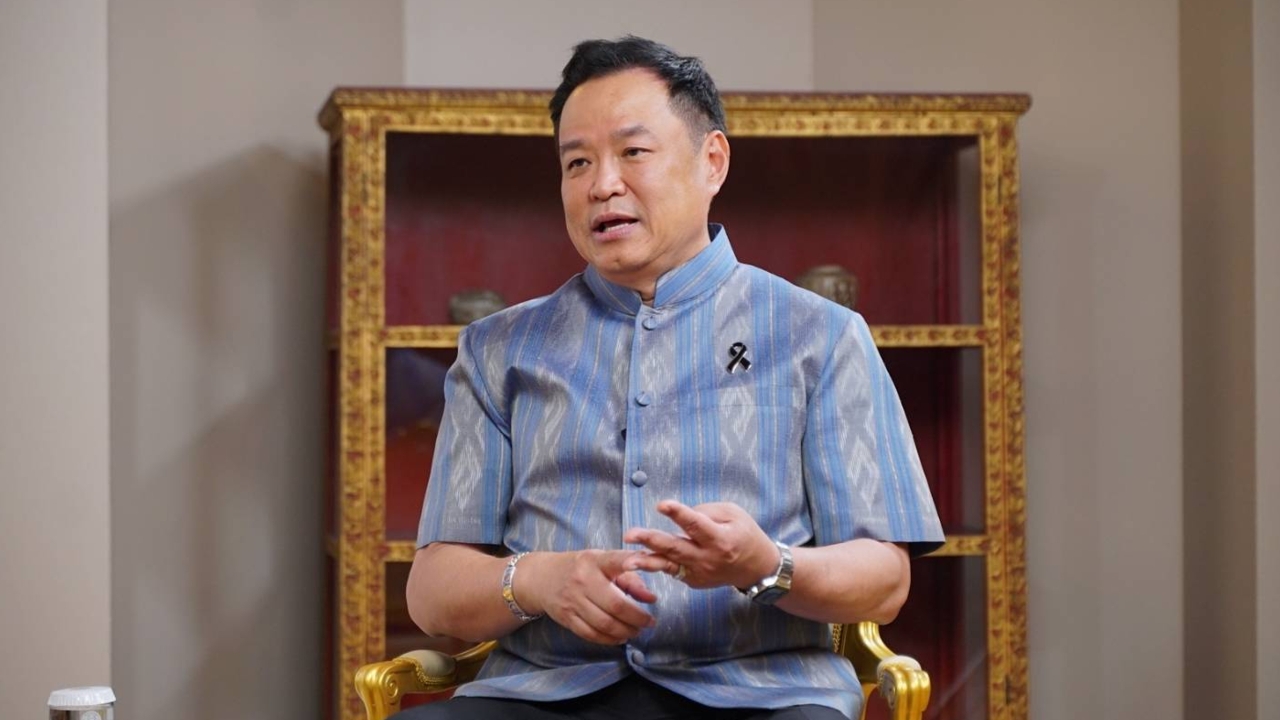
At 09:00 on 28 Nov 2026, Anutin Charnvirakul, Prime Minister and Minister of Interior, spoke on the program "Talk with PM Anutin" about the government's war on all forms of pollution. He said that fighting pollution is a constant battle, but recently there have been unusual forms beyond the norm. Pollution often starts with dust and smoke; with the arrival of winter, atmospheric pressure patterns and agricultural burning cycles occur. This is normal, with laws enforced and notices sent to neighboring countries that if they continue burning crops causing pollution and distress to Thailand, we will stop purchasing those products, which has already been implemented.
Regarding contamination found in three main rivers in northern Thailand—the Ruak, Kok, and Sai rivers—we have informed the responsible countries that they must take accountability. Even if the pollution originates within their borders from mining activities, sediments flow downstream into Thailand, and they must acknowledge their part in causing harm. We have communicated this, and know that products from their smelting are exported to China. While in China, we discussed this with Chinese leaders, who assured that China does not support industries harmful to public health. Meanwhile, Thailand has installed water quality monitoring stations to measure toxicity; some days exceed standards, but generally life continues normally. The government will issue a ban on 30 Nov 2026 through the Ministry of Defence on exporting precursor chemicals used in ore smelting. Whether the villagers’ concerns are true or not, the government must act to restore confidence. Upon return, I immediately called a meeting, assigning Deputy Prime Minister and Minister of Higher Education, Science, Research and Innovation, Chanan Wongsawat, to oversee northern disaster management, involving relevant agencies, including scientific, evaluation, public health, and administrative bodies. All agreed life can still continue normally. Although mercury and arsenic levels have risen, tests have not found health hazards. The government is not ignoring the issue.
Regarding securing alternative water sources, the Prime Minister said the Provincial Waterworks Authority must maintain backup water supplies, especially during dry seasons when water is scarce. Backup sources are always maintained. We must find replacement sources to ensure confidence in water production. Waterworks plants are continuously developed annually, not just budgeted for 2027. Each year, budgets are allocated to expand water sources, increase production capacity, and extend water distribution to communities, which is routine and not a response to criticism.
Addressing skepticism about China’s promised cooperation, the Prime Minister said he spoke directly with the Chinese president. Discussions between countries are serious and structured; if one does not believe them, it is unclear what more can be done. Meetings between leaders are not casual or for appeasement but follow formal frameworks, especially on critical issues. This is not just what Xi Jinping or I say but reflects official bilateral discussions with such statements issued.
Asked how to assure the public that the problem will be resolved, the Prime Minister said that actions have been taken and information disclosed immediately. He felt that sometimes excessive detail is given. He instructed meetings to limit disclosures to what reassures the public. Briefings are ongoing, and if one follows the news, people have trust and confidence.
"Those who say they lack confidence are not present on-site and seek to undermine government efforts. If people remain worried, the public should do nothing but keep watching the news. The government knows its duties to enable people to live normal lives daily. It is not the public’s job to sit watching screens while others incite fear, anxiety, or dissatisfaction. This is political sabotage using citizens’ daily lives as stakes, a cruel act. But the government cannot do much about it. I believe all government organs and resources can still solve these problems," the Prime Minister said.
The Prime Minister added that the country cannot remain in this condition indefinitely. We must restore the country's natural state. Otherwise, daily pollution reduction and disaster response will continue in a cycle. Everything must be resolved properly. We have supported mutual production capacities for both Thailand and Myanmar to generate income. But if these products harm Thailand, we must cut them off and establish protections against pollution entry. We will apply trade pressure as needed. Nevertheless, we must maintain friendly relations with neighbors, negotiate support measures, and urge cessation of toxic discharges while balancing diplomatic ties. Harsh measures or pressure could cause conflict and damage.
When asked about personally inspecting electronic waste disposal factories in Prachinburi, the Prime Minister said conditions were worse than expected and questioned how such illegal operations could exist without state officials’ knowledge. The site had large amounts of electronic waste; operators separated valuable materials like copper and aluminum. Residual waste was not properly disposed of; some was crushed finely, mixed with soil, and given to villagers claiming it could be used as fertilizer.
Industrial waste disposal must follow full procedures—from receiving materials, sorting, to properly discarding unusable parts by authorized landfill or incineration, which costs more than simply dumping waste with the public.
"They crush it finely, dry it, mix it with soil, and hand it to villagers. Isn't that immoral? Besides being irresponsible and illegal, they are handing over all the dangers while telling villagers it is fertilizer," the Prime Minister said.
He added that among seven factories inspected, only two had permits. Several unlicensed factories were found, prompting review of the entire permitting, oversight processes, and responsible local agencies. Illegal factories have been ordered closed, and legal action will proceed against owners, shareholders, directors, and operators. The Department of Special Investigation (DSI) has been assigned to treat this as a special case to investigate corruption and related offenses.
"This cannot happen or persist by itself. It requires cooperation from state officials. Otherwise, it would have ended. The visible problems are extensive," the Prime Minister said.
He affirmed that Thailand prohibits importing electronic waste, but some shipments have been misdeclared. Containers of waste have been imported, some compacted into large blocks not easily concealed. Some businesses with legal fronts import foreign waste improperly or fail to process it fully. Public complaints led to inspections and legal actions against all involved parties.
The Prime Minister stated that foreign offenders committing serious crimes in Thailand will be considered for deportation. He explained plans to amend ministerial regulations to empower the Minister of Interior to swiftly handle undesirable individuals. Cases involving naturalized citizens will be dealt with according to relevant laws.