

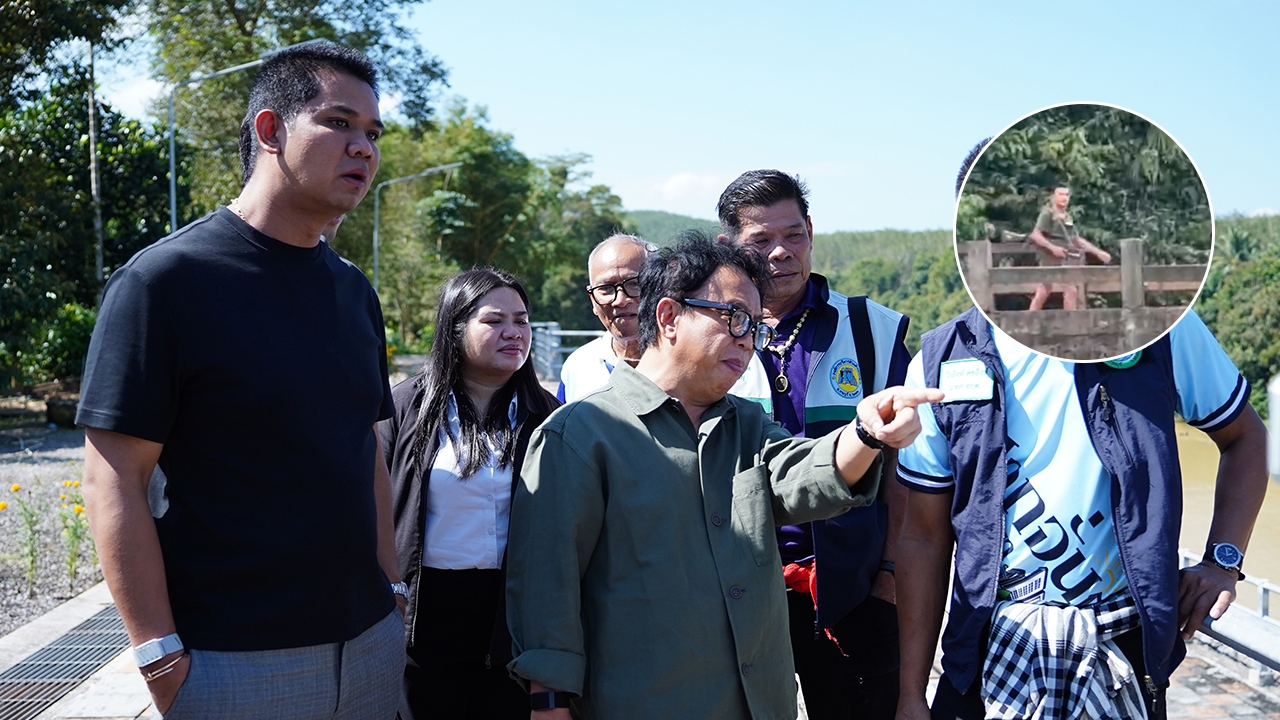
"Sathit-Chaichana" encountered Myanmar soldiers aiming guns after leading the Democrat Party delegation to Ranong to closely monitor the Kraburi River toxicity issue. They urged the Prime Minister not to neglect the problem, leaving villagers to struggle alone for 7 years, and vowed to raise the matter in parliament on 3 Dec.,
On 28 Nov 2026 in Ranong province, the Democrat Party leadership team, led by Mr. Sathit Wongnongtoey and Mr. Chaichana Dechdecho, deputy party heads, along with party spokesperson Mr. Pongsakorn Kwanmuang and deputy spokesperson Ms. Duangrutai Buakaew, visited Hat Tun village, Pak Chan subdistrict, Kraburi district, Ranong. They listened to environmental pollution concerns in the Kraburi River from local villagers, community leaders, and local administrative officials including the heads of Pak Chan and Mamu subdistrict administrative organizations.

Mr. Sathit said the transboundary pollution in the Kraburi River has been an ongoing issue that local residents have fought against for 6-7 years, since 2019, before the cases involving the Kok, Sai, and Ruak rivers in Chiang Rai. However, it has been neglected and excluded from the Terms of Reference (TOR) in negotiations between the Thai and Myanmar governments. He questioned Deputy Prime Minister and Minister of Higher Education, Science, Research and Innovation Mr. Yotchanan Wongsawat in parliament, who confirmed the Kraburi River issue had not yet been included in negotiations. The Democrat Party visited the area first to elevate this issue to a national agenda, especially since Ranong is the hometown of the Prime Minister's wife. He insisted the Prime Minister must inspect the area personally to see the real hardships and not just come for a coffee and leave. He emphasized that arsenic must not be allowed to destroy the lives of people in Ranong.
Mr. Sathit further noted that today's water appeared clearer than usual, which villagers said happens whenever senior officials visit, indicating that the suspected source of the problem from upstream mining operations in the neighboring country can be controlled and resolved if taken seriously. He pointed out conflicting arsenic test results: the Pollution Control Department reported levels within standards, but tests by Chiang Mai University academics found levels exceeding standards. Therefore, repeated testing is necessary on water, sediment, and aquatic animals, along with establishing real-time water quality monitoring stations. Local community representatives demonstrated preliminary arsenic test kits to Mr. Sathit's team and the media, showing arsenic levels 2.5 times above the standard (0.01 mg/L), meaning the water is unsafe for consumption. Previous sediment tests by villagers showed arsenic levels between 0.25 and 0.50, extremely high and indicating severe toxic accumulation in soil, contradicting official Pollution Control Department data stating levels were within standards.


Mr. Sathit proposed that to resolve the problem, the government should implement both domestic and international measures: control the export of chemical precursors from Thailand used in mining; strictly monitor mineral imports at customs and Thai operators; urgently include the Kraburi River issue in talks with Myanmar; allocate budgets to local administrative organizations for upgrading water filtration systems, as current efforts require increasing alum from 30% to 80% and daily filter cleaning; and expedite sourcing alternative water supplies nearby. He reaffirmed that on 3 Dec, he will present these concerns and data in the House of Representatives, pushing through the Environment Committee and formally submitting proposals to the government.
Mr. Chaichana emphasized his encouragement to local villagers, stating that although the Democrat Party visits as the opposition, they are ready to coordinate with local MPs and all parties to fully address the problem. He called on the public to unite in supporting local leaders and representatives in their struggle, urging villagers not to fight alone.

While Mr. Sathit was giving an interview to media near a canal adjacent to the Myanmar border, a tense incident occurred. Armed Myanmar soldiers equipped with AK-47 rifles and RPG grenade launchers appeared on the opposite bridge. They aimed their guns and stared at the Democrat Party team, local leaders, and villagers, causing great alarm among those present.
Mr. Sathit revealed that their group stood only a short distance from the Myanmar side. Thai military officials confirmed they had never witnessed such an incident before, leaving uncertainty whether it was an intimidation tactic or a signal of some kind. He urged the government not to ignore or neglect this matter because even former MPs and local leaders visiting the area faced such a situation firsthand.
