

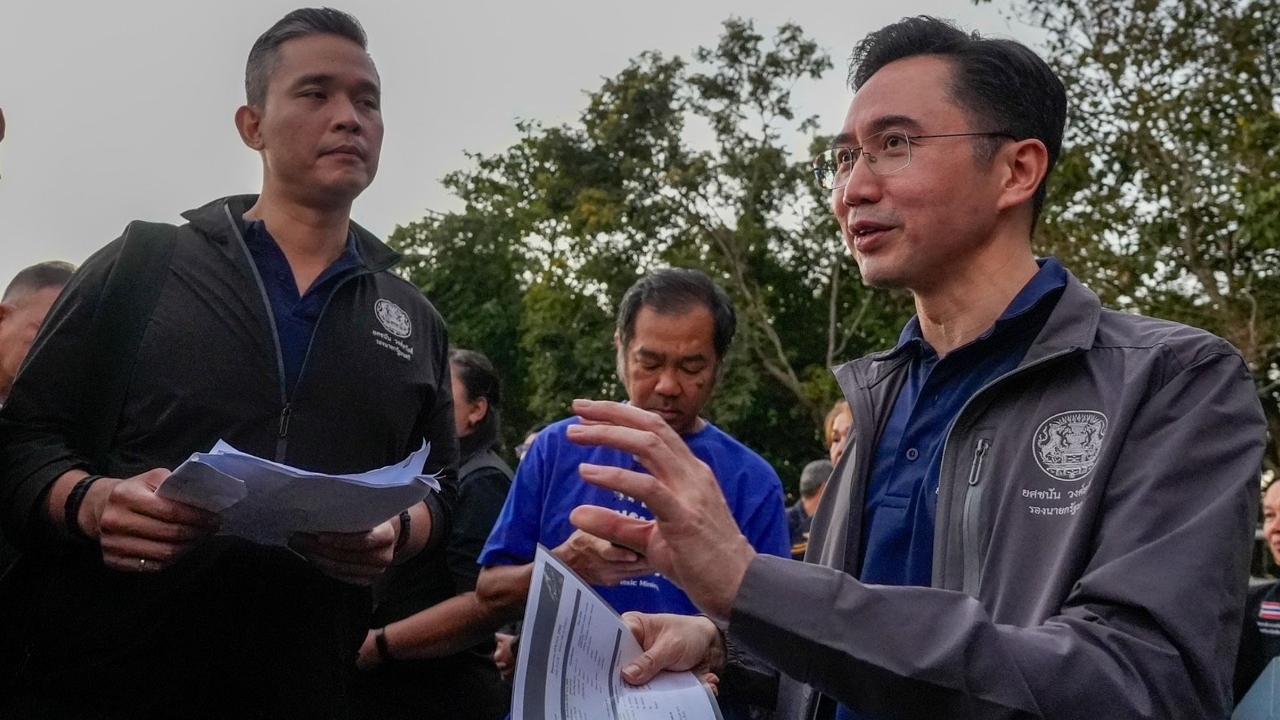
Yotchanan conducted an inspection at Chiang Saen checkpoint after data revealed tin exports surged nearly 20 times, with an additional 6,400 tons transported across the border. He is advocating for legislation to disclose the origin of every ton of mineral and expressed surprise that on the inspection day, no chemicals or minerals were recorded passing the checkpoint.
On 29 Nov 2026 in Chiang Rai Province, Yotchanan Wongsawat, Deputy Prime Minister and Minister of Higher Education, Science, Research and Innovation, visited the Chiang Saen Customs checkpoint to oversee export and transit cargo controls ahead of the ban on exporting four mining precursor chemicals taking effect on 30 Nov. He is pushing legislation requiring all minerals imported, exported, or transited through Thailand to clearly disclose their origins and destinations to prevent Thailand from becoming a transit route for minerals from polluting mines across borders.
Data from the customs clearance system shows tin ore exports through Chiang Saen checkpoint have steadily increased from 87 tons valued at 17.9 million baht in fiscal year 2024 to 422 tons worth 142.6 million baht in fiscal year 2025, and over 1,600 tons valued above 638 million baht in fiscal year 2026—an almost 20-fold volume increase and over 35-fold value increase within two years. All tin exports in the latest year were sent to China, while over 6,400 tons of tin from Myanmar passed through Thailand to China in the same fiscal year.
Yotchanan stated that these figures highlight a significant gap in regulating mineral transit, as currently minerals passing through the border do not require permits under mining law, nor is there a requirement to specify the originating mine. This prevents traceability to verify whether minerals passing through Thailand come from authorized mines or from sources polluting rivers flowing into Thailand.
“Negotiations alone are insufficient; we need measures that raise awareness and prompt real action. Thailand will stop exporting mining precursor chemicals if the rivers are not cleaned. No matter where the minerals are mined, if they enter Thailand contaminated, we cannot accept that,” the Deputy Prime Minister said.
During the visit, Yotchanan reviewed officials’ procedures, from checking chemical safety documents and hazardous materials permits to inspecting actual cargo, ensuring the checkpoint is prepared to enforce the six-month export ban on mining precursor chemicals immediately upon its announcement.
He also monitored procedures for verifying minerals transiting the border, including checking seller documents and origin, analyzing mineral composition, random sampling for laboratory testing, and exercising search authority if there is suspicion that declared origins do not match the facts.
Another point Yotchanan noted was that on the inspection day, no chemical or mineral shipments were recorded at Chiang Saen checkpoint despite fiscal year 2026 data showing over 8,000 tons of tin exported and transited from Myanmar through Thailand—an average of over 20 tons daily. He assigned relevant agencies to investigate whether shipments were delayed or redirected to other checkpoints or routes during heightened inspections.
For long-term measures, the government will push legislation requiring all minerals imported, exported, or transited through Thailand to report mine origins, recipients, and mineral composition analyses to enable full traceability and screen out minerals from illegal sources at the first checkpoint.
“Every ton of mineral passing through Thailand must be accountable for its mine of origin and destination. Thailand will not allow dirty minerals that pollute the rivers of Chiang Rai residents with arsenic,” Yotchanan reiterated his stance.
On 30 Nov 2026, Yotchanan plans to present scientific data and evidence to Myanmar leaders, requesting authorized mine lists and coordinates to enable Thai customs to verify against mineral transit data. He also aims to establish joint measures to monitor and address mines polluting the Kok and Sai rivers and coordinate with relevant Chinese authorities concerning private mining operations.

