

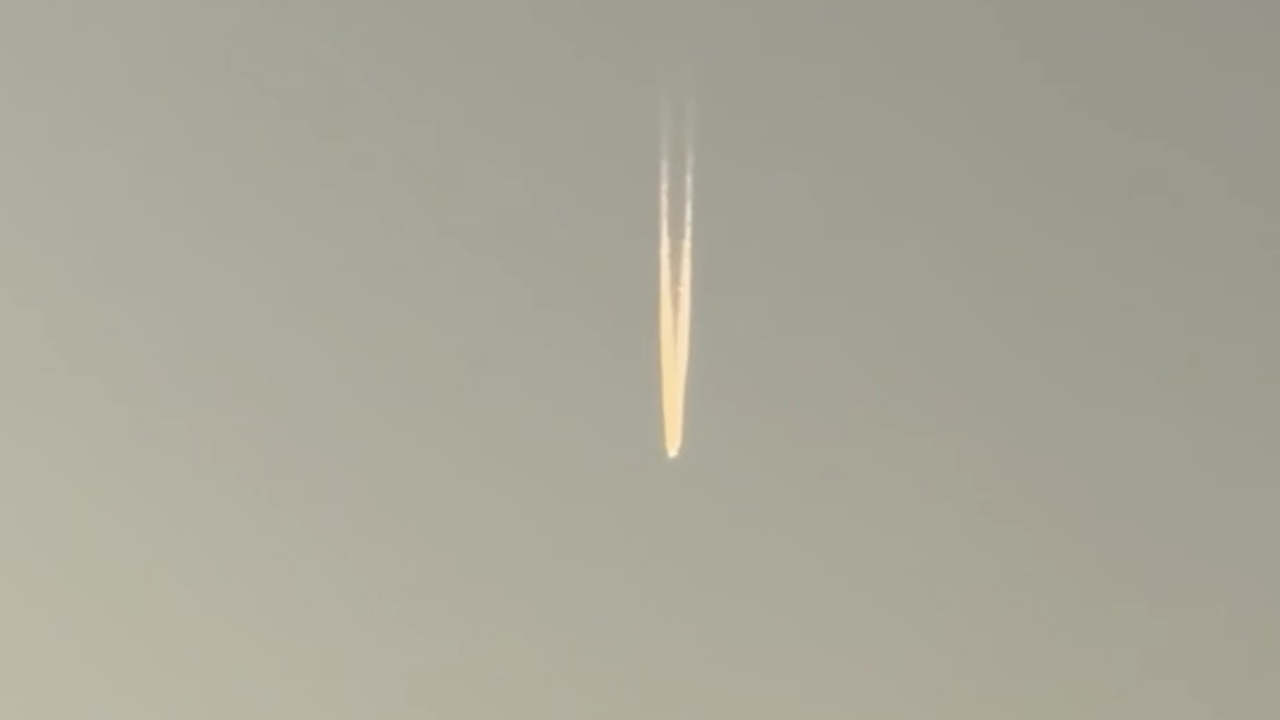
Residents were excited by a long orange fireball appearing across the Chiang Mai sky. NARIT revealed that it was a type of "contrail" or aircraft condensation trail, commonly seen during cold weather.
On 6 Feb 2026, reporters reported that at about 7:00 a.m., residents in Chiang Mai Province were alarmed and took out their phones to record the sky after spotting a phenomenon resembling a golden-orange fireball, accompanied by a sound similar to a passing airplane, over the city sky heading slightly south of Mueang District. Many shared these images online, with several others confirming they saw the same light this morning.
Recently, the news team contacted the National Astronomical Research Institute of Thailand in Mae Rim District, Chiang Mai. They found that the phenomenon was neither an astronomical event nor a comet, meteor, or meteorite. Instead, it was what is called a "contrail"—a long white cloud trail in the sky. Usually white, this morning it appeared orange because it occurred at sunrise, reflecting sunlight and creating a golden-orange glow resembling a fireball. At times, flashes were seen, but these were from the airplane's lights. There were also reports of sounds like an airplane.

Scientifically, it is known as a "contrail" (short for condensation trail), or what Thais call "airplane cloud trails." These clouds form from jet engine exhaust when jet planes fly at high altitudes. Water vapor and other combustion products meet the cold outside air, condensing into water droplets, making a visible white smoke trail behind the engines.
Water vapor is gaseous water and a component of the air around us. The amount of vapor relates to "humidity," which depends on temperature. When temperature drops, the air's capacity to hold moisture decreases, causing excess humidity to condense into water droplets in the air. Although water vapor is invisible, the "steam" we see above boiling water is actually tiny water droplets formed from condensed vapor.
Water vapor condenses more easily as temperature falls. This is why when we exhale on mountain peaks, we can see our breath as mist, since human breath contains water vapor from lung moisture and metabolic processes in the body.
Similarly, important byproducts of jet engine combustion are water and carbon dioxide, which can condense into droplets or clouds trailing behind the aircraft engines, called "contrails." Contrails form best at low temperatures, commonly seen in cold regions. Due to aircraft flying at high altitudes where temperatures are much lower than on the ground, contrails can also appear during winter in tropical countries.
Contrails are commonly observed and familiar in cold countries, sometimes lingering in the sky for hours. Tropical countries see them less frequently, especially outside the cold season, because the water vapor from jet exhaust takes time to cool and form clouds that gradually spread. This often leads to confusion between contrails and comets or meteors, particularly in tropical areas where people are less familiar with such phenomena.

Contrails usually form at high altitudes—above 8,000 meters (26,000 feet)—making them visible over wide areas. When they occur at dawn or dusk at high altitude, they can reflect twilight colors, appearing orange or red, which can easily be mistaken for a burning fireball in the sky, similar to a meteor.
However, meteors typically have variable brightness, move quickly, and do not remain visible in the sky for long. Most meteors last only a fraction of a second, with the longest visible meteors lasting only a few seconds.
In contrast, contrails move much more slowly and can remain visible as long as the airplane is observable. This difference can help clearly distinguish between the two phenomena. Additionally, meteors are rarely seen during daylight unless they are extremely bright, producing a bright flash in the sky.