

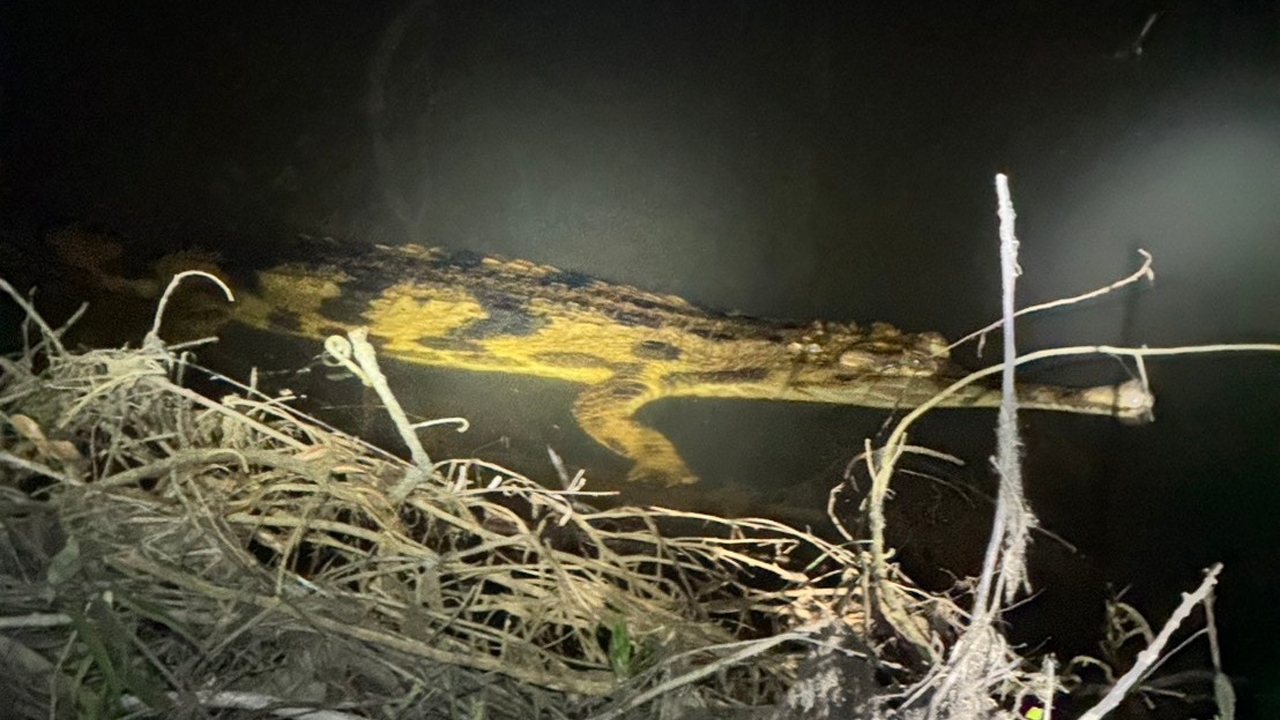
Excitement arose over the official first wild sighting of the 'Takong' in Thailand, measuring about 3 meters long, after it was believed extinct in the country. A team from the Pru-Halabala Wildlife Research Station conducted an investigation following a report.
On 14 February 2026, reporters noted that the Facebook page of the Wildlife Research Division posted a video of the rare and endangered Thai animal, the “Takong.” It confirmed the first official natural sighting in Thailand on 25 January 2026 at Khlong Bang Son, Tak Bai District, Narathiwat Province. The species was clearly identified from photographic evidence.
According to Natthawut Yuenchon, the photographer, he spotted the Takong floating near the canal’s edge at dusk. Measuring about 3 meters, he approached and took photos with his mobile phone. Afterwards, more locals came to see it, but the Takong swam away into the darkness.
On 26 January 2026, after hearing the news, a team from the Pru-Halabala Wildlife Research Station searched by shining lights along the canal near the initial sighting spot. They found another Takong not far away but could not photograph it as it swam away. This individual measured only 1.5 meters, suggesting there are at least two Takongs in the area.
Earlier, locals recorded a video in September 2025, though species identification was uncertain from the footage. Later, officials from the Chalerm Phrakiat Somdet Phra Theparat Wildlife Sanctuary investigated but found no Takong. The locations of these sightings are along a main canal flowing from the upper peat swamp forest to the sea in Tak Bai District, Narathiwat Province.
Status: According to the 2023 IUCN Red List, the Takong is classified as Endangered and was believed extinct in Thailand. However, recent sightings confirm its continued presence. Under the Convention on International Trade in Endangered Species (CITES), it is listed in Appendix I, prohibiting hunting or trade except for scientific research purposes.