

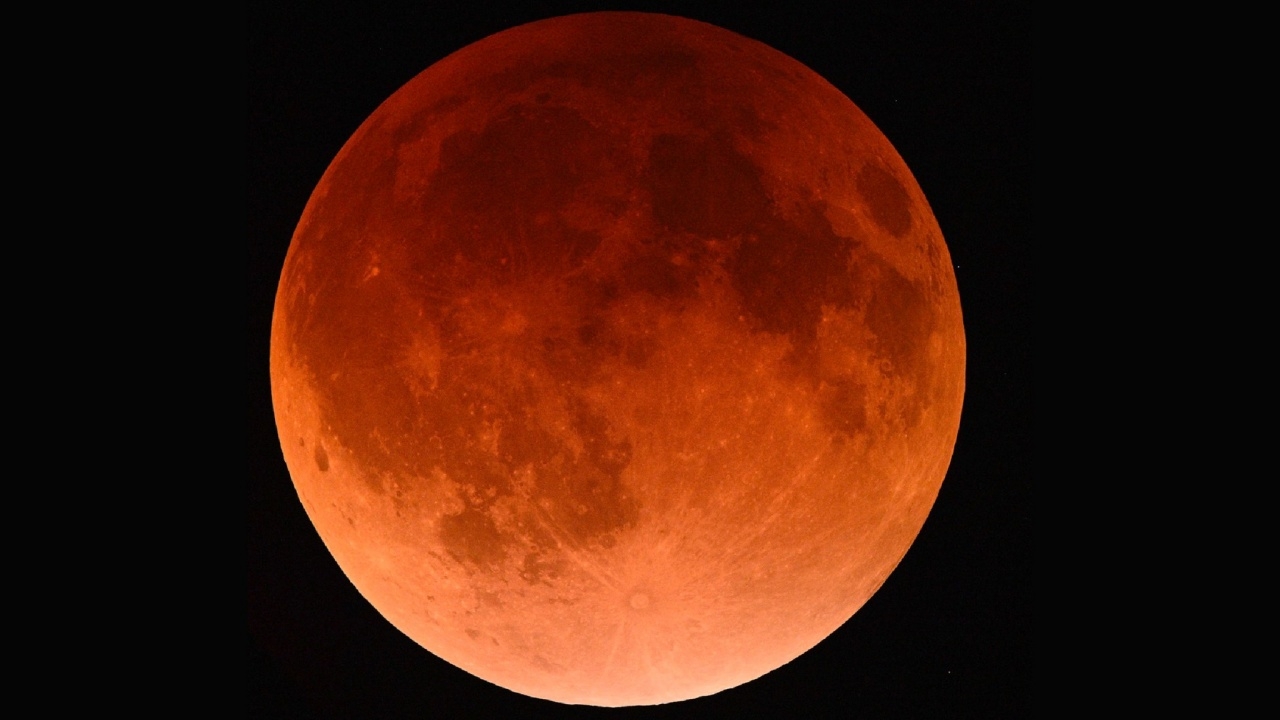
"Magha Puja Day" is a Buddhist holy day observed in Thailand and other countries. On 3 March 2026, people are invited to observe the phenomenon known as the "total lunar eclipse." The moon will rise from the eastern horizon with a brick-red color from 18:23 to 19:02, visible to the naked eye throughout Thailand.
FacebookNARIT, the National Astronomical Research Institute of Thailand,posted that "On 3 March 2026, a lunar eclipse will occur, coinciding with Magha Puja Day, from approximately 15:44 to 21:23 (Thailand time, Bangkok). The moon will enter the Earth's penumbra at 15:44, move into the Earth's umbra causing a partial lunar eclipse at 16:50, and reach total lunar eclipse from 18:04 to 19:02. Afterwards, the moon will gradually emerge from the Earth's umbra, ending the partial eclipse at 20:17 and leaving the penumbra at 21:23, concluding the event."
For Thailand, on that day the moon will rise above the eastern horizon around 18:23, coinciding with the total eclipse phase. The full moon will appear brick-red as it rises, visible to the naked eye nationwide (times may vary by location) until about 19:02, giving 39 minutes of viewing. Then a partial lunar eclipse and penumbral phases will follow until the event ends.
Besides Thailand, this event will be observable in many parts of the world including eastern Europe, Asia, Australia, North and South America, the Pacific, Atlantic, and Indian Oceans, as well as the North and South Poles.
A lunar eclipse occurs when the sun, Earth, and moon align in a straight line with Earth between the sun and moon. It happens only during a full moon or the 14th–15th lunar day when the moon passes through Earth's shadow in space. Observers see the moon gradually darken until fully in Earth's umbra and then slowly reappear. Ancient Thais called this event "Rahu swallowing the moon."
However, lunar eclipses are natural events caused by the moon orbiting Earth. Since the moon's orbital plane is tilted about 5 degrees relative to Earth's orbital plane, the moon does not pass through Earth's shadow every month but sometimes above or below it.
Lunar eclipses occur on average at least twice a year. Whether they can be seen depends on geographic location, and the dates, times, and visible areas can be precisely predicted in advance.
Meanwhile, NARIT is opening five main observation sites, inviting the public to watch the total lunar eclipse on Magha Puja Day and observe interesting celestial objects on the night of 3 March 2026 from 18:00 to 22:00 at Sirindhorn Astronomy Park, Mae Rim District, Chiang Mai, and the 7th Cycle Birthday Anniversary Royal Observatories in Nakhon Ratchasima, Khon Kaen, Chachoengsao, and Songkhla. Admission is free. The phenomenon will also be livestreamed on NARIT's Facebook and YouTube pages.
Thanks to the Facebook page of NARIT, the National Astronomical Research Institute of Thailand.