

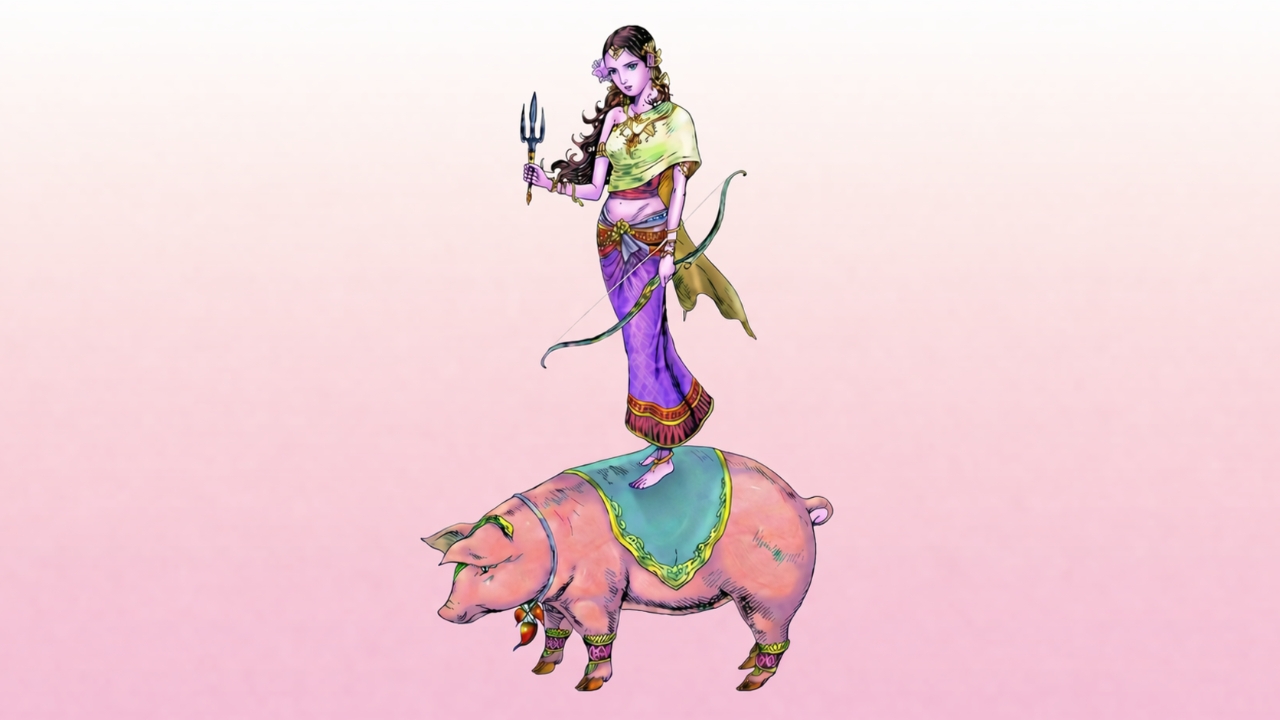
The Songkran Lady for 2026, named "Rakshasadevi," is depicted standing atop a Varaha (boar). The crop forecast predicts damage, with rice seedlings in the region expected to have a mixed outcome—partly successful, partly lost—and water levels will be low.
On 9 April 2026, the Department of Cultural Promotion under the Ministry of Culture reported that the Brahmin astrologers of the Royal Ceremonies Division, Bureau of the Royal Household, announced the Songkran for Buddhist Era 2569 as follows: the year of the Horse (female deity, fire element), Atthasak, Chulasakarat 1388; in the lunar calendar it is an intercalary month, and in the solar calendar it is a normal Suratin year.
14 April marks the Great Songkran Day, which in the lunar calendar corresponds to Tuesday, the waning moon on the 12th day of the fifth month, at 10:34:35.
The Songkran Lady is named "Rakshasadevi." She wears a phahurat garment, adorned with a lotus flower crown and glass mora jewelry, holding a blood-offering food. Her right hand carries a trident, and her left hand holds a bow. She is depicted standing on the back of a Varaha as her vehicle.
On 16 April at 14:40:12, the new Chulasakarat year 1388 begins. This year, Monday is Thongchai (Victory), Saturday is Athibodi (Chief), Sunday is Ubath (Calamity), and Monday is Lokawinart (World Destruction). On Thursday, the Athibodi of rain brings rainfall measured at 500 ha: 50 ha in the human world, 100 ha over the ocean, 150 ha in the Himmapan forest, and 200 ha on the cosmic mountains. Three Nagas (serpent deities) provide water.
The crop assessment forecast is 'Vibhat' (damage) with remainder 2, indicating that rice seedlings in the area will be affected by pests such as beetles and insects, resulting in a partly successful, partly lost harvest.
The water quality forecast shows the rasyatejo sign (fire), indicating low water levels.
